AI APIs have become one of the fastest ways for developers to add intelligent features into mobile and web applications without building complex machine learning systems from scratch. Instead of spending months training models, developers can connect their apps to powerful APIs and immediately unlock features like chatbots, image generation, search, voice recognition, and automation. This has changed the way software is built. Today, even a small startup can create advanced AI-powered products by choosing the right API.
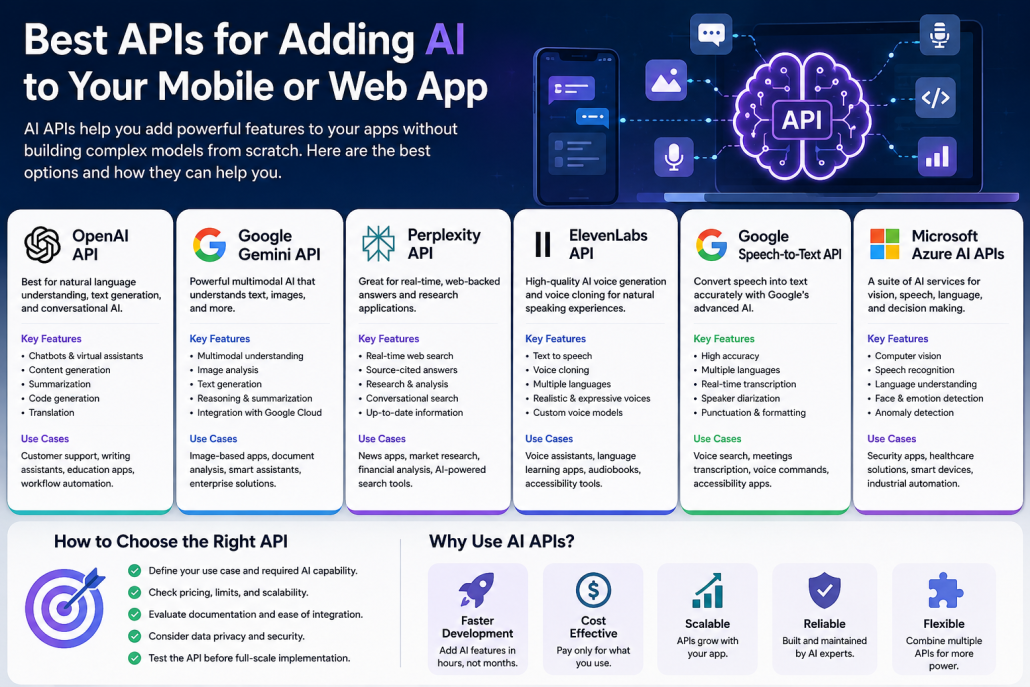
One of the most widely used options is the API from OpenAI. It is popular because it offers strong natural language understanding, text generation, code assistance, summarization, and conversational AI. For example, if you want to build a customer support chatbot inside a shopping app, OpenAI can understand user questions, remember context, and provide useful answers. It is also flexible for content creation, translation, and workflow automation. Many developers choose it because the documentation is clear and integration is relatively simple.
Another strong option is the API from Google through its GoogleGemini models. Gemini is especially useful for developers who need strong multimodal capabilities, meaning it can understand text, images, and other data together. Imagine a mobile app where a user uploads a photo of a broken machine and asks for troubleshooting advice. Gemini can analyze both the image and the text. It is also often attractive because of pricing and integration with Google Cloud services.
For apps focused on knowledge retrieval and real-time research, Perplexity AI offers an interesting API path. Unlike traditional models that rely heavily on training data, Perplexity emphasizes live web-backed responses. This makes it useful for applications where fresh information matters, such as market analysis, news tracking, or research assistants. For example, a financial app could use it to pull current trends and explain them to users.
Voice-based apps can benefit from APIs like ElevenLabs for realistic speech generation or speech cloning. This is valuable for language learning apps, accessibility tools, or interactive assistants. On the input side, speech recognition APIs from Google or Microsoft can convert spoken language into text, allowing hands-free interaction.
The best API depends on the goal of your app. If you need conversation and reasoning, OpenAI is often a strong choice. If you need image understanding and a broad ecosystem, Gemini may fit better. If your app depends on live information, Perplexity can be useful. A good way to think about it is like hiring specialists: one is a writer, one is a researcher, and one is a visual analyst. Choosing the right one can save time, reduce costs, and make your app far more powerful.
https://kiaapp.xyz/wp-content/uploads/2025/09/favicon2-4-300x200.png00Kiahttps://kiaapp.xyz/wp-content/uploads/2025/09/favicon2-4-300x200.pngKia2026-07-01 08:04:552026-09-17 10:27:03Best APIs for Adding AI to Your Mobile or Web App
The conversation around Artificial Intelligence has officially shifted from speculative hype to tangible utility. In businesses and daily workflows, AI is no longer a futuristic concept—it is an active utility bill reducer and hours-saver. By offloading repetitive, data-heavy, and predictable tasks to intelligent systems, organizations and independent professionals are capturing massive efficiencies.
Here are the primary real-world AI use cases delivering measurable returns on time and money.
1. Automated Customer Support and Instant Triage
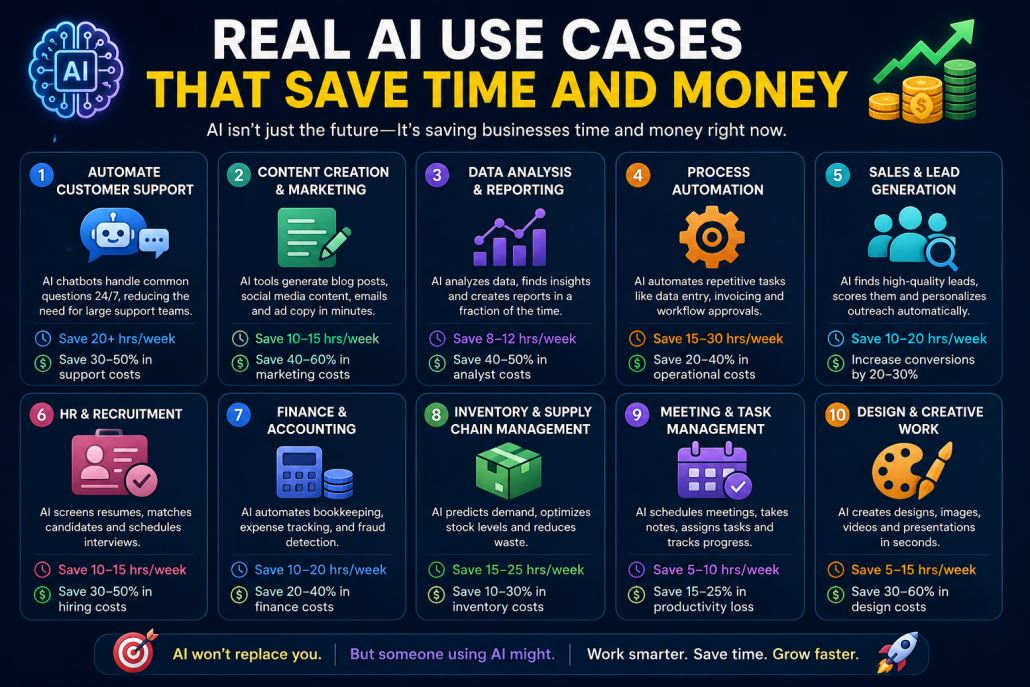
Traditional customer service is expensive and bottlenecked by human bandwidth. AI-driven agents and conversational bots have evolved far beyond the rigid, frustrating scripts of the past. Modern systems utilize advanced language understanding to resolve high-volume, repetitive inquiries—such as tracking orders, processing returns, or troubleshooting basic technical setups—24/7.
The Savings: By handling up to $70\%$ or more of incoming tier-one tickets without human intervention, companies drastically reduce overhead costs and clear the queue, allowing human agents to focus exclusively on complex, high-value client issues.
2. Intelligent Code Acceleration and Debugging
For software engineering and web development, developer velocity is directly tied to profitability. AI code copilots are fundamentally changing how software is built. Instead of spending hours digging through documentation or writing boilerplate code, developers can describe functionality in plain language or provide code blocks to be refactored.
The Savings: AI speeds up code generation, instantly highlights syntax errors, and suggests structural improvements. This reduces development cycles by an estimated $30\%$ to $45\%$, accelerating time-to-market and freeing engineering hours for architecture and system design.
3. Hyper-Efficient Content and Asset Production
In marketing and design, content scaling used to require exponential increases in budget and timeline. Generative AI tools allow teams to turn existing brand guidelines into reusable infrastructure. Marketers can instantly localize copy, generate multi-variant ad designs for A/B testing, and produce targeted social media elements from a single master asset.
The Savings: Tasks that traditionally took creative agencies weeks—such as building massive icon libraries or generating months of on-brand contextual imagery—can now be generated and refined in hours, slashing production costs and eliminating severe creative bottlenecks.
4. Meeting Intelligence and Workflow Automation
A subtle but massive drain on corporate productivity is administrative friction—specifically, meetings and manual data entry. AI meeting assistants seamlessly transcribe calls, separate speakers, and automatically synthesize decisions into actionable task lists. When paired with workflow automation engines, this data flows seamlessly into CRMs and internal databases.
The Savings: Professionals save hours weekly by eliminating manual note-taking and administrative cleanup. Proposals can be generated instantly from call summaries, ensuring projects move forward without delayed administrative friction.
The Bottom Line: AI’s highest and best use is not to replace human strategic insight, but to eliminate the administrative, repetitive production work that crowds it out. By strategically deploying these tools, modern operations buy back their time and protect their bottom line.
https://kiaapp.xyz/wp-content/uploads/2025/09/favicon2-4-300x200.png00Kiahttps://kiaapp.xyz/wp-content/uploads/2025/09/favicon2-4-300x200.pngKia2026-07-01 07:43:372026-09-17 21:56:41Real AI Use Cases That Save Time and Money
Adding AI to mobile and web applications has become one of the fastest ways to improve user experience, automate tasks, and create smarter digital products. Instead of building machine learning models from scratch, developers today can connect ready-made AI APIs and bring advanced features into their apps in just a few hours. This has changed the way software is built. Whether you are developing a chatbot, a recommendation system, a voice assistant, or content generation tools, choosing the right AI API can save months of work and significantly reduce development costs.
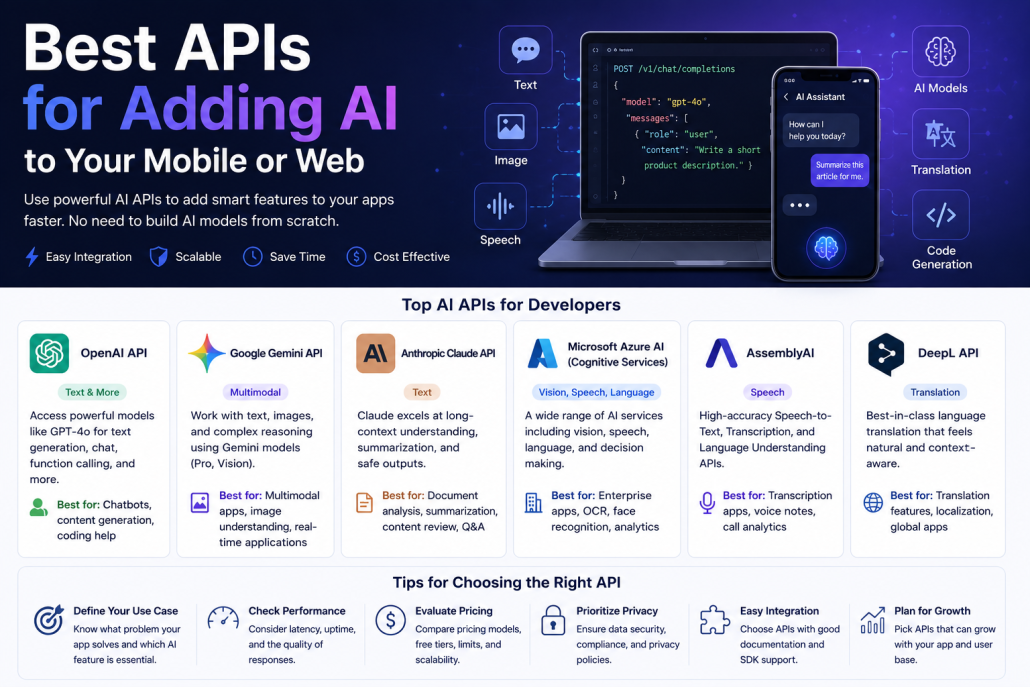
One of the most popular choices for developers is OpenAI. Its API offers powerful language models that can handle text generation, summarization, coding assistance, and conversational chat. For many apps, OpenAI is often the first option because of its flexibility and strong performance. For example, a productivity app can use it to summarize notes, while an e-commerce app can create product descriptions automatically.
Another strong option is Google Gemini. Gemini is especially useful for developers who want multimodal capabilities, meaning the ability to work with text, images, and reasoning together. This makes it a great choice for apps that need visual understanding, document analysis, or more advanced AI interactions. If your app combines text and images, Gemini can offer strong value.
Anthropic Claude is also becoming popular, especially for long-form text and safe AI responses. Claude performs well when handling large documents, detailed analysis, or structured conversations. Developers building tools for legal, academic, or enterprise use often find it useful because of its context length and strong reasoning.
For voice-based applications, AssemblyAI is one of the best APIs available. It specializes in speech-to-text, transcription, and audio analysis. This is ideal for apps like voice note managers, meeting assistants, or customer call analysis systems.
When it comes to translation, DeepL remains one of the strongest options. Its translations often feel more natural and context-aware than many alternatives, making it perfect for multilingual apps and international products.
Choosing the best API depends on your app’s purpose. Developers should think about pricing, speed, scalability, privacy, and how easily the API fits into their backend. Some APIs are better for conversation, others for voice, images, or data analysis.
In the end, AI APIs have made advanced technology accessible to every developer. You no longer need a huge team or years of AI research to build intelligent apps. The right API can transform a simple application into a smarter, faster, and more valuable product for users.
https://kiaapp.xyz/wp-content/uploads/2025/09/favicon2-4-300x200.png00Kiahttps://kiaapp.xyz/wp-content/uploads/2025/09/favicon2-4-300x200.pngKia2026-06-30 23:12:592026-09-17 10:24:41Best APIs for Adding AI to Your Mobile or Web
The question of whether AI will replace developers has become one of the biggest discussions in technology. With tools now capable of writing code, debugging errors, and even generating entire app structures, it is easy to understand why many developers feel uncertain. At first glance, it may seem like AI is moving toward replacing programmers entirely. But when we look closer, the reality is different. AI is changing development—but not eliminating the need for developers.
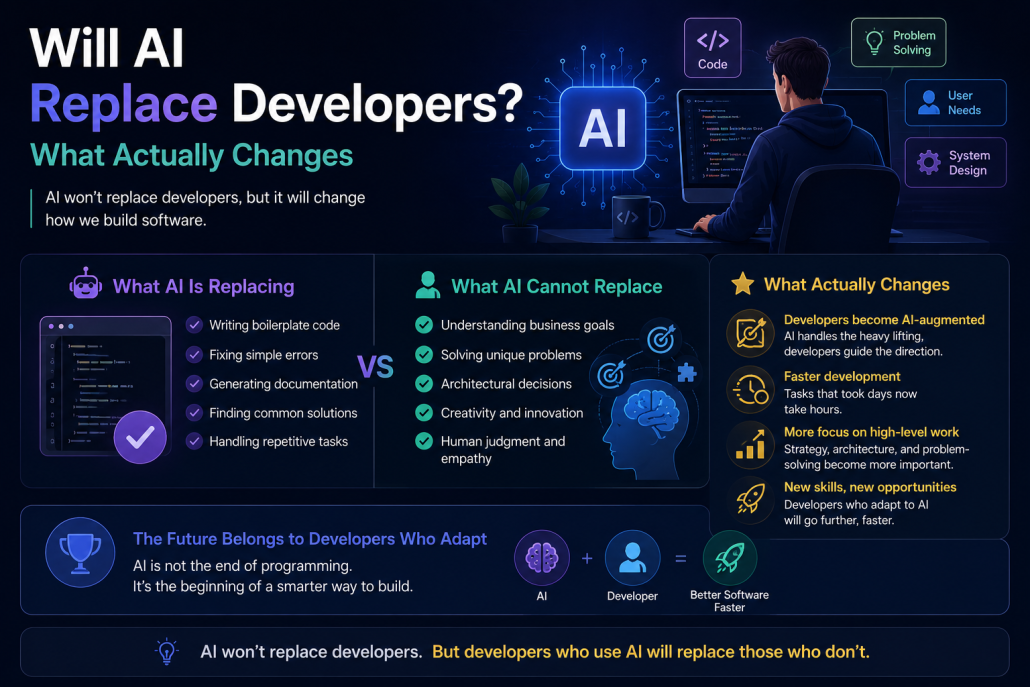
What AI is really replacing are certain tasks, not the people behind them. Developers spend a large amount of time on repetitive work: writing boilerplate code, fixing simple syntax errors, generating documentation, or searching for common solutions. These are areas where AI performs extremely well. A developer can now describe a function in plain language and receive usable code within seconds. This saves time and speeds up workflows dramatically.
But software development is much more than writing code. It involves understanding business needs, solving unique problems, making architectural decisions, and designing user experiences. AI can assist with these things, but it cannot fully replace human judgment. For example, if a business wants to build a custom app for managing internal operations, AI might generate code, but it cannot fully understand company culture, long-term goals, or hidden workflow challenges the way a human developer can.
What changes most is the role of the developer. Instead of spending hours on basic coding tasks, developers are shifting toward higher-level thinking. They become more like strategists, system designers, and decision-makers. AI becomes a tool that handles the heavy lifting, while the developer guides the direction. It is similar to how calculators changed mathematics. They did not replace mathematicians; they allowed them to work faster and focus on deeper problems.
Another major change is speed. Development cycles are becoming shorter. Tasks that once took days may now take hours. This means developers who learn to work with AI can become much more productive. A solo developer today can build what once required a small team. This creates opportunities, especially for freelancers and startups.
However, there is also a challenge. Basic coding skills alone may become less valuable. If everyone can generate simple code with AI, the competitive advantage shifts to problem-solving, creativity, system architecture, and communication. Developers who only write routine code may struggle, while those who adapt will grow stronger.
So, will AI replace developers? Not likely. But it will replace developers who refuse to adapt. The future belongs to those who know how to use AI as a partner. The real change is not the disappearance of developers—it is the evolution of what being a developer means. In many ways, AI is not ending software development; it is pushing it into a smarter and faster era.
https://kiaapp.xyz/wp-content/uploads/2025/09/favicon2-4-300x200.png00Kiahttps://kiaapp.xyz/wp-content/uploads/2025/09/favicon2-4-300x200.pngKia2026-06-30 22:27:092026-09-17 23:18:32Will AI Replace Developers? What Actually Changes
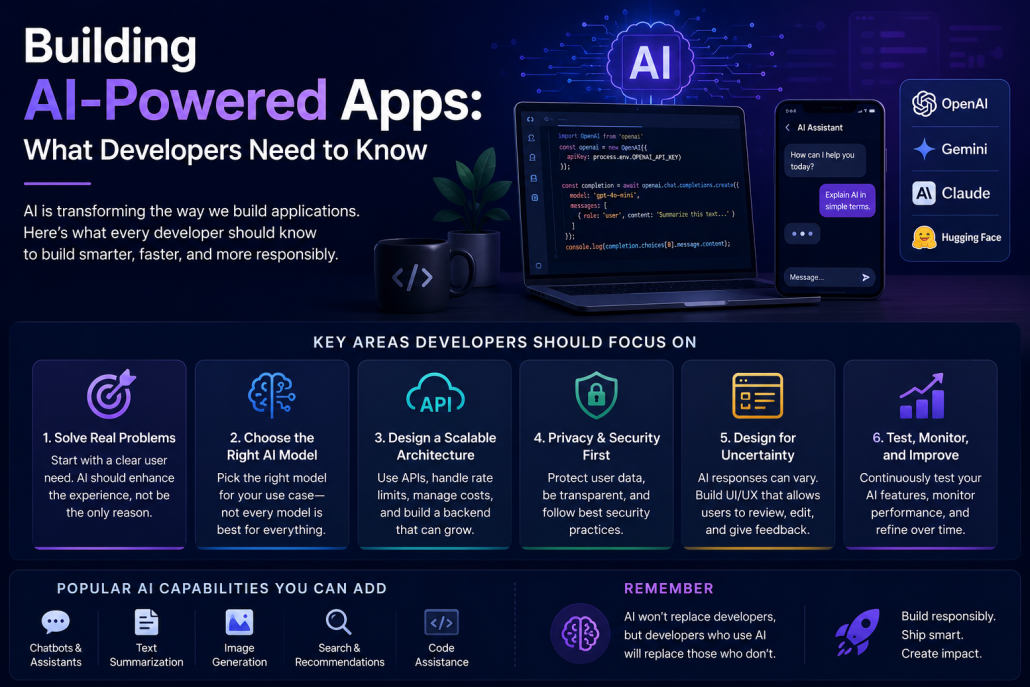
Building AI-powered apps has become one of the most exciting shifts in software development. Just a few years ago, adding artificial intelligence to an app meant working with complex machine learning models, large datasets, and deep technical expertise. Today, things are very different. Developers can integrate powerful AI capabilities into mobile, web, and desktop applications faster than ever. But while the tools have become easier, building useful AI-powered apps still requires clear thinking and the right strategy.
The first thing developers need to understand is that AI is not a product by itself—it is a feature. Many beginners make the mistake of building “an AI app” without solving a real problem. The strongest AI-powered apps start with a practical need. For example, an e-commerce app may use AI for personalized recommendations. A productivity app might summarize notes or generate tasks. A customer support app could use AI chat to answer questions instantly. The focus should always be on the user problem first.
Choosing the right AI model is another major decision. Today developers have access to tools like OpenAI, Google Gemini, and Anthropic Claude. Each has strengths. Some are better for writing, some for reasoning, and some for coding assistance. The best choice depends on what the app needs. A chatbot may need strong conversation skills, while a document analyzer may need better summarization and data extraction.
Another important factor is backend architecture. AI apps often rely on APIs, which means developers must think about authentication, rate limits, cost management, and data security. For example, if your app sends every user request directly to an AI model, costs can rise quickly. A smarter backend can cache repeated responses, filter unnecessary requests, and optimize token usage.
Developers also need to design for uncertainty. Traditional apps are predictable—you click a button and expect the same result every time. AI behaves differently. Responses can vary, be incomplete, or sometimes wrong. That means UI and UX become even more important. Apps should guide users clearly, offer editing options, and avoid presenting AI output as absolute truth.
Privacy is another key issue. Many AI apps process user data, messages, or files. Developers must be transparent about what data is sent, stored, or analyzed. Strong privacy policies and secure backend systems are no longer optional.
In the end, building AI-powered apps is less about adding trendy technology and more about creating smarter user experiences. Developers who understand user needs, choose the right tools, manage costs, and build responsibly will create apps that are not only innovative, but truly valuable. AI is changing development—but the best apps will still be built on the same foundation: solving real problems well.
https://kiaapp.xyz/wp-content/uploads/2025/09/favicon2-4-300x200.png00Kiahttps://kiaapp.xyz/wp-content/uploads/2025/09/favicon2-4-300x200.pngKia2026-06-30 22:14:142026-09-17 10:42:56Building AI-Powered Apps: What Developers Need to Know
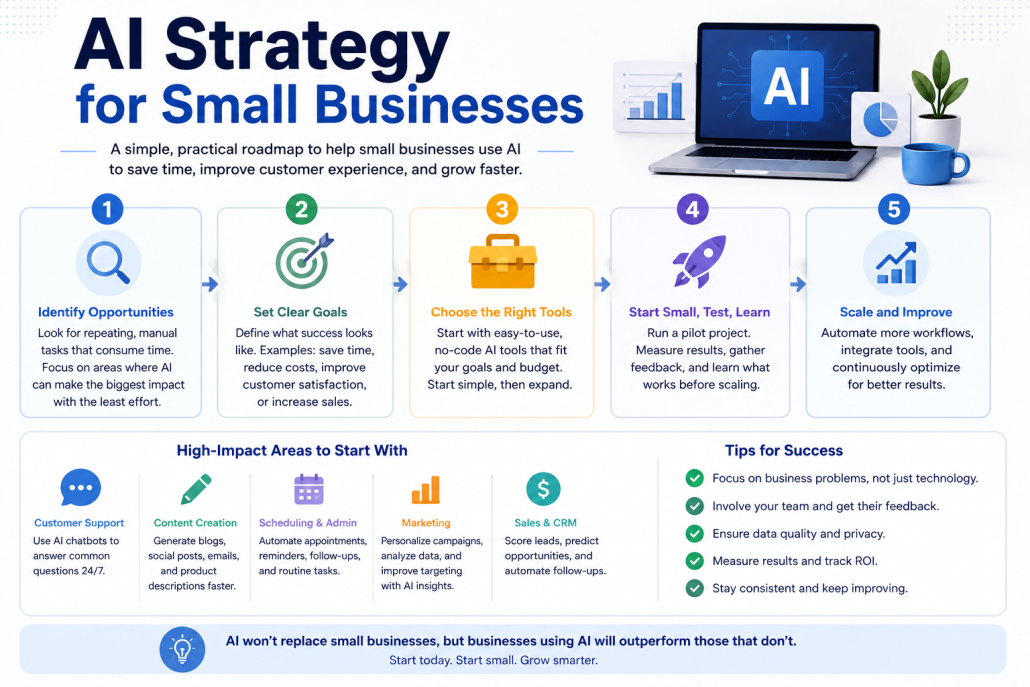
Artificial intelligence is no longer a future concept reserved for large corporations with huge budgets and technical teams. It has become a practical tool that small businesses can use today to improve efficiency, save time, and compete more effectively. Yet many small business owners still feel unsure about where to begin. The term “AI strategy” can sound overwhelming, as if it requires complex systems and expert knowledge. In reality, building an AI strategy often starts with something much simpler: understanding your daily challenges and finding the right tools to solve them.
For most small businesses, the first step is not buying software or hiring consultants. It is identifying repetitive tasks that take up too much time. These tasks often include answering customer questions, writing emails, managing bookings, creating content, organizing data, or following up with clients. While each task may seem small on its own, together they can consume hours every week. AI can reduce that workload significantly. For example, a local business can use an AI chatbot to answer common customer questions instantly, even outside working hours. This improves customer experience while allowing staff to focus on more valuable work.
Content creation is another strong starting point. Many businesses struggle to keep up with social media, blogs, newsletters, and product descriptions. AI writing tools can help generate ideas, draft content, and speed up the process. Instead of spending three hours writing a post, a business owner might spend thirty minutes editing and improving an AI-generated draft. That time saved can be invested elsewhere.
The most important part of an AI strategy is starting small. Many businesses make the mistake of trying too much too soon. They sign up for multiple tools, test too many ideas, and quickly lose focus. A better approach is to choose one problem and solve it first. Think of it like improving one department before changing the whole company. If customer support is your biggest challenge, begin there. If your marketing is inconsistent, focus on AI content tools first.
Choosing simple, no-code tools is also important. Today, many platforms are built for beginners. Tools like ChatGPT, Canva AI, and workflow automation apps allow businesses to use AI without technical skills. This removes one of the biggest barriers to entry.
In the end, AI strategy is not really about technology—it is about clarity and priorities. Small businesses that understand their problems, start with one clear goal, and use AI as a support system can create powerful long-term advantages. The best time to begin is not when everything is perfect. It is now, with small practical steps.
https://kiaapp.xyz/wp-content/uploads/2025/09/favicon2-4-300x200.png00Kiahttps://kiaapp.xyz/wp-content/uploads/2025/09/favicon2-4-300x200.pngKia2026-06-30 22:03:372026-09-17 09:50:26AI Strategy for Small Businesses
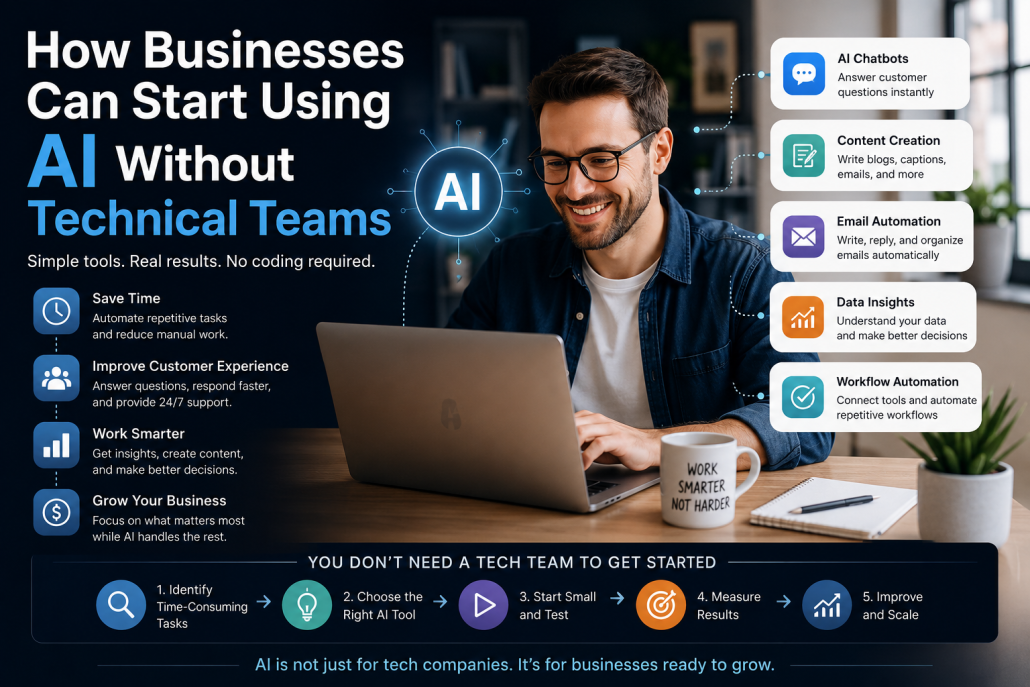
Artificial intelligence is often seen as something complex—something that belongs to large companies with engineers, data scientists, and technical departments. For many small businesses, that image creates distance. Owners often think AI is expensive, difficult, or simply “not for us.” But that is changing quickly. Today, businesses of any size can start using AI without hiring technical teams or learning how to code.
The first thing to understand is that AI is no longer just about building advanced software. In many cases, it is simply about using smart tools to save time. Think about daily business tasks: answering customer questions, writing emails, managing appointments, creating content, analyzing feedback, or organizing internal documents. These are repetitive tasks that slow teams down. AI can help automate many of them.
A good example is customer support. A small business may spend hours every week answering the same questions: What are your opening hours? Do you deliver? What are your prices? Instead of doing this manually, an AI chatbot can answer these questions instantly, day and night. This improves customer experience while freeing up time for staff to focus on more important work.
Marketing is another area where AI can make an immediate difference. Many business owners struggle to create content regularly. Writing social media posts, blog articles, product descriptions, or email campaigns takes time and energy. Tools like ChatGPT can help generate ideas, draft content, and improve writing speed. It does not replace creativity, but it gives businesses a faster starting point.
The key for beginners is to start small. This is where many businesses make mistakes. They try to automate everything at once and end up overwhelmed. A better approach is simple: choose one problem and solve it first. For example, if email management takes too much time, start there. If content creation is the problem, focus on that. Once one process improves, move to the next.
Another important point is choosing no-code tools. Many AI platforms today are designed for non-technical users. They have simple dashboards, clear instructions, and ready-made templates. Tools like ChatGPT, Canva AI, and Zapier allow businesses to use AI without touching a single line of code. This makes adoption much easier.
Of course, AI is not magic. It still needs human direction. Businesses must know their goals and understand what they want to improve. AI works best when it supports clear business needs, not when it is used just because it is trendy.
In the end, businesses do not need technical teams to begin using AI. What they need is a willingness to experiment and a clear understanding of where time is being wasted. Starting small, staying practical, and focusing on real problems can make AI one of the most valuable tools for growth. The future of business is not about replacing people—it is about helping them work smarter.
https://kiaapp.xyz/wp-content/uploads/2025/09/favicon2-4-300x200.png00Kiahttps://kiaapp.xyz/wp-content/uploads/2025/09/favicon2-4-300x200.pngKia2026-06-30 20:45:322026-09-17 19:58:49How Businesses Can Start Using AI Without Technical Teams
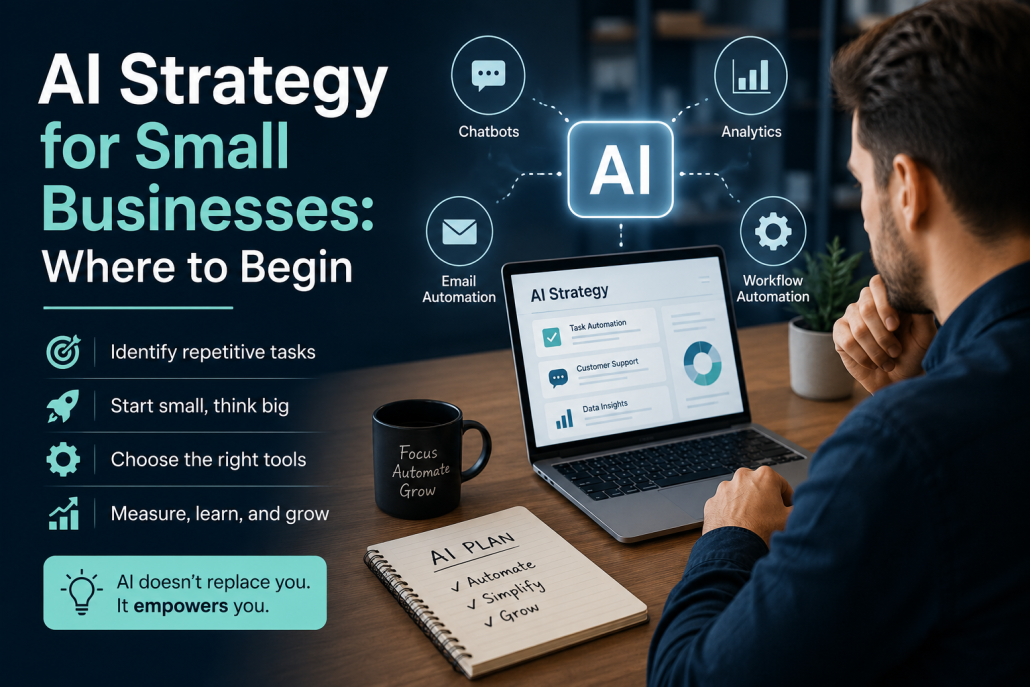
Artificial intelligence is no longer something only large companies can afford or understand. Today, small businesses can use AI to save time, improve customer service, and make better decisions. The real challenge is not whether to use AI, but where to begin.
The first step is to identify repetitive tasks. Every small business has them: answering common customer questions, managing emails, scheduling appointments, creating social media content, or organizing data. These are often the easiest places to introduce AI because they consume time but do not always require human creativity.
For example, a small online store can use AI chatbots to answer customer questions 24/7. A local marketing agency can use AI to generate content ideas or improve SEO. Even a small accounting office can use AI tools to sort invoices or summarize reports. The goal is not to replace people, but to reduce manual work.
The second step is to start small. Many businesses make the mistake of trying to automate everything at once. A better strategy is to choose one problem and solve it first. Think of it like testing a new employee: you give one task, measure the results, and expand from there.
Another important point is choosing the right tools. Platforms like OpenAI, Google Gemini, and Zapier offer practical solutions for businesses of all sizes.
In the end, AI strategy is less about technology and more about clarity. Small businesses should ask: What wastes our time? What slows our growth? What can be simplified? Starting with these questions makes AI practical, affordable, and powerful.
https://kiaapp.xyz/wp-content/uploads/2025/09/favicon2-4-300x200.png00Kiahttps://kiaapp.xyz/wp-content/uploads/2025/09/favicon2-4-300x200.pngKia2026-06-30 20:33:292026-09-17 09:52:14AI Strategy for Small Businesses: Where to Begin
https://kiaapp.xyz/wp-content/uploads/2025/09/favicon2-4-300x200.png00Kiahttps://kiaapp.xyz/wp-content/uploads/2025/09/favicon2-4-300x200.pngKia2026-06-30 19:52:042026-09-16 22:42:29AI + Business
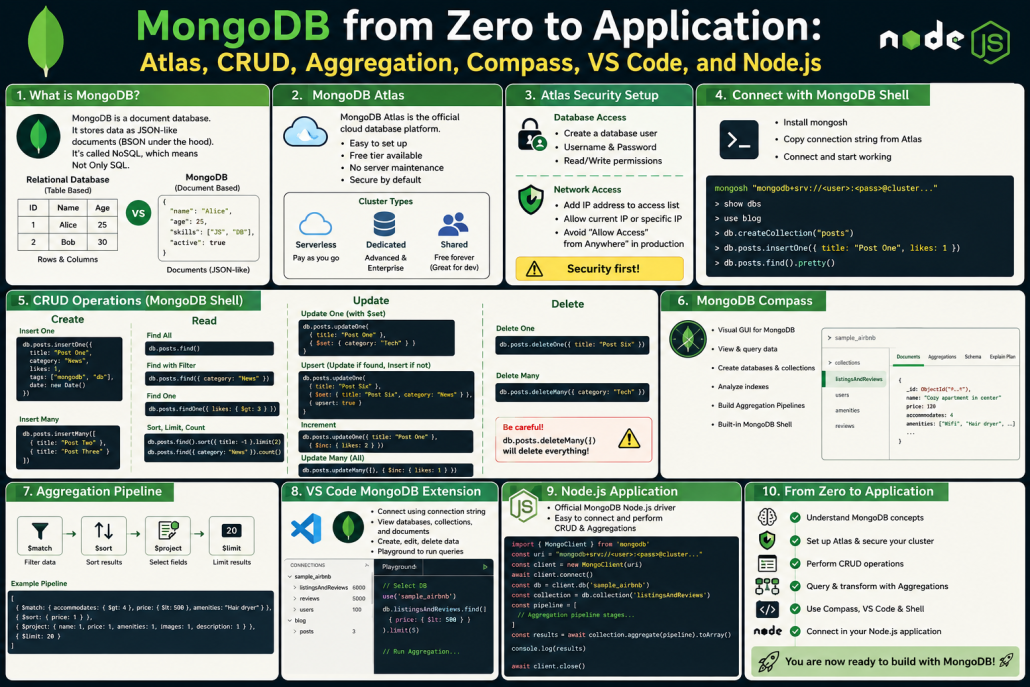
MongoDB Practical Beginner Guide: From Database Concepts to Node.js Integration
1. What MongoDB Is
MongoDB is often called a NoSQL database, but the better meaning is Not Only SQL, not “No SQL.”
The text explains that MongoDB is best understood as a document database. It stores data in documents that look like JSON, although internally MongoDB stores them as BSON.
Main idea:
MongoDB = Document Database
⸻
2. MongoDB vs Relational Databases
Relational databases store data like spreadsheets:
Tables → Rows → Columns
They need a strict schema before inserting data.
MongoDB works differently:
Database → Collection → Document
A document can store related data together, for example:
{
“title”: “Post One”,
“category”: “News”,
“tags”: [“MongoDB”, “Database”],
“likes”: 5
}
So instead of splitting data into many tables, MongoDB often keeps related data in one document.
⸻
3. JSON and BSON
Developers usually work with JSON-like data:
{
“name”: “Sara”,
“age”: 25
}
But MongoDB stores it internally as BSON.
BSON is like JSON, but with extra data types and better database performance.
⸻
4. Flexible Schema
MongoDB does not require a fixed schema by default.
That means documents in the same collection do not all need the exact same fields.
The tutorial shows the blog database and posts collection.
⸻
18. MongoDB Compass
MongoDB Compass is the visual desktop app for MongoDB.
It can be used to:
* View data
* Query data
* Create databases
* Create collections
* Analyze indexes
* Build aggregation pipelines
⸻
19. Sample Data
The tutorial loads MongoDB sample data.
One example is:
sample_airbnb
It contains rental listings, like Airbnb data.
This is used for practicing real queries.
⸻
20. Aggregation Pipeline
Aggregation lets you filter and transform data step by step.
Example goal:
Find rental listings that:
* Accommodate more than 4 people
* Cost less than 500
* Include a hair dryer
* Are sorted by price
* Show only needed fields
* Limit results to 20
Pipeline stages:
$match
$sort
$project
$limit
Important:
The order matters.
Good order:
Match → Sort → Project → Limit
⸻
21. VS Code MongoDB Extension
The tutorial also connects MongoDB to VS Code.
With the extension, you can:
* View databases
* View collections
* Open documents
* Create playgrounds
* Run queries inside VS Code
This makes MongoDB easier for developers working inside a code editor.
⸻
22. MongoDB Playground
A playground is like a practice file for MongoDB commands.
You can:
* Select a database
* Drop a collection
* Insert test data
* Run find queries
* Run aggregation pipelines
Useful for learning and testing before writing backend code.
⸻
23. Connecting MongoDB to Node.js
The tutorial ends by connecting MongoDB to a Node.js app.
Setup:
npm init -y
npm i mongodb
Basic flow:
Import MongoDB package
→ Create MongoClient
→ Connect with URI
→ Select database
→ Select collection
→ Run query or aggregation
Important production note:
The password should be stored in an environment variable, not directly in the code.
⸻
24. Final Understanding
The full context teaches MongoDB in this order:
Concepts
→ Atlas setup
→ Security
→ Shell connection
→ CRUD
→ Atlas dashboard
→ Compass
→ Aggregation
→ VS Code
→ Node.js app
https://kiaapp.xyz/wp-content/uploads/2025/09/favicon2-4-300x200.png00Kiahttps://kiaapp.xyz/wp-content/uploads/2025/09/favicon2-4-300x200.pngKia2026-06-29 10:01:262026-09-17 21:26:29MongoDB from Zero to Application: Atlas, CRUD, Aggregation, Compass, VS Code, and Node.js