
Real AI Use Cases That Save Time and Money
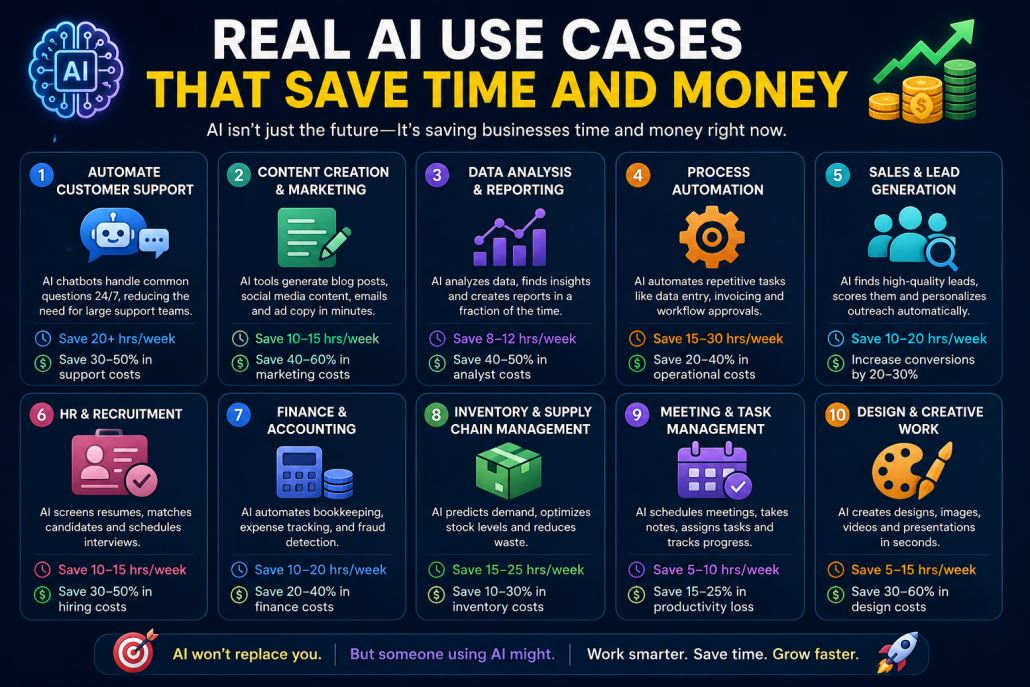
Real AI Use Cases That Save Time and Money
The conversation around Artificial Intelligence has officially shifted from speculative hype to tangible utility. In businesses and daily workflows, AI is no longer a futuristic concept—it is an active utility bill reducer and hours-saver. By offloading repetitive, data-heavy, and predictable tasks to intelligent systems, organizations and independent professionals are capturing massive efficiencies.
Here are the primary real-world AI use cases delivering measurable returns on time and money.
1. Automated Customer Support and Instant Triage
Traditional customer service is expensive and bottlenecked by human bandwidth. AI-driven agents and conversational bots have evolved far beyond the rigid, frustrating scripts of the past. Modern systems utilize advanced language understanding to resolve high-volume, repetitive inquiries—such as tracking orders, processing returns, or troubleshooting basic technical setups—24/7.
- The Savings: By handling up to $70\%$ or more of incoming tier-one tickets without human intervention, companies drastically reduce overhead costs and clear the queue, allowing human agents to focus exclusively on complex, high-value client issues.
2. Intelligent Code Acceleration and Debugging
For software engineering and web development, developer velocity is directly tied to profitability. AI code copilots are fundamentally changing how software is built. Instead of spending hours digging through documentation or writing boilerplate code, developers can describe functionality in plain language or provide code blocks to be refactored.
- The Savings: AI speeds up code generation, instantly highlights syntax errors, and suggests structural improvements. This reduces development cycles by an estimated $30\%$ to $45\%$, accelerating time-to-market and freeing engineering hours for architecture and system design.
3. Hyper-Efficient Content and Asset Production
In marketing and design, content scaling used to require exponential increases in budget and timeline. Generative AI tools allow teams to turn existing brand guidelines into reusable infrastructure. Marketers can instantly localize copy, generate multi-variant ad designs for A/B testing, and produce targeted social media elements from a single master asset.
- The Savings: Tasks that traditionally took creative agencies weeks—such as building massive icon libraries or generating months of on-brand contextual imagery—can now be generated and refined in hours, slashing production costs and eliminating severe creative bottlenecks.
4. Meeting Intelligence and Workflow Automation
A subtle but massive drain on corporate productivity is administrative friction—specifically, meetings and manual data entry. AI meeting assistants seamlessly transcribe calls, separate speakers, and automatically synthesize decisions into actionable task lists. When paired with workflow automation engines, this data flows seamlessly into CRMs and internal databases.
- The Savings: Professionals save hours weekly by eliminating manual note-taking and administrative cleanup. Proposals can be generated instantly from call summaries, ensuring projects move forward without delayed administrative friction.
The Bottom Line: AI’s highest and best use is not to replace human strategic insight, but to eliminate the administrative, repetitive production work that crowds it out. By strategically deploying these tools, modern operations buy back their time and protect their bottom line.