
Why Users Complain About Digital Assistants
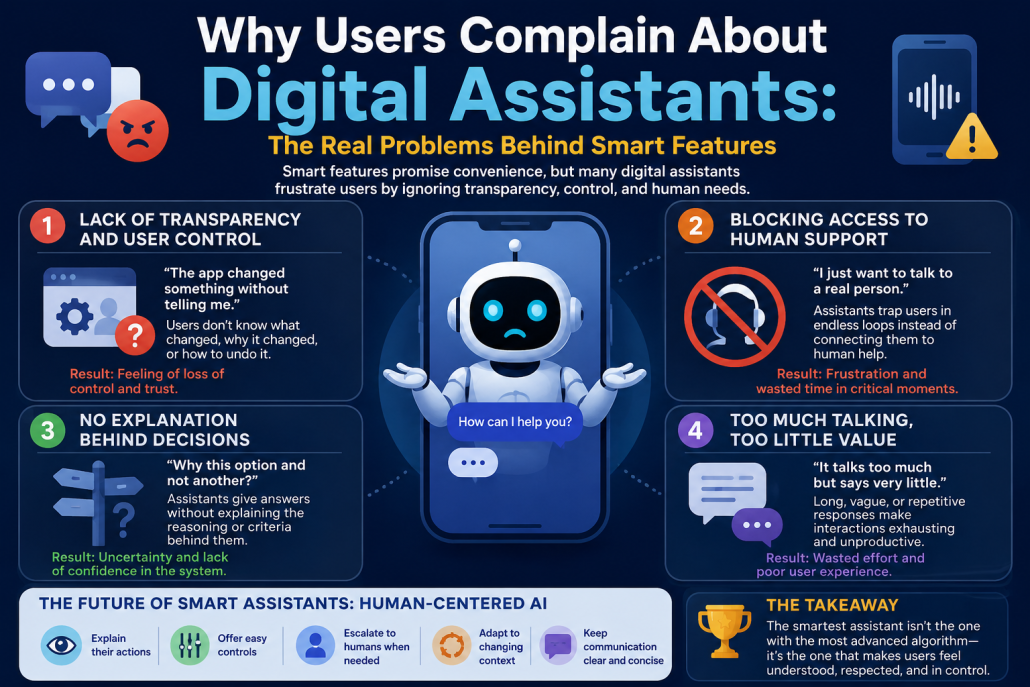
Based on the insights from [KiaApp’s analysis of smart features](https://kiaapp.xyz/smart-features-in-apps-recommendations-assistants-and-automation/), user frustration with digital assistants often stems from a gap between advanced technology and human expectations. When an assistant fails, it isn’t usually due to a lack of technical capability, but rather a failure to respect user autonomy.
The most critical user complaints center around a loss of agency, communication barriers, and a total lack of rationale behind automated choices.
—
### 1. The Total Illusion of Transparency and Control
The absolute core of user frustration lies in what the KiaApp text highlights: *”Users are generally open to intelligent behavior, but they want to know what is happening and why.”* Too often, digital assistants act as black boxes. They alter settings, categorize data, log personal information, or trigger automated workflows behind the scenes without explicit user consent. When an assistant makes an executive decision without explaining its logic, it ceases to feel like a helpful tool and begins to feel like an intrusive force.
True utility requires control. Users need a straightforward way to **correct, pause, or completely deactivate** specific behaviors. When an app denies them the ability to override a bad decision or fine-tune the assistant’s boundaries, it breeds anxiety. Advanced engineering means nothing if the interface feels entirely disrespectful of the user’s intent.
### 2. Acting as an Impenetrable Barrier to Human Help
Perhaps the most universally reviled experience is when an assistant transforms from a helpful guide into an unyielding gatekeeper. A dominant complaint among users is some variation of, *”I just want to talk to a human, but the app won’t let me.”*
This is especially damaging in high-stakes environments like banking, insurance, or healthcare, where users are often dealing with time-sensitive, complex crises. Instead of routing the user to a customer service representative, the digital assistant forces them through endless, cyclical troubleshooting loops.
By failing to recognize its own operational limitations, the assistant actively prevents resolution. When a system refuses to hand off the conversation to a human agent—or hides the option behind layers of menus—it fundamentally breaks user trust and turns a minor issue into a major source of resentment.
### 3. The Refusal to Explain “Why This and Not That?”
A distinct but deeply aggravating flaw in modern digital assistants is their utter failure to explain comparative decision-making. Assistants frequently present a single solution, recommendation, or path forward as an absolute truth, completely failing to justify why they selected that specific option over viable alternatives.
For example, if an assistant automatically selects a specific travel itinerary, a particular payment method, or a distinct workflow, it rarely explains the criteria used to make that choice. It doesn’t clarify if the decision was based on cost, efficiency, past user behavior, or a hidden algorithmic bias.
Because the assistant doesn’t explain its method, users cannot evaluate whether the logic matches their current priorities. Without this context, the assistant’s guidance feels arbitrary, leaving users to constantly second-guess the system rather than relying on it.
### 4. Repetitive Misunderstanding and Verbosity
To compound these systemic flaws, assistants are frequently criticized for being over-communicative yet unhelpful. Users often note that assistants **”talk too much but say very little,”** offering long, scripted, or vague responses instead of direct answers. When this verbosity is paired with a failure to grasp context—causing the system to repeatedly misunderstand a query even when rephrased—the interaction becomes an exhausting exercise in futility.
—
> **The Takeaway:** Digital assistants must evolve past simple automation. To genuinely assist, they must operate with absolute transparency, know when to step aside for human intervention, and explicitly communicate the “why” behind their decisions.