
Agentic AI, AI Agents, Modern AI.
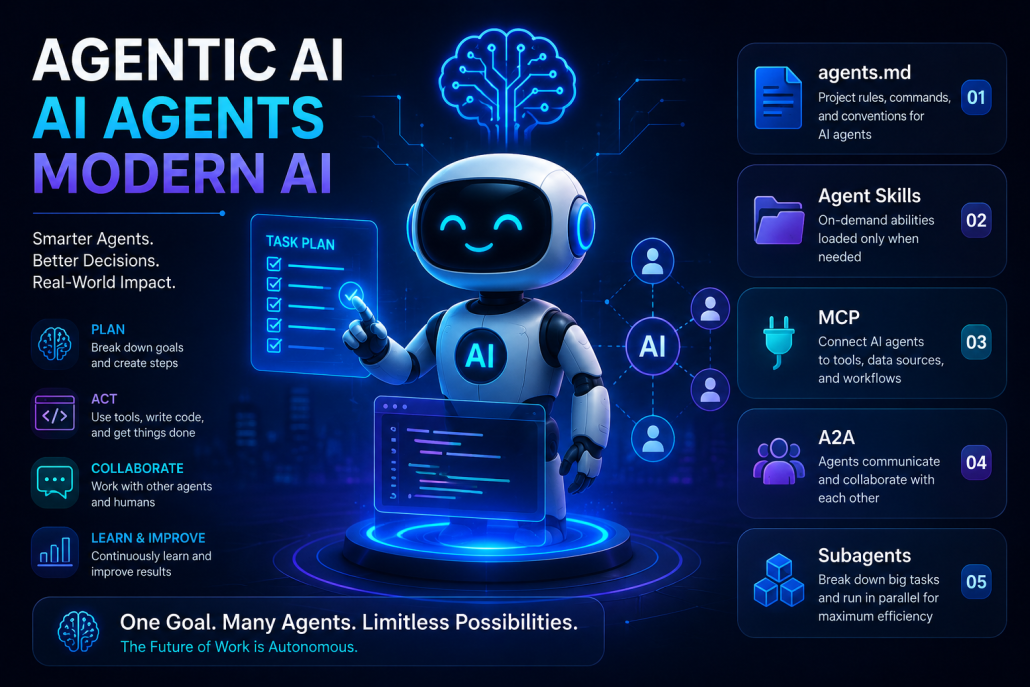
Frontier AI agents have become surprisingly capable. They can plan tasks, write code, and solve problems with very little human involvement. But this ability does not come from the language model alone. Under the surface, there are several important layers and systems that turn a simple conversational model into a true autonomous agent. To understand how agentic AI works today, it helps to know five key concepts.
At the center of every AI agent is a large language model. This is the part responsible for generating text, reasoning, and understanding instructions. On its own, though, it is just a conversational system. What makes it an actual agent is the layer of instructions and structure wrapped around it. One important part of that structure is something called agents.md. This is usually a Markdown file placed at the root of a project. Whenever the agent begins working, it reads this file first. It may include coding rules, setup commands, testing instructions, or formatting conventions. In many ways, it acts like a README file, but one written specifically for AI agents. Instead of a human reading it, the agent uses it as guidance for how to behave inside that project.
Another important concept is agent skills. Not every piece of knowledge needs to be loaded all the time. For example, if an agent only occasionally needs to create a PowerPoint presentation, it would be inefficient to carry all that information in its context constantly. Agent skills solve this by storing specialized abilities separately. Each skill can have its own instructions, resources, and scripts, and the agent only loads them when the user’s request matches that specific need. This keeps the system lighter and more efficient.
Of course, agents do not work in isolation. They often need to connect with external tools like APIs, databases, SaaS platforms, or developer tools. This is where MCP (Model Context Protocol) becomes important. MCP is an open standard that gives AI agents a unified way to communicate with external systems. Instead of building custom integrations for every service, an MCP server acts like a translator between the agent and the tool. Whether it is pulling notes from Notion or creating a payment link in Stripe, MCP makes the connection smoother and more scalable.
Then there is A2A (Agent-to-Agent communication). While MCP handles tools and data, A2A handles communication between agents themselves. Imagine a procurement agent negotiating a contract and then needing approval from a finance agent. Without a shared protocol, this would require custom integration. A2A gives agents a common language so they can delegate tasks, exchange information, and collaborate naturally.
Finally, there are subagents. Sometimes a task is simply too large for one agent to handle efficiently. In those cases, the main agent can create smaller child agents to handle pieces of the work. Each subagent runs independently, completes its assigned task, and returns the result. This makes large-scale work—like reviewing thousands of files or running dozens of checks in parallel—much faster and more manageable.
Together, these five concepts show that modern AI agents are much more than chatbots. They follow project-specific rules, load specialized knowledge only when needed, connect to outside tools, collaborate with other agents, and break down large tasks into smaller parts. That is what makes frontier AI agents so powerful today and why they are quickly becoming an important part of software development and business workflows.