
Best APIs for Adding AI to Your Mobile or Web
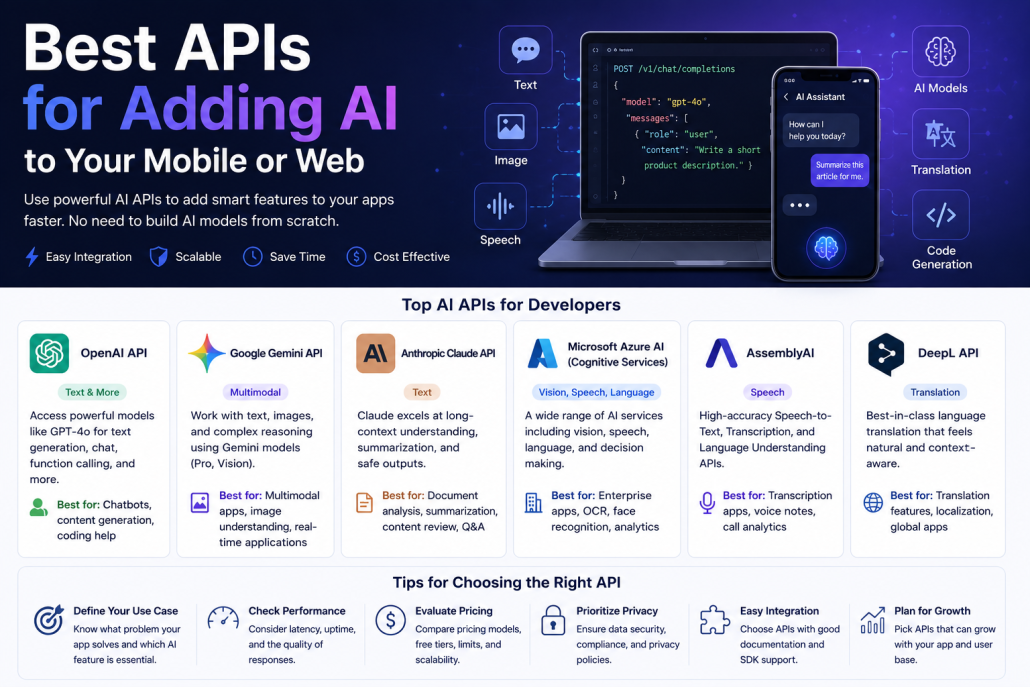
Adding AI to mobile and web applications has become one of the fastest ways to improve user experience, automate tasks, and create smarter digital products. Instead of building machine learning models from scratch, developers today can connect ready-made AI APIs and bring advanced features into their apps in just a few hours. This has changed the way software is built. Whether you are developing a chatbot, a recommendation system, a voice assistant, or content generation tools, choosing the right AI API can save months of work and significantly reduce development costs.
One of the most popular choices for developers is OpenAI. Its API offers powerful language models that can handle text generation, summarization, coding assistance, and conversational chat. For many apps, OpenAI is often the first option because of its flexibility and strong performance. For example, a productivity app can use it to summarize notes, while an e-commerce app can create product descriptions automatically.
Another strong option is Google Gemini. Gemini is especially useful for developers who want multimodal capabilities, meaning the ability to work with text, images, and reasoning together. This makes it a great choice for apps that need visual understanding, document analysis, or more advanced AI interactions. If your app combines text and images, Gemini can offer strong value.
Anthropic Claude is also becoming popular, especially for long-form text and safe AI responses. Claude performs well when handling large documents, detailed analysis, or structured conversations. Developers building tools for legal, academic, or enterprise use often find it useful because of its context length and strong reasoning.
For voice-based applications, AssemblyAI is one of the best APIs available. It specializes in speech-to-text, transcription, and audio analysis. This is ideal for apps like voice note managers, meeting assistants, or customer call analysis systems.
When it comes to translation, DeepL remains one of the strongest options. Its translations often feel more natural and context-aware than many alternatives, making it perfect for multilingual apps and international products.
Choosing the best API depends on your app’s purpose. Developers should think about pricing, speed, scalability, privacy, and how easily the API fits into their backend. Some APIs are better for conversation, others for voice, images, or data analysis.
In the end, AI APIs have made advanced technology accessible to every developer. You no longer need a huge team or years of AI research to build intelligent apps. The right API can transform a simple application into a smarter, faster, and more valuable product for users.