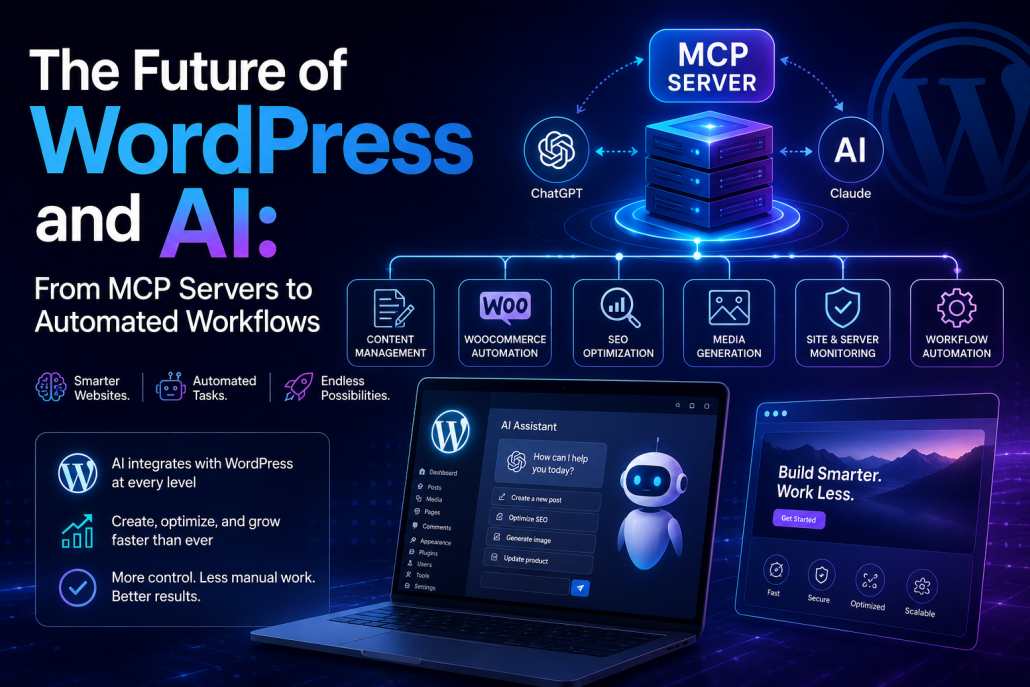
The Future of WordPress and AI: From MCP Servers to Automated Workflows
It feels like every month artificial intelligence is becoming more deeply integrated into the tools we use every day. Recently, we’ve seen major AI developments in browsers with tools like Perplexity AI Comet and new features from OpenAI ChatGPT. But this shift is not limited to browsers. It is happening just as fast inside WordPress and throughout the web design process. AI is no longer a simple gimmick or a fun experiment. It is becoming a real part of how websites are built, managed, and optimized. That is why understanding these changes matters now more than ever.
One of the biggest developments inside WordPress is the rise of MCPs (Model Context Protocols). Think of MCP as a bridge between your website and large language models like OpenAI ChatGPT or Anthropic Claude. In simple terms, it works like an API designed specifically for AI. This connection allows your AI assistant to interact directly with your website and perform tasks. Instead of logging into WordPress and manually updating content, you could ask ChatGPT to publish a post, edit a page, generate images, or optimize SEO—all directly from the AI interface itself.
This becomes even more powerful when combined with WooCommerce. Imagine asking AI to add products, update descriptions, optimize product titles, or adjust pricing details. These are repetitive tasks that usually take time, but with MCPs they can become almost instant. Plugins like MCP Adapter are making this possible by turning a WordPress site into an MCP server, opening up a new level of automation.
The next major shift is happening in page builders. Elementor is now moving beyond its old AI content tools with new systems like Angie. This is much more than generating text. It can change visuals, edit graphics, update images, and even create promotions or sitewide sales. Tasks like setting up discounts, launching campaigns, or creating coupons can be handled with simple AI instructions. Think of it like giving tasks to a virtual assistant: “Update the homepage,” “launch a sale,” or “create a coupon.” These are exactly the kinds of tasks AI is beginning to handle.
AI agents are another huge step forward. Tools like AutoKit are bringing AI agents directly into WordPress itself. Before, creating AI agents often required external automation platforms like Make or N8N. Now, these workflows can live inside your website. That means more control, faster automation, and deeper integration. Instead of relying on separate services, WordPress itself can become the center of your AI-powered workflow.
Plugins are evolving quickly too. Tools like AI Engine are already showing what’s possible. From chatbots to content generation and image management, these plugins are expanding what WordPress can do. Even SEO tools are changing. For example, SEOPress has useful AI integrations like automatic alt-text generation for uploaded images. What once felt advanced now seems basic compared to what direct AI-to-WordPress connections can do.
Hosting is also becoming smarter. Companies like Cloudways are integrating AI tools such as Co-Pilot for server monitoring. This is a big deal because hosting issues can be hard to diagnose. AI can monitor uptime, detect attacks like DDoS, identify bot overload, and suggest configuration fixes. Instead of just telling you something is wrong, it can offer solutions and even help apply them. It’s like having an extra technical assistant watching your server 24/7.
Finally, AI is transforming the design side too. Figma has been adding AI tools that make design tasks much faster. Something simple like removing a background from an image, which used to take several minutes in software like Affinity Photo, can now be done almost instantly. These small improvements save time and make workflows smoother. And this is likely just the beginning.
Looking ahead, AI is spreading into five key layers of the WordPress ecosystem: the core platform, page builders, plugins, hosting, and design tools. That means the entire website-building process is changing from top to bottom. A year from now, WordPress could look very different, with AI playing a central role in almost every task. Right now, we are only at the start of that transformation, and the possibilities ahead are far bigger than most people realize.