
Will AI Replace Developers? What Actually Changes
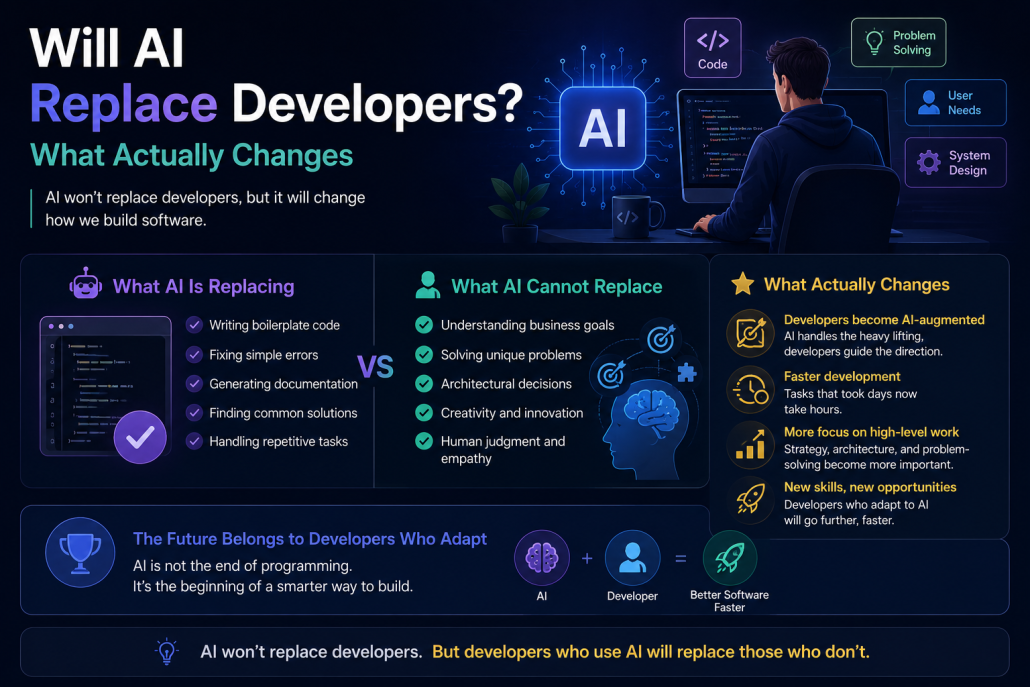
The question of whether AI will replace developers has become one of the biggest discussions in technology. With tools now capable of writing code, debugging errors, and even generating entire app structures, it is easy to understand why many developers feel uncertain. At first glance, it may seem like AI is moving toward replacing programmers entirely. But when we look closer, the reality is different. AI is changing development—but not eliminating the need for developers.
What AI is really replacing are certain tasks, not the people behind them. Developers spend a large amount of time on repetitive work: writing boilerplate code, fixing simple syntax errors, generating documentation, or searching for common solutions. These are areas where AI performs extremely well. A developer can now describe a function in plain language and receive usable code within seconds. This saves time and speeds up workflows dramatically.
But software development is much more than writing code. It involves understanding business needs, solving unique problems, making architectural decisions, and designing user experiences. AI can assist with these things, but it cannot fully replace human judgment. For example, if a business wants to build a custom app for managing internal operations, AI might generate code, but it cannot fully understand company culture, long-term goals, or hidden workflow challenges the way a human developer can.
What changes most is the role of the developer. Instead of spending hours on basic coding tasks, developers are shifting toward higher-level thinking. They become more like strategists, system designers, and decision-makers. AI becomes a tool that handles the heavy lifting, while the developer guides the direction. It is similar to how calculators changed mathematics. They did not replace mathematicians; they allowed them to work faster and focus on deeper problems.
Another major change is speed. Development cycles are becoming shorter. Tasks that once took days may now take hours. This means developers who learn to work with AI can become much more productive. A solo developer today can build what once required a small team. This creates opportunities, especially for freelancers and startups.
However, there is also a challenge. Basic coding skills alone may become less valuable. If everyone can generate simple code with AI, the competitive advantage shifts to problem-solving, creativity, system architecture, and communication. Developers who only write routine code may struggle, while those who adapt will grow stronger.
So, will AI replace developers? Not likely. But it will replace developers who refuse to adapt. The future belongs to those who know how to use AI as a partner. The real change is not the disappearance of developers—it is the evolution of what being a developer means. In many ways, AI is not ending software development; it is pushing it into a smarter and faster era.