AI Strategy for Small Businesses
Artificial intelligence is no longer a future concept reserved for large corporations with huge budgets and technical teams. It has become a practical tool that small businesses can use today to improve efficiency, save time, and compete more effectively. Yet many small business owners still feel unsure about where to begin. The term “AI strategy” can sound overwhelming, as if it requires complex systems and expert knowledge. In reality, building an AI strategy often starts with something much simpler: understanding your daily challenges and finding the right tools to solve them.
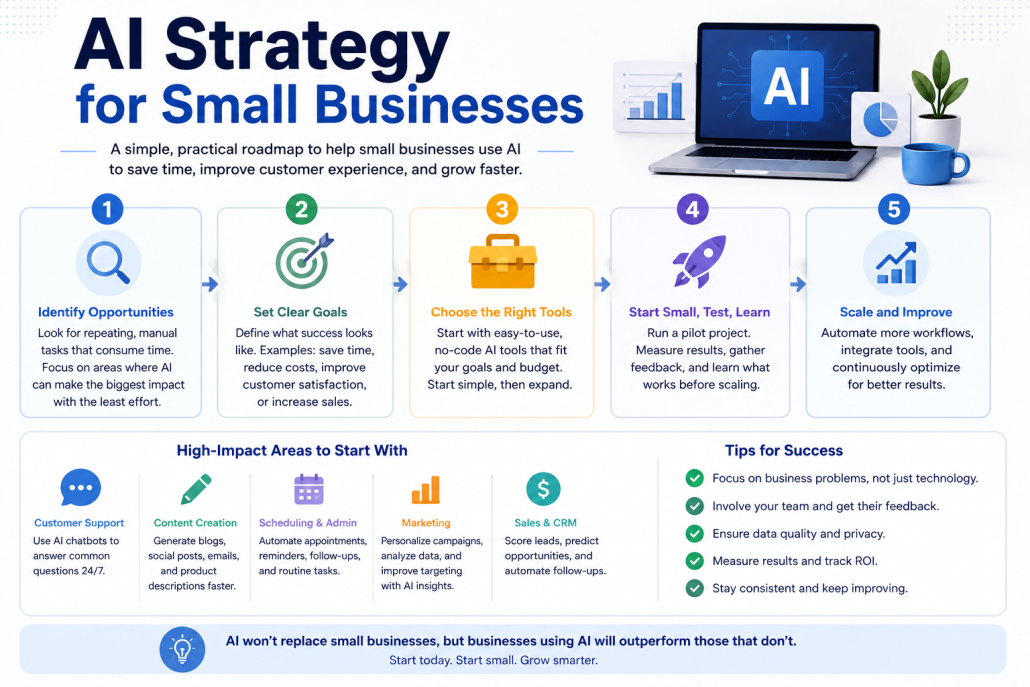
For most small businesses, the first step is not buying software or hiring consultants. It is identifying repetitive tasks that take up too much time. These tasks often include answering customer questions, writing emails, managing bookings, creating content, organizing data, or following up with clients. While each task may seem small on its own, together they can consume hours every week. AI can reduce that workload significantly. For example, a local business can use an AI chatbot to answer common customer questions instantly, even outside working hours. This improves customer experience while allowing staff to focus on more valuable work.
Content creation is another strong starting point. Many businesses struggle to keep up with social media, blogs, newsletters, and product descriptions. AI writing tools can help generate ideas, draft content, and speed up the process. Instead of spending three hours writing a post, a business owner might spend thirty minutes editing and improving an AI-generated draft. That time saved can be invested elsewhere.
The most important part of an AI strategy is starting small. Many businesses make the mistake of trying too much too soon. They sign up for multiple tools, test too many ideas, and quickly lose focus. A better approach is to choose one problem and solve it first. Think of it like improving one department before changing the whole company. If customer support is your biggest challenge, begin there. If your marketing is inconsistent, focus on AI content tools first.
Choosing simple, no-code tools is also important. Today, many platforms are built for beginners. Tools like ChatGPT, Canva AI, and workflow automation apps allow businesses to use AI without technical skills. This removes one of the biggest barriers to entry.
In the end, AI strategy is not really about technology—it is about clarity and priorities. Small businesses that understand their problems, start with one clear goal, and use AI as a support system can create powerful long-term advantages. The best time to begin is not when everything is perfect. It is now, with small practical steps.