
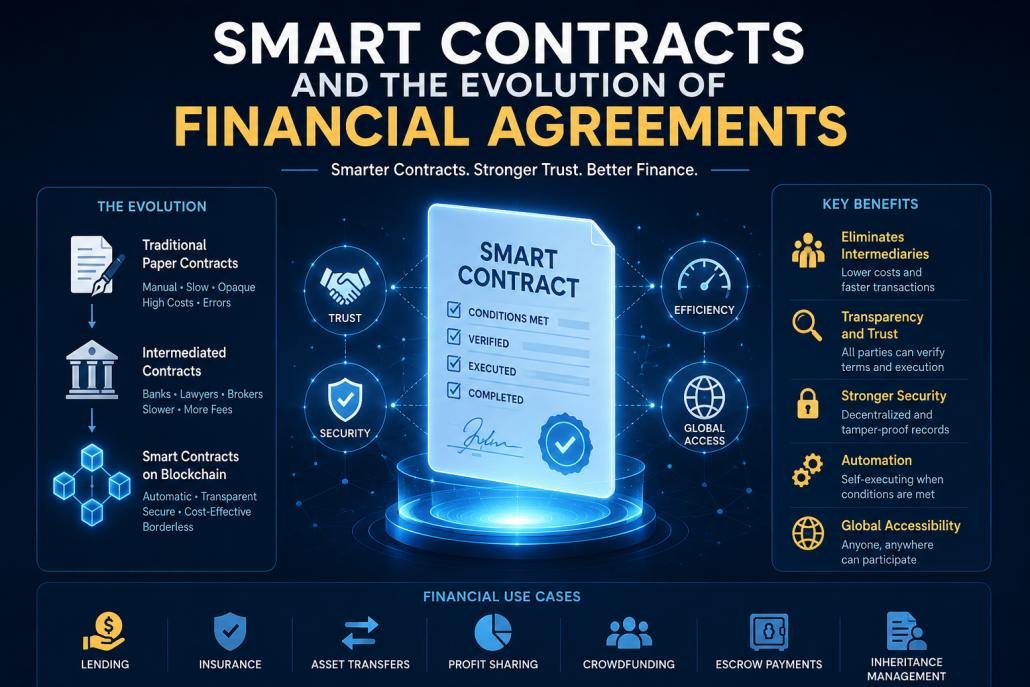
Smart Contracts and the Evolution of Financial Agreements
If we connect this discussion to Smart Contract in finance, the
topic becomes even more compelling, because it shows how
artificial intelligence and blockchain can reshape traditional
financial systems Hedera.
What is a Smart Contract?
A smart contract is a self-executing digital agreement stored on
a Blockchain. Instead of relying on intermediaries like banks,
lawyers, or brokers, the contract automatically performs actions
once predefined conditions are met.
Think of it like a vending machine. You insert money, choose your
product, and the machine delivers it instantly. There is no cashier or
human approval needed. Smart contracts work the same way, but
for financial deals.
For example, imagine selling a house. Traditionally, this process
involves multiple steps: verifying funds, signing legal papers,
waiting for bank approvals, and registering ownership. With a smart
contract:
- The buyer deposits the agreed amount.
- The blockchain verifies the payment.
- Ownership is transferred automatically.
This reduces time, cost, and complexity.
Advantages of Smart Contracts in Financial Transactions
1. Elimination of Intermediaries
One of the biggest advantages is removing unnecessary
middlemen. Banks, notaries, and brokers can be minimized.
This leads to:
- Lower fees
- Faster transactions
- Less bureaucracy
For example, international wire transfers that usually take days can
be completed within minutes.
2. Transparency and Trust
Every transaction is permanently recorded on the blockchain. Both
parties can verify the contract terms and execution.
In lending, for instance, the borrower and lender can clearly see
repayment schedules, penalties, and collateral terms without
hidden clauses.
This transparency builds trust.
3. Improved Security
Because blockchain records are decentralized and immutable,
altering a smart contract after deployment is extremely difficult.
This makes fraud, tampering, and document manipulation much
harder compared to traditional paper contracts.
4. Automation and Efficiency
Smart contracts can automate repetitive financial tasks.
For example:
- Loan repayments can be deducted automatically.
- Insurance claims can be triggered instantly.
- Dividends can be distributed without manual processing.
Imagine a travel insurance policy: if your flight is delayed, the
system can automatically detect it and pay compensation
immediately.
5. Global Accessibility
Smart contracts are borderless. Anyone with internet access can
participate.
A person in Greece, Iran, or Germany can enter the same
agreement without depending on local banks or regulators.
This creates more inclusive financial systems.
Disadvantages and Risks
1. Coding Vulnerabilities
A smart contract is only as good as its code. If there is a bug, the
consequences can be severe.
A famous example is the The DAO Hack, where millions were lost
due to a flaw.
2. Lack of Human Judgment
Life is complex. Contracts often need interpretation, negotiation, or
empathy.
Smart contracts cannot understand special circumstances like
illness, emergencies, or force majeure.
3. Legal Uncertainty
In many countries, the legal framework around Decentralized
Finance is still unclear.
If disputes arise, courts may struggle to enforce or interpret
blockchain contracts.
4. Dependence on Oracles
Smart contracts often depend on Blockchain Oracle for real-
world information such as exchange rates, gold prices, or weather
data.
If the oracle is corrupted or inaccurate, the contract may fail.
5. Irreversible Transactions
Mistakes are difficult to fix. If funds are sent incorrectly, they usually
cannot be recovered.
This makes precision extremely important.
Best Use Cases in Finance
Smart contracts are especially useful for:
- Automated lending
- Insurance settlements
- Escrow services
- Asset tokenization
- Profit-sharing agreements
- Inheritance planning
- Crowdfunding platforms
Final Thought
Smart contracts offer a powerful combination of speed, security,
and transparency. They reduce costs and make financial systems
more efficient. But they also introduce technical and legal risks.
That is why many experts prefer a hybrid model:
Smart Contract + Human Oversight
This approach combines automation with human judgment,
creating a safer and more balanced financial system for the future