
AI Commerce Evolution: From SEO to AEO, GEO, and ACCO
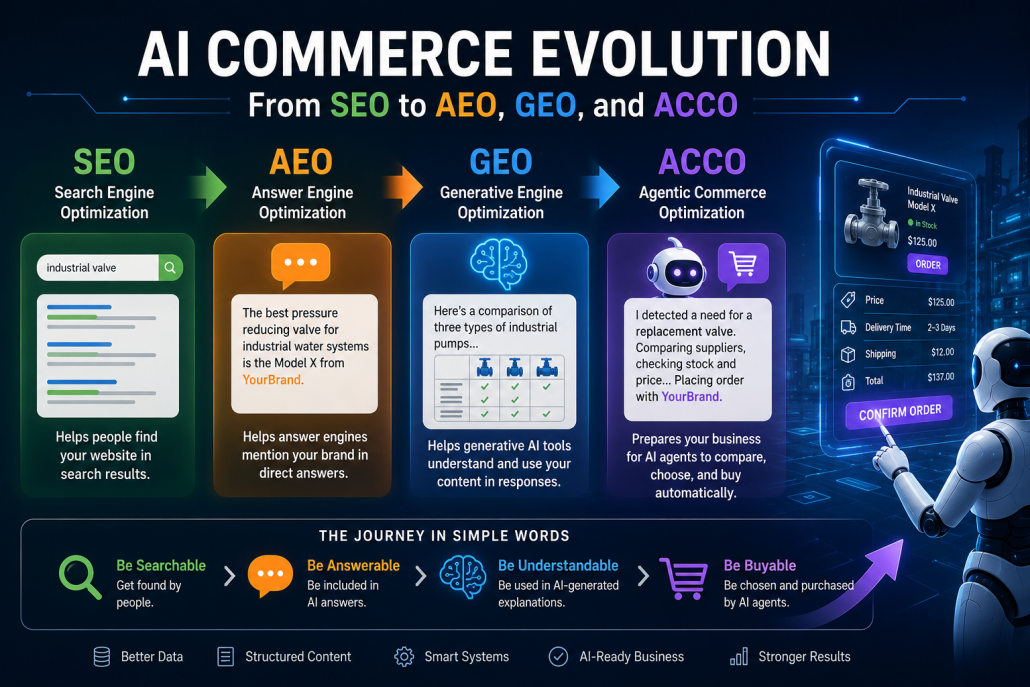
Artificial intelligence is changing digital commerce in a very practical way. In the past, businesses focused mainly on SEO so people could find their websites on Google. That still matters, but it is no longer enough. Buyers are changing how they search, compare, and purchase products. They now ask AI tools questions, use chatbots to compare options, receive direct answers from search engines, and may soon rely on AI agents to make buying decisions for them.
This shift can be understood as a journey from SEO to AEO, GEO, and ACCO. SEO helps people find your website. AEO helps answer engines mention your brand in direct answers. GEO helps generative AI tools understand and use your content when creating responses. ACCO prepares your business for a future where AI agents can compare, choose, and even buy your products automatically.
AEO, or Answer Engine Optimization, is about preparing your content so AI-powered answer engines can use it directly. In traditional SEO, the goal was to appear on the first page of Google. With AEO, the goal is to appear inside the answer itself. For example, if a buyer asks, “What is the best pressure reducing valve for an industrial water system?”, an AI answer engine may not show ten links first. It may give a direct explanation. If your website has clear headings, useful FAQs, product specifications, comparison tables, and trustworthy explanations, your brand or product has a better chance of being included.
GEO, or Generative Engine Optimization, goes one step further. It focuses on making your content useful for tools like ChatGPT, Gemini, Claude, and Perplexity. These platforms do not only show links; they generate full answers, comparisons, summaries, and recommendations. A weak product page with only a short description will not help much. But a strong page with use cases, technical details, limitations, benefits, installation notes, and comparison points can become valuable for AI-generated answers.
ACCO, or Agentic Commerce Optimization, is newer and more future-focused. It prepares your business for AI agents that can act on behalf of buyers. An AI agent is not just a chatbot. It can plan, compare, decide, and take action. Imagine a factory where an AI system notices that a machine part may fail soon. It checks inventory, compares suppliers, reviews delivery times, confirms compatibility, and places an order. For this to work, your product data, stock levels, prices, shipping costs, tax details, return policies, and order systems must be clear and accessible.
This is why data is everything. AI is only as strong as the data behind it. If your product descriptions are poor, your chatbot will give weak answers. If your inventory is not updated, an AI agent cannot order safely. If your customer data is messy, AI cannot personalize the buying experience. In B2B commerce, product data, customer data, and order data are the foundation. A product named only “Valve 220V” is not enough. A better title would be “220V brass solenoid valve for water control systems, normally closed, 1/2 inch connection.” The second version gives AI enough context to understand and recommend the product correctly.
This is where PIM and MDM become important. PIM means Product Information Management, and it keeps product names, descriptions, images, specifications, and categories consistent. MDM means Master Data Management, and it manages broader business data such as products, customers, suppliers, pricing, and orders. Without these systems, product information becomes inconsistent and confusing. With them, businesses can prepare their data for SEO, AEO, GEO, and ACCO.
Another major change is AI-powered product discovery. Instead of forcing buyers to search manually, AI can help them find the right product by understanding their problem. A buyer might say, “I need a valve for controlling water flow in a small industrial system.” The AI can then ask about pressure range, pipe size, voltage, material, and usage. After that, it can recommend the best product, suggest alternatives, offer accessories, and support cross-sell or upsell opportunities.
However, companies should not adopt AI just because it sounds modern. They should follow an ROI-first AI strategy. This means starting with a real business problem. Can AI reduce customer support time? Can it improve inventory accuracy? Can it reduce wrong orders? Can it help sales teams recommend better products? A small AI project with measurable results is much better than a large, unclear experiment.
Conversational commerce is another important part of this future. Instead of clicking through many filters and menus, customers can simply talk to an AI assistant. For example, a customer may say, “I need a replacement valve for a heating system.” The AI can ask the right questions and show suitable options. This can happen on websites, mobile apps, WhatsApp, customer portals, or voice assistants. But again, the chatbot must be connected to real product data, pricing, inventory, and order history.
Automated order entry is also becoming valuable, especially in B2B. Many business orders still arrive through emails, PDFs, Excel files, scanned documents, or purchase orders. AI can read these documents, identify products, check stock, confirm pricing, and create a draft order. This saves time, reduces mistakes, and connects traditional buying habits with modern digital systems.
By 2030, agentic commerce may become normal in B2B. Purchases may not always start with a human search. They may start with an AI agent detecting a need. A machine may show signs of wear, the AI predicts a part will fail, checks suppliers, compares prices and delivery times, and places the order automatically or asks for approval. This rewards companies that are machine-readable, fast, transparent, and reliable.
The full evolution is clear: SEO → AEO → GEO → ACCO. SEO helps you appear in search results. AEO helps you appear in direct AI answers. GEO helps your content become part of AI-generated explanations. ACCO helps your products be selected and purchased by AI agents.
In simple terms, the future of commerce is moving from being searchable, to being answerable, to being understandable by AI, and finally to being buyable by AI agents. Companies that prepare their content, data, systems, and workflows now will be in a much stronger position as digital buying becomes more AI-driven.