The Ultimate Guide to AI Models: GPT, Gemini, Claude, Grok, DeepSeek, and More
Before comparing every AI model, one important point needs to be clear: ChatGPT is not the model. ChatGPT is the app. GPT is the model behind it. Think of ChatGPT as a door you walk through to access GPT. Copilot, Gemini, and Claude work in a similar way. Each has a different interface, logo, and product experience, but behind them sits a powerful AI model doing the real work.
Most AI models are trained on huge amounts of text, code, books, articles, and websites. They do not “memorize” information in the way humans do. Instead, they learn patterns. At the most basic level, many of these models predict the next word, or more accurately, the next token. That may sound simple, but when done extremely well, it can produce essays, explain science, write code, summarize documents, and answer complex questions. It is like autocomplete, but trained on a massive amount of information and improved to understand context far better.
Two important ideas help explain why some models feel smarter than others: parameters and context window. Parameters are like the internal settings the model uses to recognize patterns. More parameters usually mean the model can understand more complex relationships. The context window is how much information the model can keep in mind during a conversation. A larger context window means you can give it longer documents, bigger code files, or extended conversations without it losing track.
Some newer models also include stronger reasoning abilities. These models do not just answer immediately; they take more time to work through the problem. That makes them slower, but often much better for math, logic, coding, planning, and multi-step tasks.
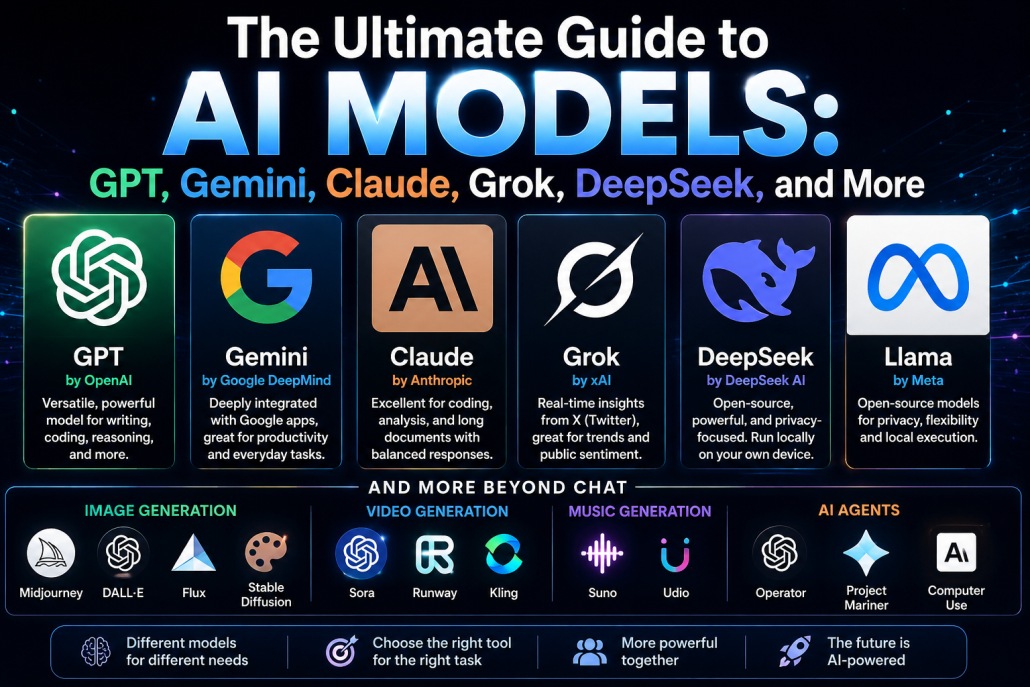
GPT, developed by OpenAI, is one of the most well-known model families because it is strong across many tasks. It can help with writing, analysis, coding, image-related work, voice interaction, and general problem solving. Its biggest advantage is not only the model itself, but the ecosystem around it. Many apps, plugins, businesses, and third-party tools are built around OpenAI’s GPT models, which makes them widely useful in everyday work.
Gemini, developed by Google DeepMind, is especially powerful because of its integration with Google’s ecosystem. If someone already uses Gmail, Google Docs, Sheets, Android, Search, or Maps, Gemini fits naturally into that workflow. Its strength is not only answering questions, but also helping inside the tools people already use every day.
Claude, developed by Anthropic, is often preferred for coding, long-document analysis, and deep reasoning. Many developers recommend Claude because it can review code, explain complex systems, and produce well-structured summaries. It is also known for providing more balanced and direct feedback rather than simply agreeing with every suggestion.
Grok, developed by xAI, is best known for its integration with X (formerly Twitter) and its ability to analyze real-time conversations and trending topics. This makes it particularly useful for following breaking news, monitoring public sentiment, and understanding online discussions as they happen.
DeepSeek, developed by DeepSeek AI, represents another important direction in AI development. As an open-source model, it allows users to download and run AI locally instead of relying on cloud services. Other open-source models such as Llama from Meta, Qwen from Alibaba, and Mistral from Mistral AI also give users greater control, improved privacy, and the ability to run powerful AI models on their own hardware.
Beyond conversational models, there are also specialized AI systems. Midjourney is widely regarded for producing highly artistic images. DALL·E, developed by OpenAI, is easy to use and performs particularly well when generating images containing readable text. Flux and Stable Diffusion offer greater customization and are popular among users who want to generate images locally.
For AI-generated video, Sora from OpenAI, Runway, and Kling are among the leading platforms, while Suno and Udio have become popular for creating complete songs with vocals and instruments from simple text prompts.
The next major evolution is AI agents. Instead of simply answering questions, AI agents can browse websites, execute code, manage files, fill out forms, and complete complex multi-step tasks with limited human supervision. Systems such as OpenAI Operator, Google Project Mariner, and Anthropic Computer Use demonstrate how AI is evolving from a conversational assistant into an autonomous digital worker.
The best strategy today is not to rely on a single AI model. Use GPT for general-purpose work, Gemini if you live inside Google’s ecosystem, Claude for programming and detailed analysis, Perplexity for research with source citations, and Llama or DeepSeek if privacy and local execution are priorities. AI is becoming less like one universal application and more like a complete toolbox, where choosing the right model for the right task produces the best results.