How AI Agent Teams Work: Roles, Collaboration, and Specialized Subagents
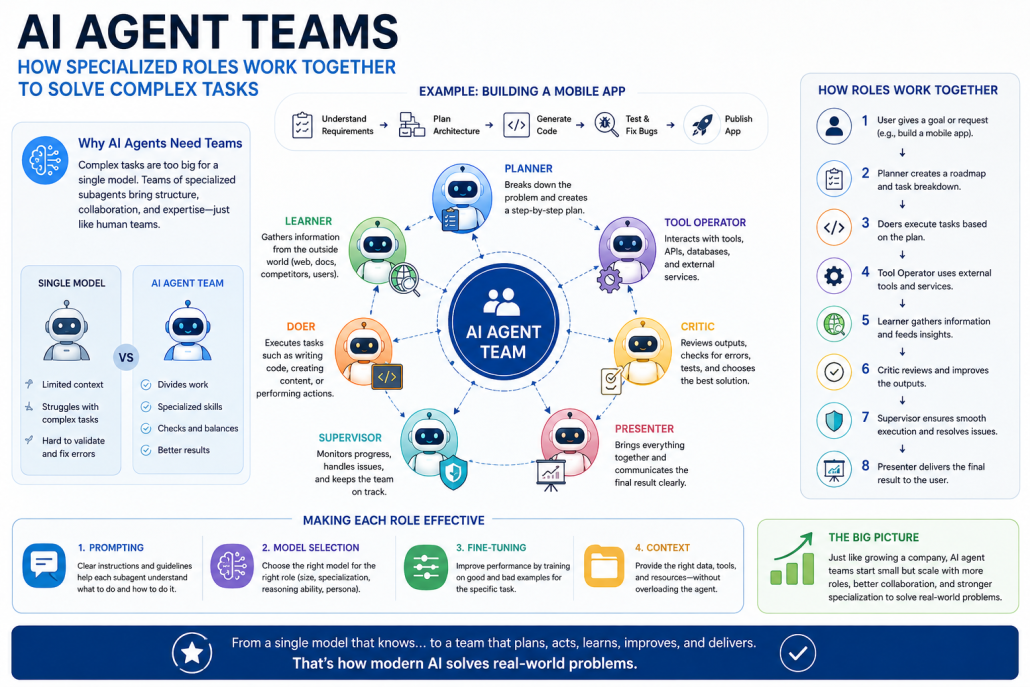
AI agents are designed to handle tasks that are far more complex than what a standalone large language model can solve with its built-in knowledge. A single model can answer questions, generate text, or write small pieces of code, but when it comes to building something larger—like a full mobile application—it needs structure, collaboration, and specialized roles. In many ways, this looks a lot like how human teams work. Just as people divide work between planners, workers, reviewers, and managers, AI agents can do the same by creating teams of subagents.
Think about building a mobile app. It is not just one step. First, someone needs to understand user requirements. Then there has to be a plan for the app’s architecture. After that comes coding, testing, fixing bugs, and finally publishing. A single AI model trying to do all of this at once would struggle. But a team of specialized AI roles can make the process much more organized and reliable.
The first role in almost every AI team is the doer. This is the worker that writes code, creates content, or performs tasks directly. It is like a junior developer on a human team—good at execution but not always great at seeing the bigger picture. That bigger picture usually belongs to the planner. The planner breaks down a large problem into smaller tasks. In a mobile app project, this could mean turning a simple user prompt into clear feature requirements and then designing the app’s architecture before any coding begins.
Another important role is the tool operator. AI agents often need to interact with APIs, databases, or external services. The tool operator handles those interactions. For example, if the app needs payment integration or cloud storage, this role knows how to connect to those systems. Alongside that, there is often a learner. This role gathers information from outside sources like websites, competitor apps, or user reviews. In app development, this might help the AI discover what features users expect or what trends are popular in the market.
No strong team works without feedback, and AI teams are no different. That is where the critic comes in. The critic reviews outputs, checks for errors, looks for hallucinations, and tests whether the generated code actually works. Sometimes it even compares multiple solutions and chooses the best one. Then there is the supervisor, which watches the overall workflow. If one subagent gets stuck or something fails, the supervisor steps in to keep the process moving. Finally, there is the presenter. This role takes all the pieces and communicates the final result back to the user in a clear and understandable way.
Making these roles effective depends on a few things. First is prompting—clear instructions are like good management. Second is model selection, because not every model is suited for every role. Third is fine-tuning, which can improve performance with examples. And fourth is context, giving each subagent the right information without overwhelming it.
In the end, AI agent teams are starting to look a lot like human organizations. Small teams can solve simple problems quickly, but bigger and more complex tasks require more roles, more specialization, and stronger internal collaboration. That is how modern AI moves from simple chat to real-world problem solving.