
Why Businesses That Ignore AI May Fall Behind Faster Than They Think
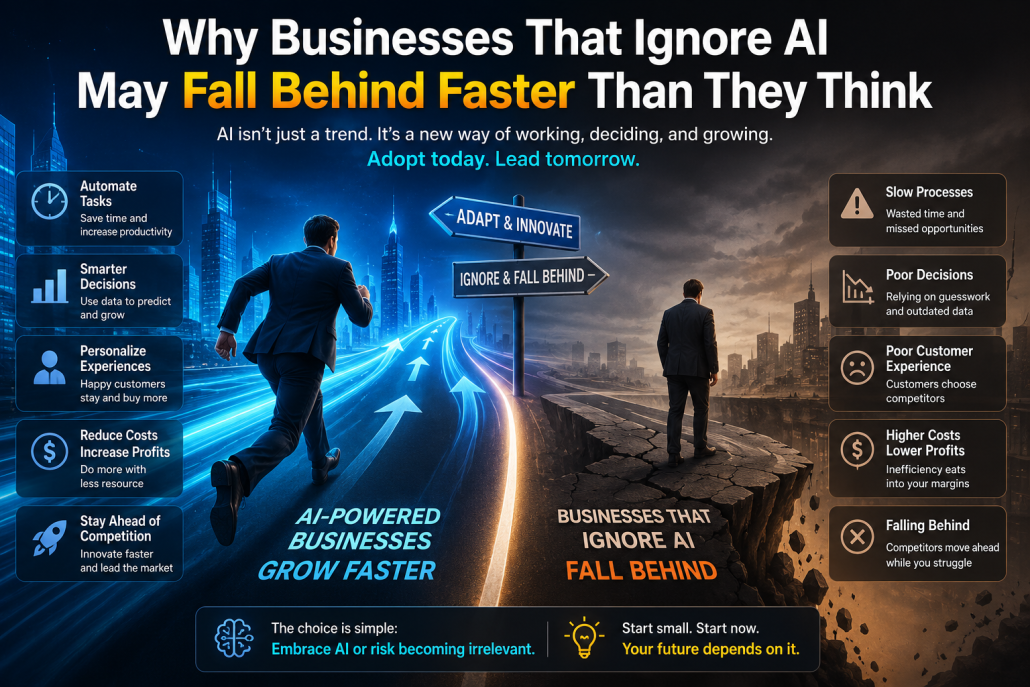
Artificial intelligence is no longer a future technology reserved for large corporations. It has quickly become a practical tool that businesses of all sizes can use to improve efficiency, reduce costs, and make better decisions. Yet many companies still hesitate. Some believe AI is too expensive, too complex, or simply unnecessary for their industry. The problem is that ignoring AI today may create bigger risks tomorrow. In many markets, businesses that delay adoption are already starting to fall behind faster than they realize.
One of the main reasons is speed. AI helps companies work faster by automating repetitive tasks. A customer support team, for example, can use AI chatbots to answer common questions instantly instead of relying entirely on human staff. This saves time and improves response speed. Imagine two businesses selling similar products online. One replies to customer questions in seconds through AI, while the other takes hours. Most customers will naturally move toward the faster experience. Over time, that speed advantage turns into stronger customer loyalty and more sales.
AI also improves decision-making. Businesses create huge amounts of data every day—sales reports, customer behavior, website traffic, and market trends. Without AI, much of this data stays unused or takes too long to analyze. AI can detect patterns, predict demand, and identify problems before they grow. A retail company, for instance, can use AI to forecast which products will sell more next month. That means better inventory planning and less wasted money. Companies that ignore this advantage often make slower and weaker decisions.
Another major factor is personalization. Modern customers expect businesses to understand their needs. Platforms like Amazon and Spotify have shaped this expectation through recommendation systems. AI allows businesses to offer tailored suggestions, personalized emails, and targeted promotions. Without this, a company may feel outdated. Think about walking into two stores: one remembers what you like, and the other treats every visit the same. Most people will return to the first.
Competition is changing as well. Small businesses now have access to AI tools that were once only available to major companies. This means the market is becoming more efficient and more competitive at the same time. A smaller competitor using AI for marketing, analytics, and customer service can move faster than a larger traditional business. Size alone no longer guarantees advantage.
Of course, adopting AI does not mean replacing people or changing everything overnight. It often starts small—automating emails, improving website search, or analyzing customer behavior. The goal is not to remove human judgment but to strengthen it. Businesses that start early gain experience, learn faster, and adapt more easily.
In the end, ignoring AI is like ignoring the internet in the early 2000s. At first, it may seem optional. But over time, it becomes the standard. Businesses that wait too long may find themselves not just behind—but struggling to catch up at all.