AI Assistants vs AI Agents: How They Shape the Future of Work
Imagine a movie star who works with both a personal assistant and a professional agent. The assistant helps with daily tasks such as managing the calendar, answering messages, booking meetings, and keeping life organized. The agent, however, works more proactively. They search for new opportunities, negotiate deals, plan the star’s career path, and make strategic decisions. Artificial intelligence works in a similar way. There are AI assistants and AI agents, and although they may sound similar, they play very different roles.

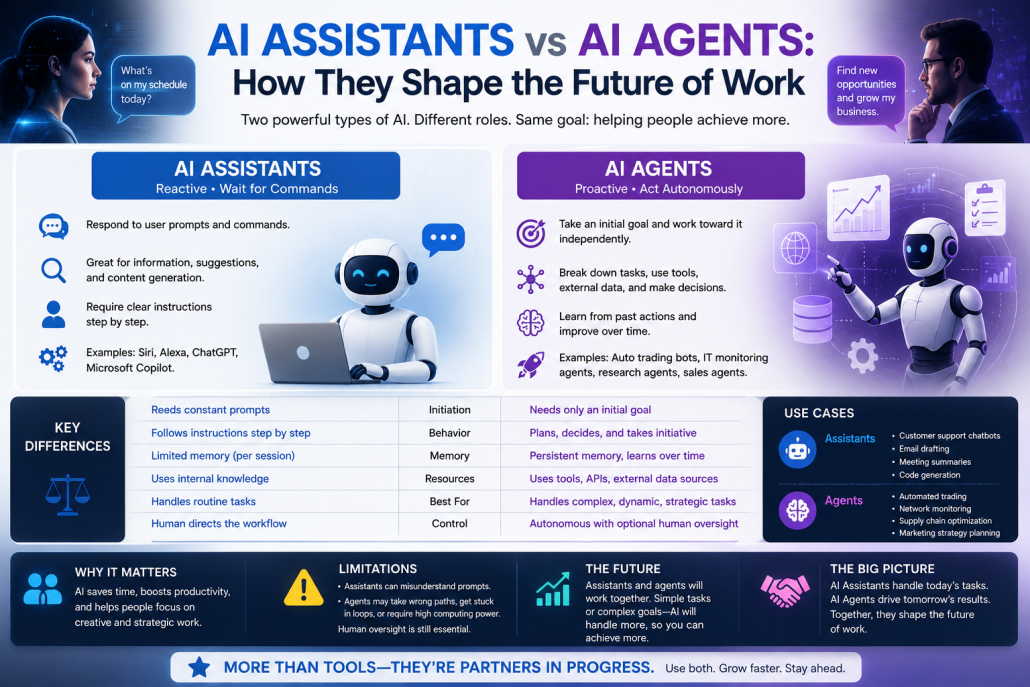
AI assistants are mostly reactive. They wait for a command from the user before taking action. Tools like Siri, Alexa, and ChatGPT are common examples. A user asks a question, gives an instruction, or writes a prompt, and the assistant responds. These systems are useful because they can understand natural language, organize information, answer customer questions, summarize text, write content, and even help generate code. However, they usually need clear direction. The user must guide the conversation step by step, almost like a tennis match: prompt, response, prompt, response.

Most AI assistants are powered by large language models, often called LLMs. These models help the assistant understand language and produce useful answers. Their quality can improve through techniques like prompt tuning and fine-tuning. Prompt tuning helps adjust the assistant for a specific task, while fine-tuning trains it with examples so it can perform repeated tasks more accurately. For example, a business may fine-tune an AI assistant to write customer emails in the company’s tone.

AI agents are different because they are more proactive. They do not just wait for every small instruction. Instead, they can take an initial goal and work toward it independently. For example, a company might tell an AI agent, “Improve our sales strategy.” The agent can then break that goal into smaller tasks, analyze data, compare customer behavior, suggest improvements, and even use external tools to complete parts of the work.

This makes AI agents more suitable for complex and strategic tasks. In finance, an AI agent might analyze market trends, news, and historical data to support automated trading decisions. In IT, an agent could monitor a network, detect problems, and suggest fixes before a major failure happens. Unlike simple assistants, agents can often use memory, tools, and external data sources to improve their decisions over time.

The difference is simple: AI assistants help with routine work, while AI agents aim to achieve bigger goals. An assistant might answer a customer question. An agent might study thousands of customer interactions and recommend a better support strategy.

Still, both systems have limits. AI assistants can misunderstand unclear prompts. AI agents can sometimes follow the wrong path, repeat mistakes, or require high computing power. Because of this, human supervision is still important. Businesses should not blindly trust every AI output.

In the future, the strongest results will likely come from combining both. AI assistants will handle daily tasks, while AI agents will manage larger workflows. Together, they can help people work faster, make smarter decisions, and focus more on creative and strategic work.
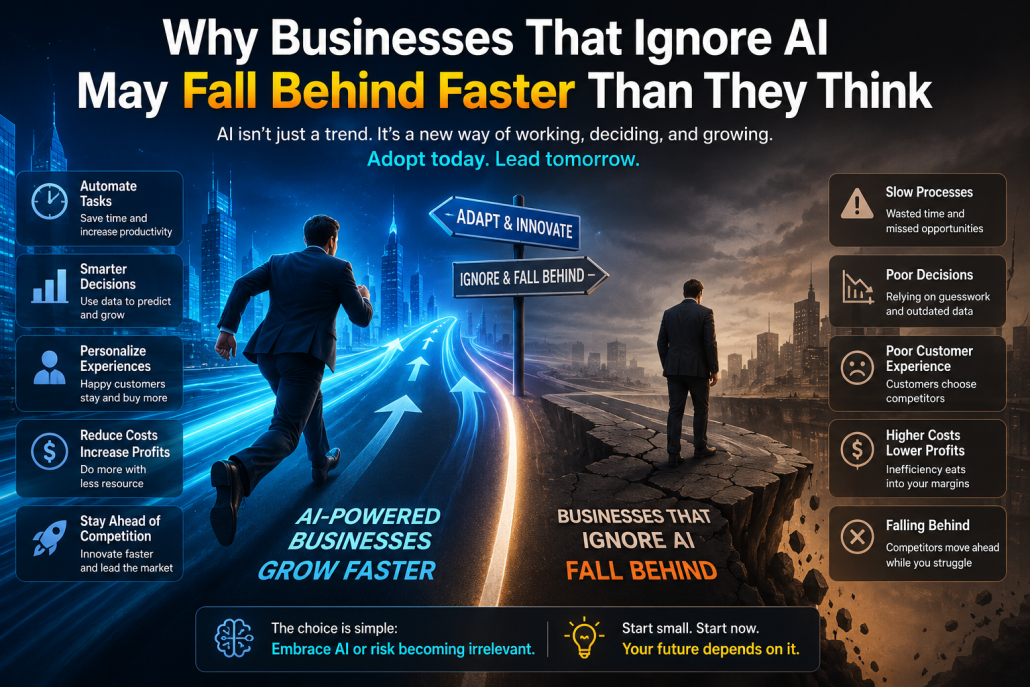
Why Businesses That Ignore AI May Fall Behind Faster Than They Think

Artificial intelligence is no longer a future technology reserved for large corporations. It has quickly become a practical tool that businesses of all sizes can use to improve efficiency, reduce costs, and make better decisions. Yet many companies still hesitate. Some believe AI is too expensive, too complex, or simply unnecessary for their industry. The problem is that ignoring AI today may create bigger risks tomorrow. In many markets, businesses that delay adoption are already starting to fall behind faster than they realize.

One of the main reasons is speed. AI helps companies work faster by automating repetitive tasks. A customer support team, for example, can use AI chatbots to answer common questions instantly instead of relying entirely on human staff. This saves time and improves response speed. Imagine two businesses selling similar products online. One replies to customer questions in seconds through AI, while the other takes hours. Most customers will naturally move toward the faster experience. Over time, that speed advantage turns into stronger customer loyalty and more sales.

AI also improves decision-making. Businesses create huge amounts of data every day—sales reports, customer behavior, website traffic, and market trends. Without AI, much of this data stays unused or takes too long to analyze. AI can detect patterns, predict demand, and identify problems before they grow. A retail company, for instance, can use AI to forecast which products will sell more next month. That means better inventory planning and less wasted money. Companies that ignore this advantage often make slower and weaker decisions.

Another major factor is personalization. Modern customers expect businesses to understand their needs. Platforms like Amazon and Spotify have shaped this expectation through recommendation systems. AI allows businesses to offer tailored suggestions, personalized emails, and targeted promotions. Without this, a company may feel outdated. Think about walking into two stores: one remembers what you like, and the other treats every visit the same. Most people will return to the first.

Competition is changing as well. Small businesses now have access to AI tools that were once only available to major companies. This means the market is becoming more efficient and more competitive at the same time. A smaller competitor using AI for marketing, analytics, and customer service can move faster than a larger traditional business. Size alone no longer guarantees advantage.

Of course, adopting AI does not mean replacing people or changing everything overnight. It often starts small—automating emails, improving website search, or analyzing customer behavior. The goal is not to remove human judgment but to strengthen it. Businesses that start early gain experience, learn faster, and adapt more easily.

In the end, ignoring AI is like ignoring the internet in the early 2000s. At first, it may seem optional. But over time, it becomes the standard. Businesses that wait too long may find themselves not just behind—but struggling to catch up at all.

AI and Consumer Behavior: How Buying Decisions Are Changin

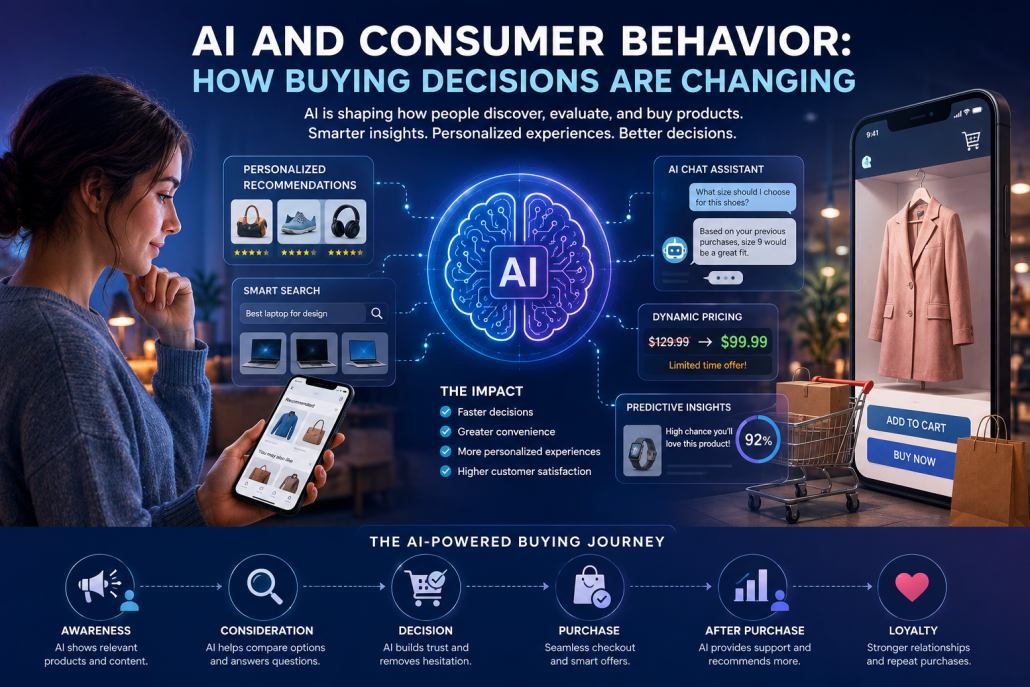
AI and consumer behavior infographic showing personalized recommendations, smart search, AI chatbots, dynamic pricing, predictive shopping insights, and the customer buying journey.

Artificial intelligence is changing the way people make buying decisions, often in ways they do not even notice. In the past, consumers relied heavily on advertisements, word of mouth, or their own research before making a purchase. Today, AI has become a quiet partner in that process. From personalized product recommendations to smart chatbots and dynamic pricing, AI is shaping how people discover, compare, and choose products. This shift is changing consumer behavior and transforming the relationship between businesses and buyers.

One of the biggest ways AI affects buying behavior is through personalization. Platforms like Amazon and Netflix have made this common. When you browse products or watch content, AI analyzes your actions—what you click, how long you stay, and what you buy—to predict what you might want next. This makes shopping feel easier and faster. Imagine entering an online store and finding exactly what you were thinking about buying. That convenience often leads to quicker decisions and more purchases.

AI also changes how people search for information. Instead of scrolling through endless product pages, consumers increasingly interact with AI-powered search tools and assistants. A shopper looking for the best smartphone, for example, can ask an AI assistant to compare models, prices, and features in seconds. This reduces the time spent researching and can make decisions feel more confident. It also means businesses must focus on clear, accurate, and optimized product information because AI systems use that data to guide consumers.

Another important change is trust. AI-powered chatbots on websites can answer questions instantly, 24 hours a day. For many buyers, this creates a smoother experience. If someone is unsure about shipping, product compatibility, or return policies, getting an immediate answer can remove doubt. A small hesitation that once caused a customer to leave may now turn into a sale. In this way, AI helps bridge the gap between curiosity and commitment.

At the same time, AI introduces new challenges. Dynamic pricing, where prices change based on demand or behavior, can influence buyers in both positive and negative ways. A person might feel encouraged to buy quickly when they see a limited-time discount, but they may also feel manipulated if prices keep changing. Privacy is another concern. Many consumers know AI uses their data, and not everyone feels comfortable with that. Businesses must balance personalization with transparency.

The future of consumer behavior will likely become even more connected to AI. Voice shopping, predictive recommendations, and virtual assistants will continue to make buying faster and more tailored. Imagine your phone reminding you to reorder coffee before you run out, or suggesting a better product based on your habits. For businesses, this means understanding AI is no longer optional. It is becoming a key part of how people buy. In simple terms, AI is not just changing products—it is changing the psychology of purchasing itself.

Best APIs for Adding AI to Your Mobile or Web App

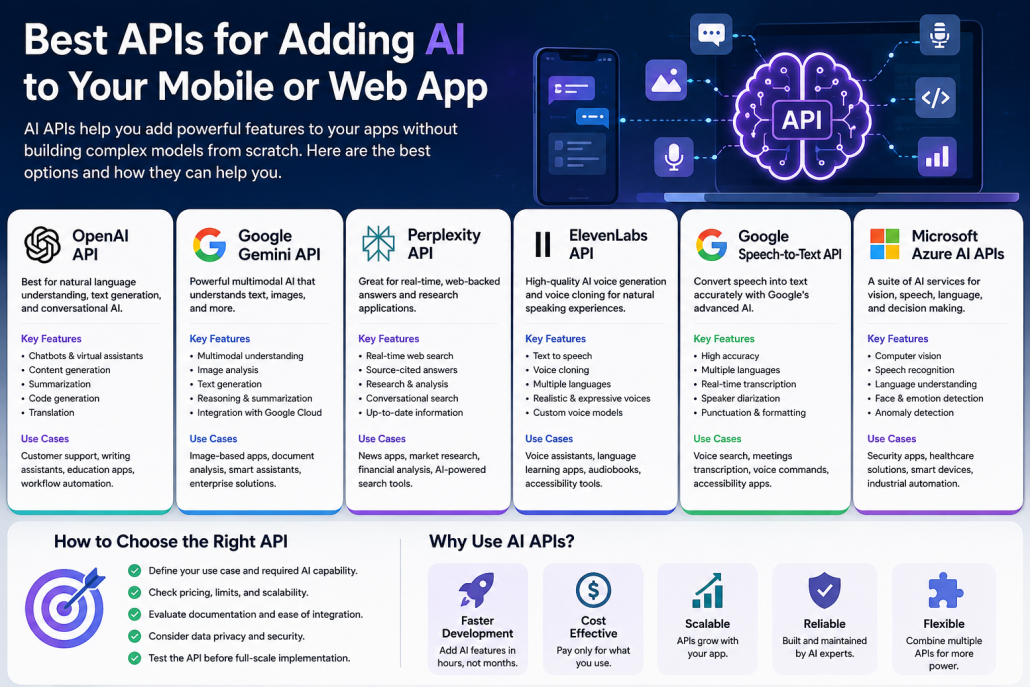
AI APIs have become one of the fastest ways for developers to add intelligent features into mobile and web applications without building complex machine learning systems from scratch. Instead of spending months training models, developers can connect their apps to powerful APIs and immediately unlock features like chatbots, image generation, search, voice recognition, and automation. This has changed the way software is built. Today, even a small startup can create advanced AI-powered products by choosing the right API.

One of the most widely used options is the API from OpenAI. It is popular because it offers strong natural language understanding, text generation, code assistance, summarization, and conversational AI. For example, if you want to build a customer support chatbot inside a shopping app, OpenAI can understand user questions, remember context, and provide useful answers. It is also flexible for content creation, translation, and workflow automation. Many developers choose it because the documentation is clear and integration is relatively simple.

Another strong option is the API from Google through its Google Gemini models. Gemini is especially useful for developers who need strong multimodal capabilities, meaning it can understand text, images, and other data together. Imagine a mobile app where a user uploads a photo of a broken machine and asks for troubleshooting advice. Gemini can analyze both the image and the text. It is also often attractive because of pricing and integration with Google Cloud services.

For apps focused on knowledge retrieval and real-time research, Perplexity AI offers an interesting API path. Unlike traditional models that rely heavily on training data, Perplexity emphasizes live web-backed responses. This makes it useful for applications where fresh information matters, such as market analysis, news tracking, or research assistants. For example, a financial app could use it to pull current trends and explain them to users.

Voice-based apps can benefit from APIs like ElevenLabs for realistic speech generation or speech cloning. This is valuable for language learning apps, accessibility tools, or interactive assistants. On the input side, speech recognition APIs from Google or Microsoft can convert spoken language into text, allowing hands-free interaction.

The best API depends on the goal of your app. If you need conversation and reasoning, OpenAI is often a strong choice. If you need image understanding and a broad ecosystem, Gemini may fit better. If your app depends on live information, Perplexity can be useful. A good way to think about it is like hiring specialists: one is a writer, one is a researcher, and one is a visual analyst. Choosing the right one can save time, reduce costs, and make your app far more powerful.

Real AI Use Cases That Save Time and Money

Real AI Use Cases That Save Time and Money

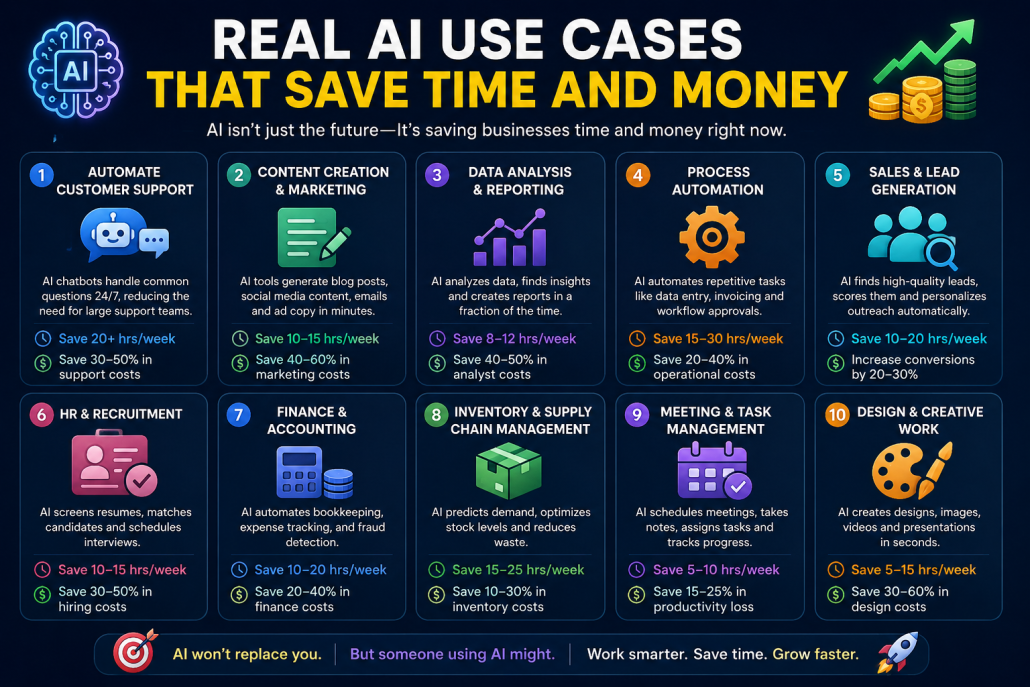
The conversation around Artificial Intelligence has officially shifted from speculative hype to tangible utility. In businesses and daily workflows, AI is no longer a futuristic concept—it is an active utility bill reducer and hours-saver. By offloading repetitive, data-heavy, and predictable tasks to intelligent systems, organizations and independent professionals are capturing massive efficiencies.

Here are the primary real-world AI use cases delivering measurable returns on time and money.

1. Automated Customer Support and Instant Triage

Traditional customer service is expensive and bottlenecked by human bandwidth. AI-driven agents and conversational bots have evolved far beyond the rigid, frustrating scripts of the past. Modern systems utilize advanced language understanding to resolve high-volume, repetitive inquiries—such as tracking orders, processing returns, or troubleshooting basic technical setups—24/7.

  • The Savings: By handling up to $70\%$ or more of incoming tier-one tickets without human intervention, companies drastically reduce overhead costs and clear the queue, allowing human agents to focus exclusively on complex, high-value client issues.

2. Intelligent Code Acceleration and Debugging

For software engineering and web development, developer velocity is directly tied to profitability. AI code copilots are fundamentally changing how software is built. Instead of spending hours digging through documentation or writing boilerplate code, developers can describe functionality in plain language or provide code blocks to be refactored.

  • The Savings: AI speeds up code generation, instantly highlights syntax errors, and suggests structural improvements. This reduces development cycles by an estimated $30\%$ to $45\%$, accelerating time-to-market and freeing engineering hours for architecture and system design.

3. Hyper-Efficient Content and Asset Production

In marketing and design, content scaling used to require exponential increases in budget and timeline. Generative AI tools allow teams to turn existing brand guidelines into reusable infrastructure. Marketers can instantly localize copy, generate multi-variant ad designs for A/B testing, and produce targeted social media elements from a single master asset.

  • The Savings: Tasks that traditionally took creative agencies weeks—such as building massive icon libraries or generating months of on-brand contextual imagery—can now be generated and refined in hours, slashing production costs and eliminating severe creative bottlenecks.

4. Meeting Intelligence and Workflow Automation

A subtle but massive drain on corporate productivity is administrative friction—specifically, meetings and manual data entry. AI meeting assistants seamlessly transcribe calls, separate speakers, and automatically synthesize decisions into actionable task lists. When paired with workflow automation engines, this data flows seamlessly into CRMs and internal databases.

  • The Savings: Professionals save hours weekly by eliminating manual note-taking and administrative cleanup. Proposals can be generated instantly from call summaries, ensuring projects move forward without delayed administrative friction.

The Bottom Line: AI’s highest and best use is not to replace human strategic insight, but to eliminate the administrative, repetitive production work that crowds it out. By strategically deploying these tools, modern operations buy back their time and protect their bottom line.

Best APIs for Adding AI to Your Mobile or Web 

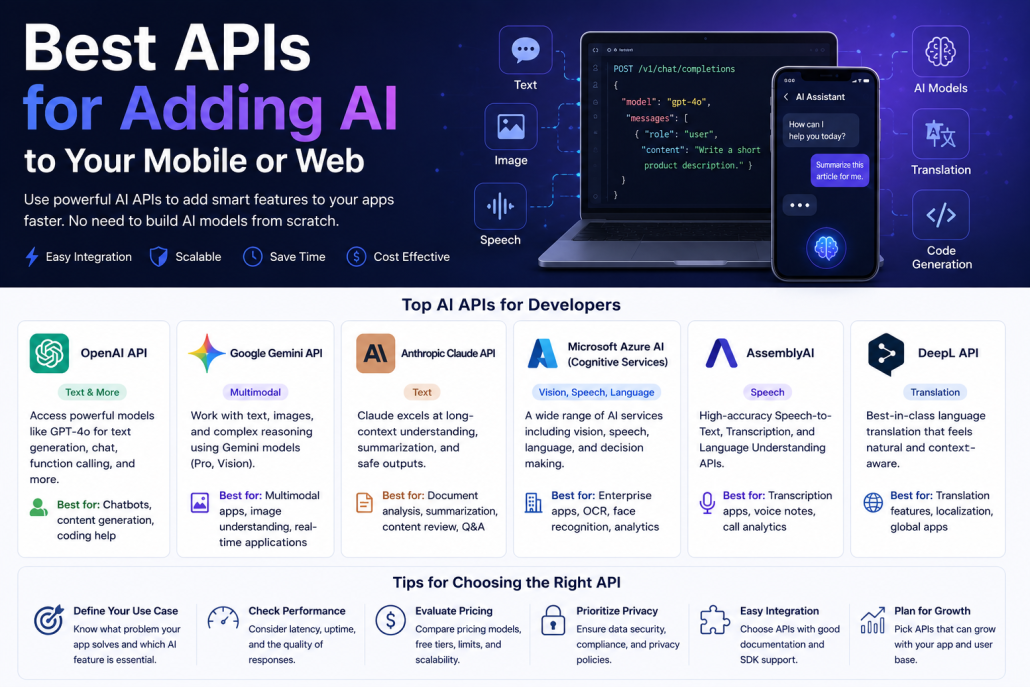
Adding AI to mobile and web applications has become one of the fastest ways to improve user experience, automate tasks, and create smarter digital products. Instead of building machine learning models from scratch, developers today can connect ready-made AI APIs and bring advanced features into their apps in just a few hours. This has changed the way software is built. Whether you are developing a chatbot, a recommendation system, a voice assistant, or content generation tools, choosing the right AI API can save months of work and significantly reduce development costs.

One of the most popular choices for developers is  OpenAI⁠Attachment.tiff. Its API offers powerful language models that can handle text generation, summarization, coding assistance, and conversational chat. For many apps, OpenAI is often the first option because of its flexibility and strong performance. For example, a productivity app can use it to summarize notes, while an e-commerce app can create product descriptions automatically.

Another strong option is  Google Gemini⁠Attachment.tiff. Gemini is especially useful for developers who want multimodal capabilities, meaning the ability to work with text, images, and reasoning together. This makes it a great choice for apps that need visual understanding, document analysis, or more advanced AI interactions. If your app combines text and images, Gemini can offer strong value.

Anthropic Claude⁠Attachment.tiff is also becoming popular, especially for long-form text and safe AI responses. Claude performs well when handling large documents, detailed analysis, or structured conversations. Developers building tools for legal, academic, or enterprise use often find it useful because of its context length and strong reasoning.

For voice-based applications,  AssemblyAI⁠Attachment.tiff is one of the best APIs available. It specializes in speech-to-text, transcription, and audio analysis. This is ideal for apps like voice note managers, meeting assistants, or customer call analysis systems.

When it comes to translation,  DeepL⁠Attachment.tiff remains one of the strongest options. Its translations often feel more natural and context-aware than many alternatives, making it perfect for multilingual apps and international products.

Choosing the best API depends on your app’s purpose. Developers should think about pricing, speed, scalability, privacy, and how easily the API fits into their backend. Some APIs are better for conversation, others for voice, images, or data analysis.

In the end, AI APIs have made advanced technology accessible to every developer. You no longer need a huge team or years of AI research to build intelligent apps. The right API can transform a simple application into a smarter, faster, and more valuable product for users.

Will AI Replace Developers? What Actually Changes

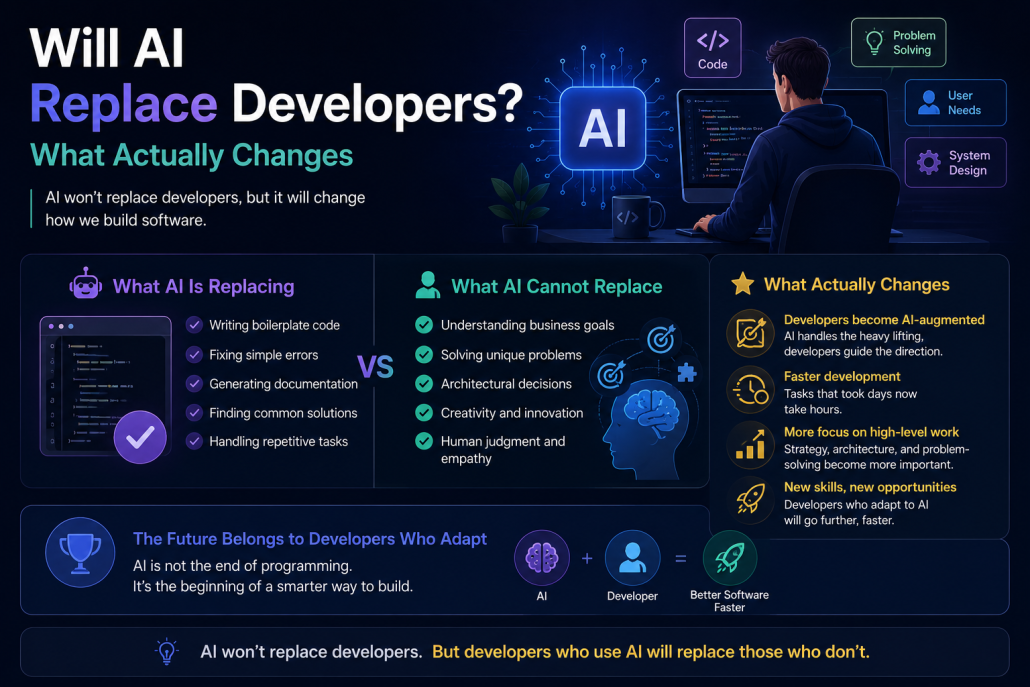
The question of whether AI will replace developers has become one of the biggest discussions in technology. With tools now capable of writing code, debugging errors, and even generating entire app structures, it is easy to understand why many developers feel uncertain. At first glance, it may seem like AI is moving toward replacing programmers entirely. But when we look closer, the reality is different. AI is changing development—but not eliminating the need for developers.

What AI is really replacing are certain tasks, not the people behind them. Developers spend a large amount of time on repetitive work: writing boilerplate code, fixing simple syntax errors, generating documentation, or searching for common solutions. These are areas where AI performs extremely well. A developer can now describe a function in plain language and receive usable code within seconds. This saves time and speeds up workflows dramatically.

But software development is much more than writing code. It involves understanding business needs, solving unique problems, making architectural decisions, and designing user experiences. AI can assist with these things, but it cannot fully replace human judgment. For example, if a business wants to build a custom app for managing internal operations, AI might generate code, but it cannot fully understand company culture, long-term goals, or hidden workflow challenges the way a human developer can.

What changes most is the role of the developer. Instead of spending hours on basic coding tasks, developers are shifting toward higher-level thinking. They become more like strategists, system designers, and decision-makers. AI becomes a tool that handles the heavy lifting, while the developer guides the direction. It is similar to how calculators changed mathematics. They did not replace mathematicians; they allowed them to work faster and focus on deeper problems.

Another major change is speed. Development cycles are becoming shorter. Tasks that once took days may now take hours. This means developers who learn to work with AI can become much more productive. A solo developer today can build what once required a small team. This creates opportunities, especially for freelancers and startups.

However, there is also a challenge. Basic coding skills alone may become less valuable. If everyone can generate simple code with AI, the competitive advantage shifts to problem-solving, creativity, system architecture, and communication. Developers who only write routine code may struggle, while those who adapt will grow stronger.

So, will AI replace developers? Not likely. But it will replace developers who refuse to adapt. The future belongs to those who know how to use AI as a partner. The real change is not the disappearance of developers—it is the evolution of what being a developer means. In many ways, AI is not ending software development; it is pushing it into a smarter and faster era.

Building AI-Powered Apps: What Developers Need to Know

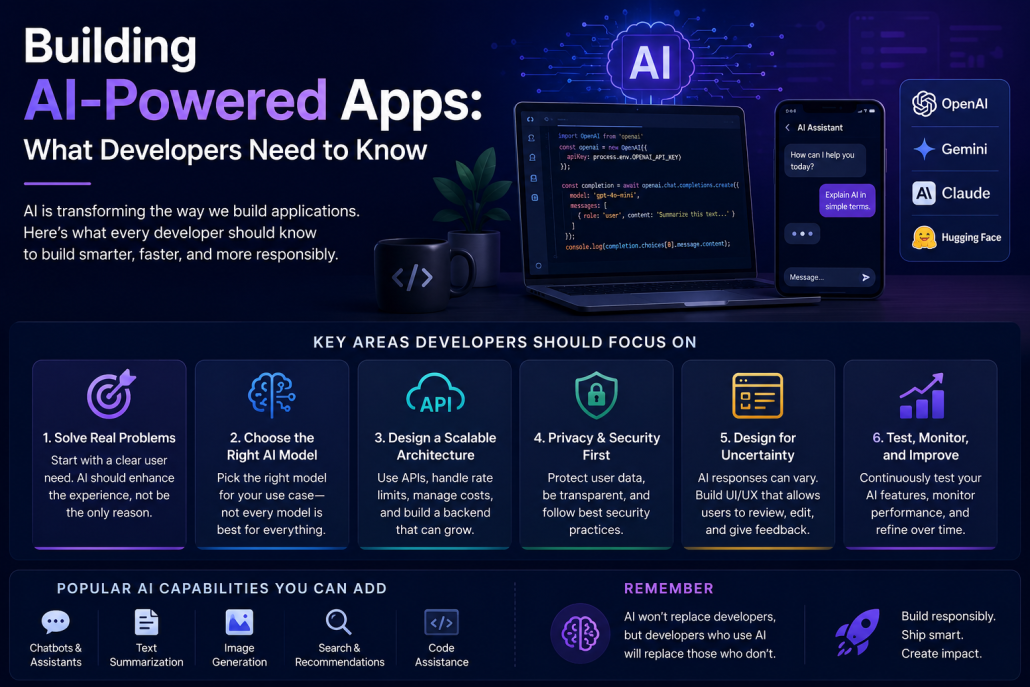
Building AI-powered apps has become one of the most exciting shifts in software development. Just a few years ago, adding artificial intelligence to an app meant working with complex machine learning models, large datasets, and deep technical expertise. Today, things are very different. Developers can integrate powerful AI capabilities into mobile, web, and desktop applications faster than ever. But while the tools have become easier, building useful AI-powered apps still requires clear thinking and the right strategy.

The first thing developers need to understand is that AI is not a product by itself—it is a feature. Many beginners make the mistake of building “an AI app” without solving a real problem. The strongest AI-powered apps start with a practical need. For example, an e-commerce app may use AI for personalized recommendations. A productivity app might summarize notes or generate tasks. A customer support app could use AI chat to answer questions instantly. The focus should always be on the user problem first.

Choosing the right AI model is another major decision. Today developers have access to tools like  OpenAI⁠Attachment.tiff,  Google Gemini⁠Attachment.tiff, and  Anthropic Claude⁠Attachment.tiff. Each has strengths. Some are better for writing, some for reasoning, and some for coding assistance. The best choice depends on what the app needs. A chatbot may need strong conversation skills, while a document analyzer may need better summarization and data extraction.

Another important factor is backend architecture. AI apps often rely on APIs, which means developers must think about authentication, rate limits, cost management, and data security. For example, if your app sends every user request directly to an AI model, costs can rise quickly. A smarter backend can cache repeated responses, filter unnecessary requests, and optimize token usage.

Developers also need to design for uncertainty. Traditional apps are predictable—you click a button and expect the same result every time. AI behaves differently. Responses can vary, be incomplete, or sometimes wrong. That means UI and UX become even more important. Apps should guide users clearly, offer editing options, and avoid presenting AI output as absolute truth.

Privacy is another key issue. Many AI apps process user data, messages, or files. Developers must be transparent about what data is sent, stored, or analyzed. Strong privacy policies and secure backend systems are no longer optional.

In the end, building AI-powered apps is less about adding trendy technology and more about creating smarter user experiences. Developers who understand user needs, choose the right tools, manage costs, and build responsibly will create apps that are not only innovative, but truly valuable. AI is changing development—but the best apps will still be built on the same foundation: solving real problems well.

AI Strategy for Small Businesses

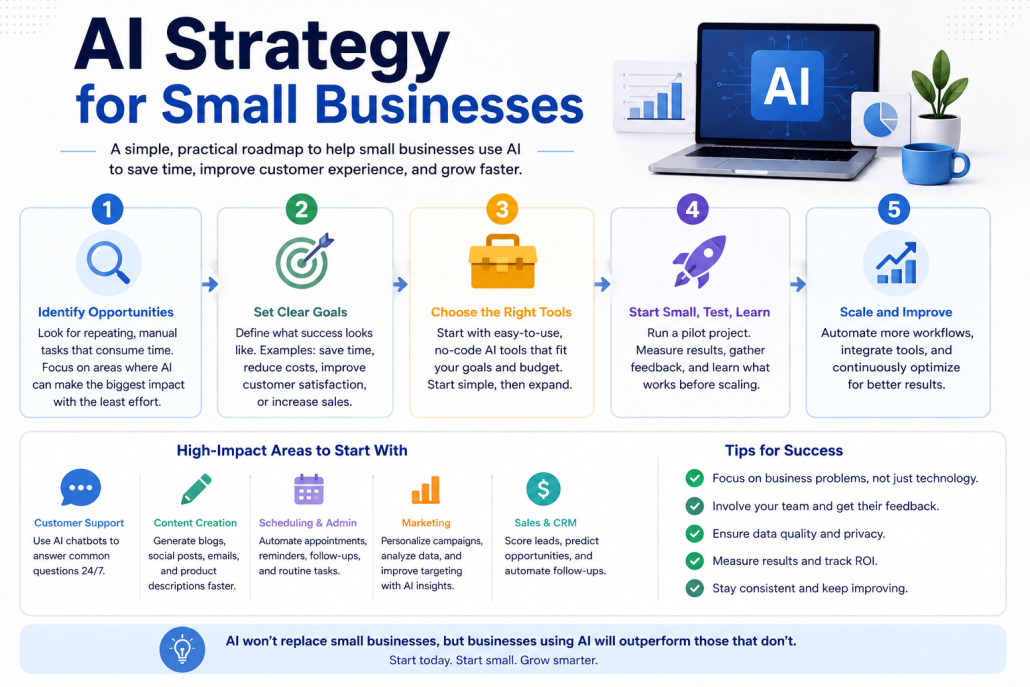
Artificial intelligence is no longer a future concept reserved for large corporations with huge budgets and technical teams. It has become a practical tool that small businesses can use today to improve efficiency, save time, and compete more effectively. Yet many small business owners still feel unsure about where to begin. The term “AI strategy” can sound overwhelming, as if it requires complex systems and expert knowledge. In reality, building an AI strategy often starts with something much simpler: understanding your daily challenges and finding the right tools to solve them.

For most small businesses, the first step is not buying software or hiring consultants. It is identifying repetitive tasks that take up too much time. These tasks often include answering customer questions, writing emails, managing bookings, creating content, organizing data, or following up with clients. While each task may seem small on its own, together they can consume hours every week. AI can reduce that workload significantly. For example, a local business can use an AI chatbot to answer common customer questions instantly, even outside working hours. This improves customer experience while allowing staff to focus on more valuable work.

Content creation is another strong starting point. Many businesses struggle to keep up with social media, blogs, newsletters, and product descriptions. AI writing tools can help generate ideas, draft content, and speed up the process. Instead of spending three hours writing a post, a business owner might spend thirty minutes editing and improving an AI-generated draft. That time saved can be invested elsewhere.

The most important part of an AI strategy is starting small. Many businesses make the mistake of trying too much too soon. They sign up for multiple tools, test too many ideas, and quickly lose focus. A better approach is to choose one problem and solve it first. Think of it like improving one department before changing the whole company. If customer support is your biggest challenge, begin there. If your marketing is inconsistent, focus on AI content tools first.

Choosing simple, no-code tools is also important. Today, many platforms are built for beginners. Tools like ChatGPT, Canva AI, and workflow automation apps allow businesses to use AI without technical skills. This removes one of the biggest barriers to entry.

In the end, AI strategy is not really about technology—it is about clarity and priorities. Small businesses that understand their problems, start with one clear goal, and use AI as a support system can create powerful long-term advantages. The best time to begin is not when everything is perfect. It is now, with small practical steps.

How Businesses Can Start Using AI Without Technical Teams

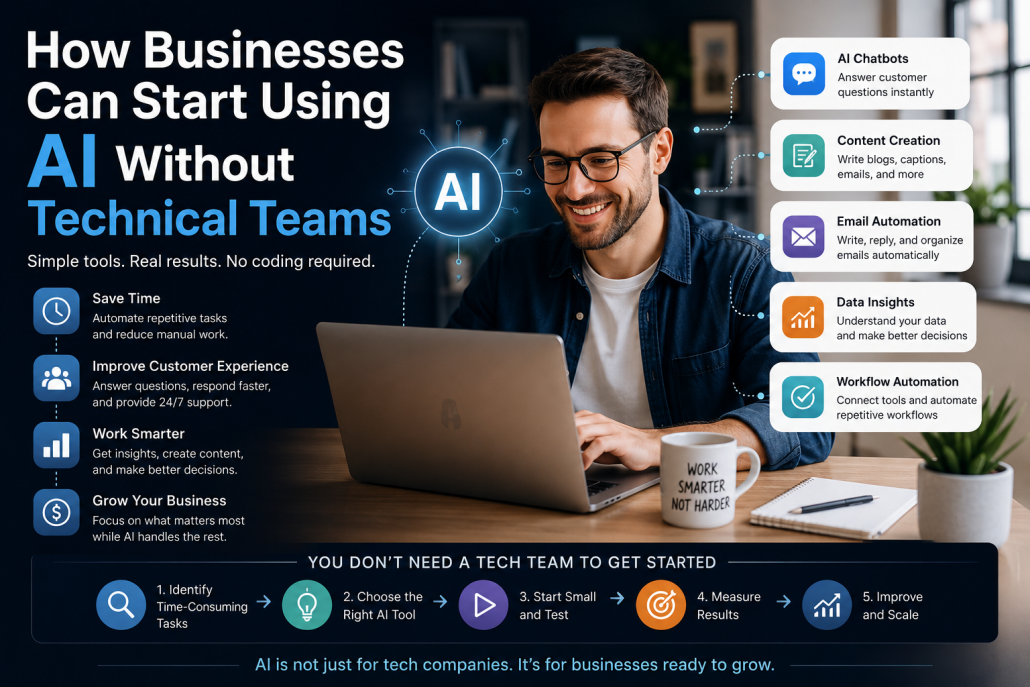
Artificial intelligence is often seen as something complex—something that belongs to large companies with engineers, data scientists, and technical departments. For many small businesses, that image creates distance. Owners often think AI is expensive, difficult, or simply “not for us.” But that is changing quickly. Today, businesses of any size can start using AI without hiring technical teams or learning how to code.

The first thing to understand is that AI is no longer just about building advanced software. In many cases, it is simply about using smart tools to save time. Think about daily business tasks: answering customer questions, writing emails, managing appointments, creating content, analyzing feedback, or organizing internal documents. These are repetitive tasks that slow teams down. AI can help automate many of them.

A good example is customer support. A small business may spend hours every week answering the same questions: What are your opening hours? Do you deliver? What are your prices? Instead of doing this manually, an AI chatbot can answer these questions instantly, day and night. This improves customer experience while freeing up time for staff to focus on more important work.

Marketing is another area where AI can make an immediate difference. Many business owners struggle to create content regularly. Writing social media posts, blog articles, product descriptions, or email campaigns takes time and energy. Tools like ChatGPT can help generate ideas, draft content, and improve writing speed. It does not replace creativity, but it gives businesses a faster starting point.

The key for beginners is to start small. This is where many businesses make mistakes. They try to automate everything at once and end up overwhelmed. A better approach is simple: choose one problem and solve it first. For example, if email management takes too much time, start there. If content creation is the problem, focus on that. Once one process improves, move to the next.

Another important point is choosing no-code tools. Many AI platforms today are designed for non-technical users. They have simple dashboards, clear instructions, and ready-made templates. Tools like ChatGPT, Canva AI, and Zapier allow businesses to use AI without touching a single line of code. This makes adoption much easier.

Of course, AI is not magic. It still needs human direction. Businesses must know their goals and understand what they want to improve. AI works best when it supports clear business needs, not when it is used just because it is trendy.

In the end, businesses do not need technical teams to begin using AI. What they need is a willingness to experiment and a clear understanding of where time is being wasted. Starting small, staying practical, and focusing on real problems can make AI one of the most valuable tools for growth. The future of business is not about replacing people—it is about helping them work smarter.