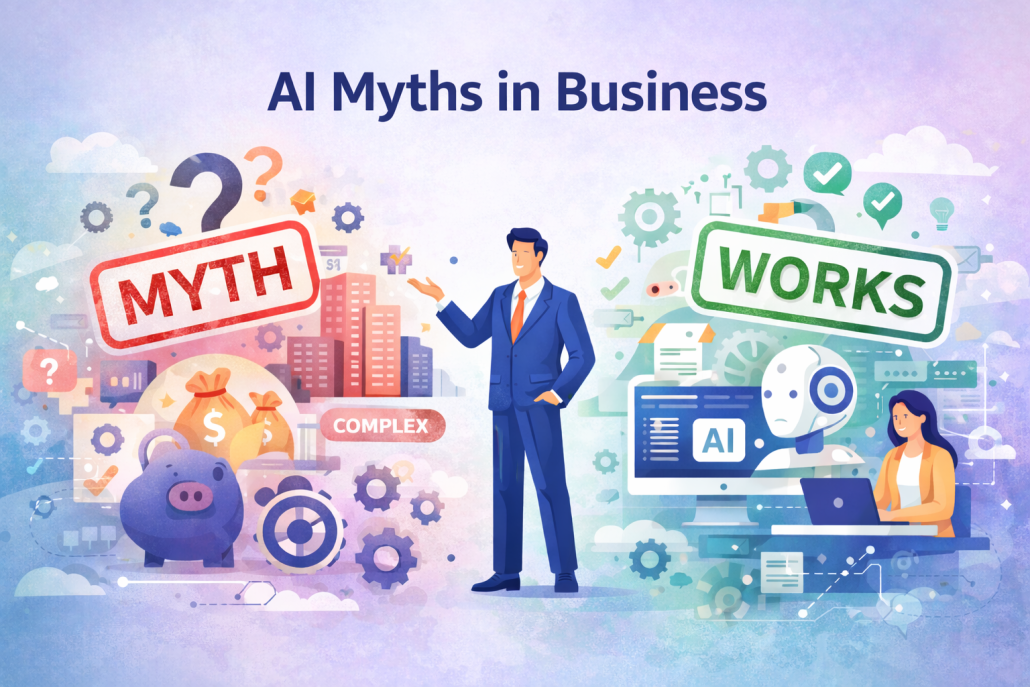
Common AI Myths in Business (and What Actually Works)
Many businesses approach AI with a mix of curiosity and hesitation,

largely because of persistent myths that distort what AI really is and

how it works in practice. One of the most common myths is that AI is

only for large corporations with massive budgets and dedicated

technical teams. This belief often stops small and mid-sized businesses

before they even start. In reality, many of today’s most effective AI

solutions are lightweight, affordable, and designed to solve very

specific problems. What actually works is starting small—using AI for

a single task such as answering customer questions, summarizing

inquiries, or automating repetitive internal work.

Another widespread myth is that AI is extremely complex and difficult

to manage. While AI can be complex behind the scenes, modern AI

tools are built to be accessible to non-technical users. Businesses do

not need to understand algorithms or machine learning models to

benefit from AI. What works instead is focusing on usability. AI

solutions that integrate smoothly into existing tools—such as websites,

email systems, or apps—deliver value without adding complexity.

When AI fits naturally into daily workflows, teams are far more likely

to trust and adopt it.

Many decision-makers also believe that AI will replace human

workers, creating fear and resistance inside organizations. This myth

causes unnecessary hesitation and internal pushback. In practice, the

AI solutions that succeed are those that support people rather than

replace them. AI works best as an assistant—handling repetitive tasks,

organizing information, or offering suggestions—while humans remain

in control of decisions and relationships. For example, AI can prepare

summaries for customer support teams, but the final response still

comes from a human. This approach increases productivity without

removing the human element.

Another misconception is that AI needs perfect data to be useful.

Businesses often assume that unless their data is clean, structured, and

complete, AI projects will fail. What actually works is using the data

that already exists and improving over time. Many AI solutions deliver

value even with imperfect data, especially when the goal is

automation, pattern recognition, or assistance rather than precision

forecasting. As AI systems are used, they naturally improve through

feedback and refinement, making data quality a process rather than a

barrier.

Some businesses also think AI is a one-time setup—something you

install, configure once, and then forget. This is another myth that leads

to disappointment. In reality, AI works best when treated as a living

system. What works is monitoring performance, reviewing results, and

adjusting the system as business needs change. Markets evolve,

customer behavior shifts, and internal processes grow. AI solutions that

are reviewed and refined over time continue to deliver value, while

static ones quickly lose relevance.

Finally, there is a myth that AI must be highly advanced to be

worthwhile. Many companies chase complex features and ambitious

use cases before mastering the basics. What actually works is

simplicity. The most successful AI projects focus on clear outcomes:

saving time, reducing manual work, improving response speed, or

helping teams make better decisions. Simple AI solutions that solve

real problems consistently outperform complex systems that look

impressive but are rarely used.

In practice, successful AI adoption is not about technology—it’s about

mindset and execution. Businesses that see AI as a practical tool rather

than a magic solution are the ones that benefit most. By starting with

clear goals, choosing simple solutions, integrating AI into existing

workflows, and improving gradually, companies can turn AI from a

source of confusion into a reliable driver of efficiency and growth.

 From Idea to Real Implementation in paragraph like human

AI for businesses usually begins with an idea rooted in a real

challenge, not in technology trends. The first step is understanding

what is not working well today—where time is wasted, customers

get confused, or decisions rely too much on guesswork. At this

stage, we translate a vague idea into a clearly defined business

problem that AI can realistically solve.

Example: A company notices that customers keep asking the same

questions by email. The idea is not “use AI,” but “reduce repetitive

support work while responding faster.”

Once the goal is clear, the next step is choosing the right AI

approach. Not every problem needs advanced models or complex

systems. Sometimes a simple AI chatbot, content generator, or

automation workflow is enough. The focus is on selecting a solution

that is reliable, easy to maintain, and understandable for the team

using it.

Example: Instead of building a complex support system, a business

starts with a chatbot trained only on its FAQ and product pages to

handle common questions.

After that comes building and integrating the solution into daily

operations. This is where the idea becomes real. The AI is

connected to existing tools such as websites, apps, email systems,

or internal databases. It is tested with real scenarios to make sure

it behaves correctly and supports users instead of creating friction.

Example: The chatbot is integrated into the website and connected

to the contact form so unanswered questions are automatically

forwarded to the support team with a summary.

Finally, real implementation means continuous improvement and

long-term value. AI is not a one-time setup. After launch, we

monitor how it is used, collect feedback, and improve its accuracy

and usefulness over time. As the business grows or changes, the AI

evolves with it.

Example: As new products are added, the chatbot is updated with

fresh content, and analytics reveal which questions customers ask

most—helping the business improve both support and product

pages.

A Practical Approach to AI Solutions for Businesses

We build practical AI solutions by focusing first on real business

needs, not on trends or buzzwords. Every project starts with a clear

understanding of how your business operates day to day—where time

is lost, where decisions are delayed, and where repetitive work slows

your team down. Instead of pushing complex or unnecessary AI, we

identify the exact point where AI can make a measurable difference,

such as improving customer communication, automating internal tasks,

generating content, or turning data into clear insights.

Once the problem is clearly defined, we select the right AI approach

for the job. This may involve chatbots trained on your own content,

workflow automation connected to your existing tools, AI-assisted

content creation, or analytics systems that highlight patterns and

opportunities. Our goal is always simplicity and reliability. The

solution must be easy to use, easy to maintain, and understandable by

non-technical users inside your organization.

We then move into design and integration, making sure the AI fits

naturally into your current website, app, or internal systems. We

integrate with tools you already use—such as email, CRM, forms,

databases, or mobile apps—so the AI becomes part of your workflow

rather than an extra layer of complexity. Throughout this phase, we test

the system with real scenarios to ensure it behaves correctly, produces

useful results, and supports your business processes instead of

disrupting them.

Finally, we focus on long-term value and improvement. After

deployment, we monitor how the AI is used, gather feedback, and fine-

tune the system over time. As your business grows or changes, the AI

can be adjusted and expanded accordingly. Our approach ensures that

the AI solution delivers continuous value, reduces manual effort,

improves decision-making, and remains aligned with your business

goals—not just at launch, but well into the future.

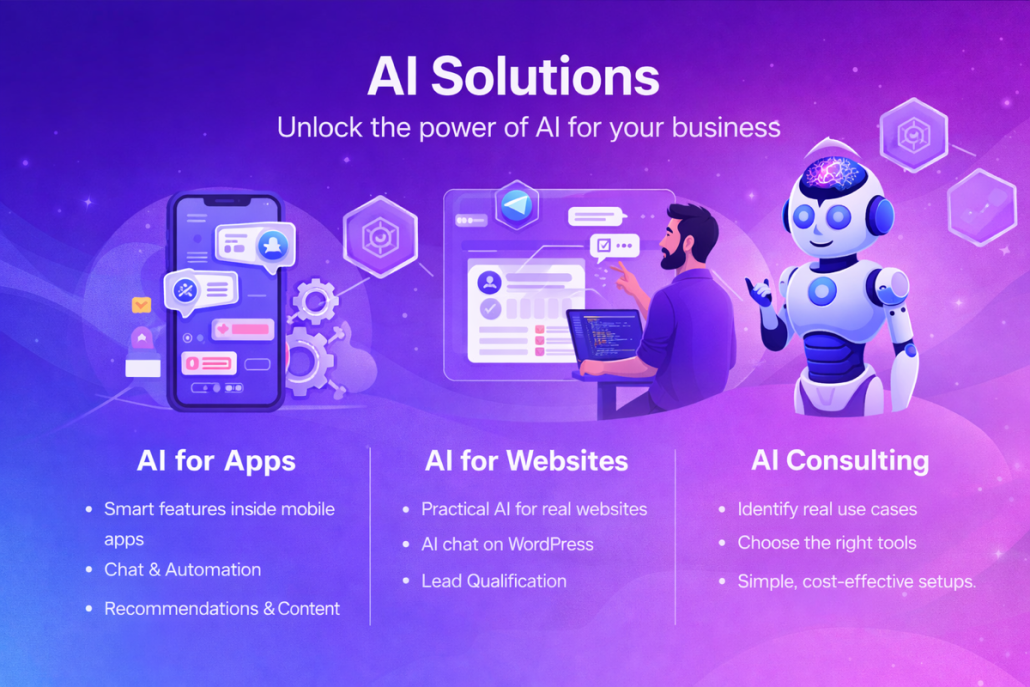
AI Solution

AI Solutions help businesses use artificial

intelligence in a practical and meaningful way.

Instead of focusing on tools or buzzwords, the goal

is to solve real problems—such as automating

repetitive tasks, improving customer interactions,

and making apps or websites more efficient.

Whether it’s adding smart features to a mobile app,

integrating AI-driven chat and lead qualification on

a website, or advising on where AI actually makes

sense, the focus is always on clear outcomes: saving

time, reducing costs, and supporting long-term

growth with simple, maintainable solutions.

Comprehensive App Distribution and Release Strategy for the App Store

his document has been prepared by the Release Strategy Team as the final protocol for managing distribution, pricing, and launch logistics within the Apple ecosystem. Our goal is to transform a technical Xcode project into a powerful commercial product—one that goes beyond technical standards and performs at the highest level in both business impact and user experience.


1. Strategic Foundations of Metadata and Brand Identity

(Metadata & Brand Identity)

From a strategist’s perspective, metadata is not merely a set of informational fields; it is the first cornerstone of App Store Optimization (ASO) and the foundation of your brand identity. Precision in this area directly drives visitor-to-user conversion rates.

Title and Subtitle Optimization

App naming must follow a brand-protection mindset. The app name must be globally unique within App Store Connect; if a name has already been reserved by another developer, Apple will not permit its use.

The subtitle should communicate the core value proposition in the shortest possible time.

Visual Asset Management

To gain the trust of professional users, leveraging the full capacity of 10 screenshots is strongly recommended. Strategically, at least one App Preview video should be uploaded to capture user attention within the first three seconds.

If the app supports iPad or Apple Watch, providing platform-specific visual assets is essential to maintain brand prestige.

Dynamic Text Strategy

Developers must clearly understand the functional difference between Promotional Text and Description.

Promotional Text is the only section that can be edited at any time without submitting a new app version—making it a critical tool for rapid marketing campaigns.

In contrast, changes to the Description or Keywords require submitting a new update.

Keyword Management

Within the 100-character keyword limit, every character is valuable. Separate keywords with commas without spaces to preserve maximum space for strategic terms.

Strategic Insight (Why it matters)

Precise copyright handling (e.g., inserting the © symbol using Option+G) and selecting a unique app name send strong signals of professionalism to Apple’s review team. This technical rigor minimizes rejection risk and prevents future legal conflicts.

Transition

Once brand identity is established, the next step is defining the app’s geographic reach and hardware boundaries.


2. Platform Distribution and Regional Availability

(Global Reach & Platform Scope)

Presence across Apple’s hardware ecosystem is the key to business scalability. A strategist must deliberately decide where the app should operate within Apple’s hardware landscape.

Distribution on New Hardware Generations

By default, distribution options for Apple Silicon Macs and Apple Vision Pro are enabled. Strategically, keeping these options active allows cost-free entry into the emerging Spatial Computing market—unless specific technical limitations prevent proper functionality.

Global Availability Management

The app may be released worldwide or restricted to selected regions based on market analysis, support capacity, and local regulatory requirements.

Distribution Methods

  • Public Distribution: The standard approach for mass-market user acquisition.
  • Private Distribution: Via Apple Business Manager or School Manager, suitable for apps developed exclusively for internal use or specific organizations.

Strategic Insight (Why it matters)

Simultaneous availability on iPhone, iPad, and Vision Pro embeds the app deeply into the user’s digital ecosystem, expanding its value across all major Apple platforms.

Transition

With hardware scope defined, attention shifts to revenue architecture and monetization strategy.


3. Pricing Architecture and Subscription Models

(Pricing Architecture & Subscriptions)

Pricing is a positioning tool. Selecting the right price tier must align with target market expectations and the value delivered.

Price Schedule Configuration

Apps can be offered as Free or assigned to specific pricing tiers. Prices should be regionally adjusted to reflect local purchasing power.

Category Selection and ASO

Choosing the correct Primary and Secondary categories has a direct impact on discoverability and ranking. Smart categorization places the app in front of more qualified users.

Advanced Subscription Management

For revenue sustainability, using an App-Specific Shared Secret is mandatory—especially when relying on third-party subscription services. This security key acts as the bridge between your servers and Apple’s systems.

Age Rating

This step goes beyond a simple form. Mismatches between actual content and the selected age rating are among the most common causes of late-stage rejections.

Strategic Insight (Why it matters)

A flexible pricing strategy combined with accurate categorization smooths user acquisition across diverse markets and reduces rejection risk due to content misalignment.

Transition

Once the business model is finalized, all technical and security pathways must be cleared for App Review.


4. Technical Readiness, Security, and Review Protocols

(Technical Readiness & Review)

Technical transparency with Apple’s App Review Team minimizes review time (typically 2–3 days). Any ambiguity at this stage results in lost launch momentum.

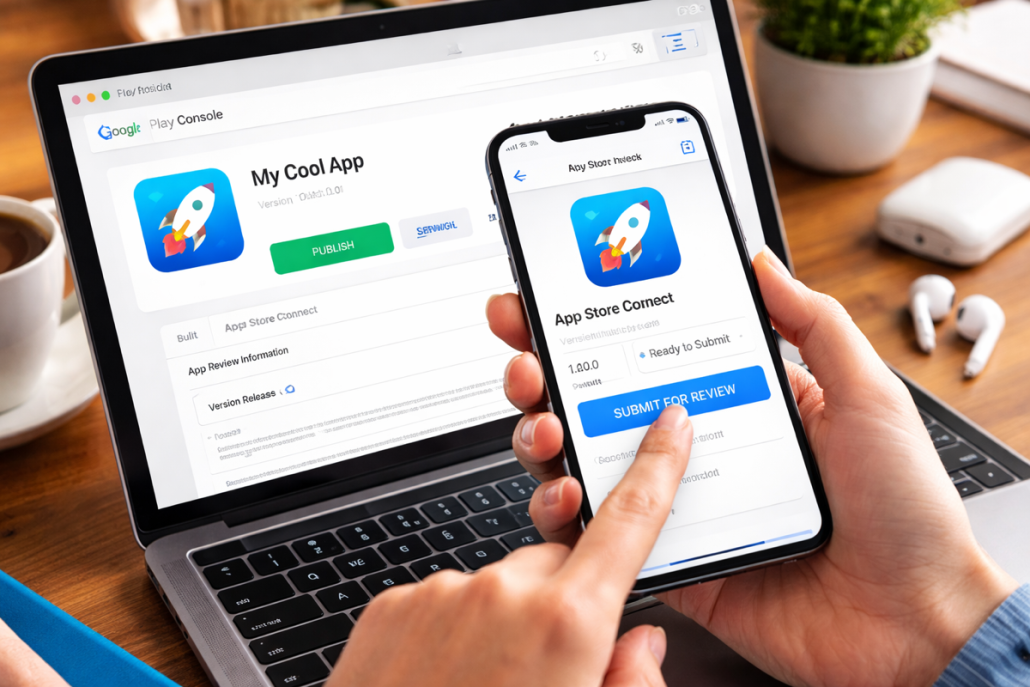
Critical Version Matching

A strict requirement applies: the version number in App Store Connect (e.g., 1.0.1) must exactly match the version defined in the Xcode project. Any discrepancy can lead to processing delays or system errors.

Build and Icon Management

After a successful upload, app icons are automatically extracted from the build. Ensuring that all required icon sizes are properly configured in Xcode is mandatory.

Reviewer Access Protocols

If the app requires authentication, providing a test (dummy) account is essential.

Special Note

If Sign in with Apple is the only authentication method, enter dummy / dummy in the access field and clearly explain in the Notes section that the app relies on Apple’s authentication system.

Additional explanations of complex app features in the Notes section can significantly accelerate the review process.

Encryption Documentation

If any form of custom encryption is used, submitting the appropriate Encryption Documentation is mandatory to comply with software export regulations.

Strategic Insight (Why it matters)

Attention to technical detail and frictionless reviewer access dramatically reduce repeated rejections and strengthen the developer’s credibility with Apple.

Transition

With technical validation complete, the final strategic decision concerns precise control over launch timing.


5. Release Strategy and Final Launch Control

(Release Triggers & Launch Control)

The release moment must align with peak marketing activity. Choosing the correct release mechanism separates a successful launch from a silent one.

Release Mechanisms

Automatic Release

  • Publishes immediately after Apple approval
  • Best suited for bug fixes or low-profile releases

Manual Release

  • Publication is held until the developer triggers it
  • Strategic recommendation: Ideal for full alignment with marketing campaigns

Scheduled Release

  • Publishes at a specific date and time (not earlier)
  • Best for coordinated global launches tied to events

Final Pre-Submission Checklist (Add for Review)

  • Xcode version matches App Store Connect (e.g., 1.0.1)
  • All 10 screenshots uploaded, including iPad/Watch assets
  • Contact details and demo account (or Sign in with Apple note) provided
  • Primary and Secondary categories selected for ASO
  • All metadata changes saved

Strategic Insight (Why it matters)

Manual Release gives product leaders full control to ensure backend infrastructure and marketing campaigns are fully ready before triggering global publication.


Final Statement

This distribution strategy transforms an application from a technical codebase into a globally scalable commercial product, fully prepared to compete in the world’s most demanding app marketplace.

Comprehensive App Store Distribution and Release Strategy

Comprehensive App Store Distribution and Release Strategy

This document has been prepared by the Release Strategy Team as the final protocol for managing distribution, pricing, and launch logistics within the Apple ecosystem. Our objective is to transform a technical Xcode project into a strong commercial product—one that not only meets technical requirements, but also excels in business positioning and user experience.

⸻

1. Strategic Foundations of Metadata and Brand Identity

(Metadata & Brand Identity)

From a strategist’s perspective, metadata is not just a set of information fields; it is the first cornerstone of App Store Optimization (ASO) and the foundation of your brand identity. Precision here directly impacts visitor-to-user conversion rates.

Title and Subtitle Optimization

App naming must follow a brand-protection mindset. The app name must be globally unique in App Store Connect—if another developer has already reserved it, Apple will not allow its use.

The subtitle should communicate the core value proposition as quickly and clearly as possible.

Visual Asset Management

To build trust with professional users, using the full capacity of 10 screenshots is strongly recommended. Strategically, at least one App Preview video should be uploaded to capture user attention within the first three seconds.

If the app supports iPad or Apple Watch, providing platform-specific visual assets is essential to maintain brand prestige.

Dynamic Text Strategy

Developers must understand the functional difference between Promotional Text and Description.

Promotional Text can be edited at any time without submitting a new version—making it a critical tool for short-term marketing campaigns.

In contrast, changes to the Description or Keywords require a new app update.

Keyword Management

Within the 100-character keyword limit, every character matters. Separate keywords with commas without spaces to maximize usable capacity.

Strategic Insight (Why it matters)

Precise copyright usage (e.g., inserting the © symbol via Option+G) and a unique app name signal professionalism to Apple’s review team. This attention to detail reduces rejection risk and prevents future legal conflicts.

Transition

Once brand identity is established, the next step is defining the app’s geographic and hardware boundaries.

⸻

2. Platform Distribution and Regional Availability

(Global Reach & Platform Scope)

Presence across Apple’s hardware ecosystem is key to business scalability. Strategically, you must decide where your app should operate within Apple’s hardware “ocean.”

Distribution on New Hardware Generations

By default, distribution for Silicon Macs and Apple Vision Pro is enabled. Strategically, leaving these options active allows cost-free entry into the emerging Spatial Computing market—unless technical limitations prevent proper functionality.

Global Availability Management

The app can be released worldwide or restricted to selected regions based on market analysis, support capacity, and local legal requirements.

Distribution Methods

• Public Distribution: Standard approach for mass-market reach.

• Private Distribution: Via Apple Business Manager or School Manager, suitable for internal or enterprise-only apps.

Strategic Insight (Why it matters)

Simultaneous presence on iPhone, iPad, and Vision Pro embeds the app deeply into the user’s digital life, expanding its value across platforms.

Transition

With hardware scope defined, the next step is designing the revenue and pricing architecture.

⸻

3. Pricing Architecture and Subscription Models

(Pricing Architecture & Subscriptions)

Pricing is a positioning tool. Selecting the right price tier must align with both market expectations and delivered value.

Price Schedule Configuration

Apps can be set as Free or assigned to specific pricing tiers. Prices should be adjusted regionally to reflect local purchasing power.

Category Selection and ASO

Choosing the correct Primary and Secondary categories directly affects discoverability. Smart category selection places the app in front of more relevant users.

Advanced Subscription Management

For sustainable revenue, using an App-Specific Shared Secret is mandatory—especially when third-party subscription services are involved. This key acts as the secure bridge to Apple’s servers.

Age Rating

This is more than a formality. Mismatches between actual content and selected age rating are among the most common reasons for last-stage rejections.

Strategic Insight (Why it matters)

Flexible pricing and accurate categorization smooth user acquisition across markets and reduce rejection risks related to content compliance.

Transition

With the business model finalized, all technical and security paths must be cleared for App Review.

⸻

4. Technical Readiness, Security, and Review Protocols

(Technical Readiness & Review)

Clear technical communication with Apple’s App Review Team minimizes review time (typically 2–3 days). Any ambiguity here results in lost launch momentum.

Critical Version Matching

The version number in App Store Connect (e.g., 1.0.1) must exactly match the version defined in Xcode. Any mismatch can cause processing errors or delays.

Build and Icon Management

After upload, icons are extracted automatically from the build. Ensuring all required icon sizes exist in Xcode is mandatory.

Reviewer Access Protocols

If login is required, providing a test (dummy) account is essential.

Special Case: Sign in with Apple Only

If Apple Sign-In is the sole authentication method, enter dummy / dummy in the access field and clearly explain in the Notes section that authentication relies on Apple’s system.

Any additional explanations of complex features in the Notes section significantly accelerate review.

Encryption Documentation

If custom encryption is used, submitting the required Encryption Documentation is mandatory to comply with export regulations.

Strategic Insight (Why it matters)

Attention to technical detail and frictionless test access dramatically reduce repeated rejections and strengthen the developer’s credibility with Apple.

Transition

With technical approval secured, the final strategic decision concerns launch timing control.

⸻

5. Release Strategy and Final Launch Control

(Release Triggers & Launch Control)

Launch timing must align with peak marketing activity. Choosing the right release mechanism separates a strong launch from a silent release.

Release Mechanisms

• Automatic Release

Publishes immediately after Apple approval.

Best for: Hotfixes or low-profile updates.

• Manual Release

Holds publication until the developer triggers it.

Strategic recommendation: Best choice for full marketing alignment.

• Scheduled Release

Publishes at a specific date and time.

Best for: Coordinated global launches tied to events.

Final Pre-Submission Checklist (Add for Review)

• Xcode version number matches App Store Connect (e.g., 1.0.1)

• All 10 screenshots uploaded, including iPad/Watch assets

• Contact info and demo account (or Apple Sign-In note) provided

• Primary and Secondary categories selected for ASO

• All metadata changes saved

Strategic Insight (Why it matters)

Manual Release gives product leaders full control to ensure backend systems and marketing campaigns are fully ready before global publication.

⸻

Final Statement

This distribution strategy transforms an app from a technical codebase into a globally competitive commercial product, ready to perform in the world’s most demanding app marketplace.

Comprehensive and Practical Guide to App Monetization Strategies: From Implementation to Sustainable Growth

In today’s dynamic market—where the global app industry has

surpassed $430 billion annually—choosing a monetization model is

no longer a simple business decision; it is a strategic necessity for

economic survival. Although most apps are offered for free, achieving

sustainable success in this red ocean requires precise engineering of

revenue streams that not only ensure cash flow but also enhance the

user experience.


1. Strategic Monetization Framework and User Lifetime Value (LTV)

App monetization is the process of extracting economic value from

users, primarily after installation. From a systems-architecture

perspective, the most critical metric for ensuring profitability is

Lifetime Value (LTV). Executive leadership must shift focus away

from short-term revenue and toward system design aligned with LTV

to secure long-term, profitable user base growth.

Market-wide data analysis of the $430B revenue share shows that

monetization strategies must be inseparably aligned with user

retention. Without retention, monetization potential effectively drops

to zero. This macro-level business architecture perspective forms the

foundation for examining the world’s most lucrative execution model:

in-app purchases.


2. In-App Purchase (IAP) Strategy: Virtual Goods Modeling

The in-app purchase model is the engine of the mobile economy,

accounting for 47% of global industry revenue (including

subscriptions). By creating purchase opportunities at key interaction

moments, IAPs offer unmatched potential to deepen user–product

relationships.

Operational Segmentation of IAP Products:

  • Consumables: Items that can be purchased repeatedly, such as
  • coins in Pokémon GO, tickets, or extra lives in games.
  • Non-consumables: One-time, permanent purchases, such as
  • unlocking advanced features in a productivity app or new levels in
  • a game.

UX execution in this area requires eliminating all friction from the

payment flow. The gold standard is frictionless payment, exemplified

by apps like Uber, where card-on-file enables payments in seconds.

Intelligent use of in-app messages and timely notifications for limited

offers significantly boosts conversion rates.

Operational success dictates that users must experience the app’s value

and enjoyment before encountering purchase prompts, ensuring

retention is not compromised. Once one-off purchases are optimized,

the next step is engineering continuous cash flow through

subscriptions.


3. Subscription and Freemium Models: Engineering Predictable Cash Flow

The $18 billion subscription market is ideal for services that deliver

continuous value. This structure enables predictable revenue streams

and serves as the financial backbone for content-driven apps like Calm

and fitness platforms.

Subscription Structures:

  • Auto-renewable subscriptions: Recurring, automated payments
  • for unlimited access.
  • Non-renewing subscriptions: Time-limited access (e.g., seasonal passes).

In the freemium model, the goal is to convert free users into premium users by proving value. Calm has perfected this

approach by offering partial free content combined with smart upgrade prompts. Market penetration strategies require free

trials and ultra-fast onboarding to minimize entry barriers.

Sustainability depends on continuously delivering exclusive content and regular updates that justify recurring payments. For

users resistant to direct payment, advertising-based models become necessary.


4. In-App Advertising (IAA): Optimizing Ad Inventory

In-app advertising holds massive potential in developed markets; in

North America, users spend 88% of their mobile time inside apps.

Strategic placement and precise timing are key to converting this time

into revenue.

Managing Ad Formats and Preventing Ad Fatigue:

  • Banner Ads: Use smart refresh rates and creative rotation to avoid fatigue.
  • Interactive Videos: Apply frequency capping and display ads only
  • at logical breakpoints (e.g., end of a level).
  • Native Ads: Success depends on seamless visual integration and content continuity.

IAA architecture requires partnerships with reliable ad networks to

ensure high fill rates and advanced analytics. Continuous monitoring

of user interaction and persistent A/B testing help determine the

optimal ad volume without causing user churn. Alongside these

methods, the classic paid-download model still holds relevance for

strong brands.


5. Paid Downloads and Brand Equity

With a 1% market share (~$5 billion), paid downloads are a niche

strategy suitable only for apps with unique value propositions or strong

brand credibility. The massive success of Minecraft, with over 140

million monthly active users, demonstrates this model’s potential when

exceptional value exists.

Operational Requirements for Paid Models:

  • App Store Optimization (ASO): Store listings must be
  • conversion-focused from the first visit.
  • Free Trials: Offering trials lowers the psychological barrier to purchase.
  • Reputation and Feedback Management: Paying users heavily
  • rely on reviews; active strategies for collecting positive feedback are essential.
  • Pre-purchase Buzz: Leveraging influencers and video platforms
  • reduces perceived purchase risk.

Long-term justification of upfront payment requires continuous

improvement based on user feedback. Still, maximum revenue

potential is achieved through a hybrid approach.


6. Hybrid Monetization Strategy: Managing Whales and Regular Users

Hybrid models eliminate single-source revenue risk by monetizing

100% of the user base. They allow revenue extraction from both the

5–10% of paying users and the non-paying majority.

A key tactic here is downselling: if a user rejects an IAP offer, the

system should redirect them to a rewarded video. Segmented user

management requires premium offers for whales (high-spending,

highly engaged users) while prioritizing IAA for regular users.

Maintaining overall experience quality is non-negotiable. Finding the

balance between IAP and IAA requires continuous experimentation

using real user data.


7. Final Implementation and Monitoring Checklist

Monetization model selection must align with product nature and

audience behavior. Monetization success is not a one-time event—it is

an iterative optimization process.

Action Plan:

  • Prioritize UX and retention: Ensure strong retention and user
  • satisfaction before activating monetization engines.
  • Simplify conversion paths: Make payments frictionless and ideally one-click.
  • Continuously optimize content: Treat exclusive and fresh content as an ongoing operational duty in subscription models.
  • Multi-format testing: Continuously test ad formats and pricing strategies to find optimal combinations.
  • Analytics integration: Deploy robust analytics to track real-time interaction with monetization surfaces.
  • Competitive analysis and feedback loops: Use market data and
  • direct user feedback to refine strategy continuously.

Sustained optimization of an app’s digital real estate—combined with

precise measurement tools—is the only path to becoming one of the

winners in the $430 billion app industry.

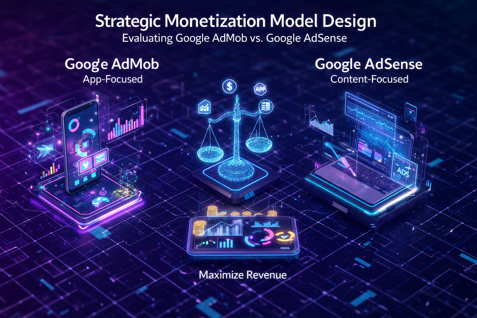
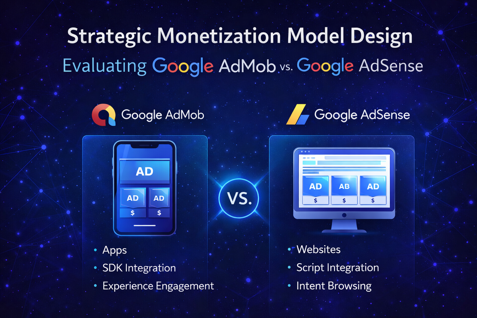
Strategic Monetization Model Design: Evaluating Google AdMob vs. Google AdSense

1. Strategic Framework and Introduction

Selecting an advertising platform is not merely a technical decision

 made at the end of the development pipeline; it represents the fiscal

 foundation and the primary determinant of unit economics in digital

 projects. This choice dictates both the technical architecture and the

 medium- to long-term growth strategy of the business. Ignoring the

 structural differences between these two platforms introduces

 significant risk to return on investment (ROI) and can lead to lock-in

 within inefficient monetization models.

The strategic objectives of this document are:

• Reengineering revenue streams based on the type of digital asset

 (App vs. Web).

• Maximizing Digital ARPU (Average Revenue Per User) through

 optimal platform selection.

• Evaluating the scalability of advertising infrastructure to support

 high-traffic volumes.

Understanding the distinction between content-centric and

 application-centric models is a strategic necessity. This distinction

 directly impacts the product lifecycle, as user acquisition (UA) models

 and retention costs differ fundamentally between applications and

 content platforms. The following sections provide a deep analysis of

 these two monetization poles.

⸻

2. In-Depth Analysis of Google AdMob: Focus on the App Economy

Google AdMob is not merely an ad network; it is a specialized

 ecosystem designed for app publishers, built on experience-based

 engagement. Unlike the web, the focus here is on retaining users

 within a controlled environment.

Strategic Capabilities of AdMob:

• SDK-based integration: Unlike web-based script integrations, AdMob

 operates through SDKs embedded within the application layer,

 enabling deeper interaction and greater technical stability.

• Granular targeting: By analyzing behavioral data, AdMob serves ads

 to users with the highest engagement potential, directly improving

 eCPM (effective cost per thousand impressions).

• Synergy with Firebase and Google Analytics: This integration is not

 merely technical; it is essential for calculating LTV (Lifetime Value).

 For investors and C-level stakeholders, accurate LTV tracking through

 Firebase forms the backbone of marketing budget allocation

 decisions.

The “So What?” Layer

Due to its application-centric nature, AdMob benefits from high DAU

 (Daily Active Users), offering significantly greater revenue potential

 than web platforms. Monetization in this model is driven by user

 engagement with tools or games. Failing to use AdMob in native

 applications means forfeiting a critical opportunity to optimize ROI

 through behavioral data.

⸻

3. In-Depth Analysis of Google AdSense: Focus on the Content

 Ecosystem

Google AdSense forms the backbone of web monetization models and

 operates on intent-based browsing. Value is created through

 information delivery, and advertising must complement the content

 flow.

Revenue Share Model

Google acts as a revenue partner, sharing income generated from

 clicks and impressions with content owners. This model is ideal for

 blogs, news sites, and YouTube channels.

Critical Limitation (E-commerce Exclusion)

According to Google standards, AdSense is not designed for e-

commerce or online stores. Its focus is on content-producing assets,

 not direct product sales.

Contextual Ad Formats

AdSense offers diverse formats that integrate seamlessly with content

 (native ads), minimizing disruption to user experience.

The “So What?” Layer

Strategic success with AdSense depends on balancing content

 production costs against advertising revenue. Low traffic is fatal in

 this model. Unlike applications—where fewer users with high

 engagement may still generate revenue—AdSense is highly dependent

 on scale and high-value keywords.

⸻

4. Comparative Evaluation and Revenue Model Analysis

For senior decision-makers, aligning asset type with platform choice is

 the most critical action. Misusing a platform (e.g., deploying AdSense

 within complex web apps) results in poor yield and degraded user experience.

Strategic Comparison Table

Evaluation Criteria Google AdMob Google AdSense

Target Asset Type Native mobile apps (iOS/Android) Content websites,

 blogs, YouTube

Technical Basis SDK integration Script integration

User Behavior Experience-based engagement Intent-based browsing

Revenue Potential Very high (DAU & impressions dependent)

 Moderate (CTR & keyword value dependent)

Key KPI Retention & impressions Content relevance & CTR

Strengths and Weaknesses

Google AdMob

• Strengths: High scalability, strong LTV tracking via Firebase, OS-level

 targeting.

• Weaknesses: Limited exclusively to app environments; ineffective on

 the open web.

Google AdSense

• Strengths: Access to the largest web advertiser network, rapid

 deployment on content platforms.

• Weaknesses: Highly sensitive to traffic volume; unsuitable for e-

commerce models.

⸻

5. Decision Roadmap and Long-Term Scalability

Business sustainability requires aligning digital assets with future

 growth objectives.

Decision Logic Guidelines:

• If your product is a mobile app: Choose AdMob immediately. Its SDK-

centric architecture is essential for optimizing mobile monetization

 and behavioral analytics.

• If your product is a content platform, blog, or YouTube channel:

 AdSense is the standard choice. However, if your site is an e-

commerce store, alternative monetization models must be explored.

Strategic Warning

Using AdSense for app-like experiences (e.g., complex web apps)

 typically results in low CTR and poor financial performance due to the

 lack of native integration.

Final Recommendations for Scalability:

• Prioritize traffic growth: Neither platform performs well at low scale.

 Focus on audience acquisition before ad optimization.

• Continuously monitor ARPU: Track revenue per user to ensure

 financial health against server and maintenance costs.

• Leverage analytics: In AdMob-based models, use Firebase data to

 personalize user experiences and extend session duration.

Final Statement

Precise alignment between platform and digital asset type is the

 primary lever for maximizing Digital ARPU and ensuring financial

 sustainability. Choosing the correct platform is not a technical

 preference—it is a strategic necessity for scalable growth in today’s

 competitive ecosystem.

App Release & Compliance Guide (2025)

1. Introduction: The Paradigm Shift in App Store Acceptance Standards (2025)

In the hyper-competitive landscape of 2025, success on the App Store

is no longer merely a technical achievement; it is the result of a

cohesive pre-submission strategy. You must understand that Apple has

adopted an extremely strict—and unapologetically ruthless—approach

toward unfinished or insufficiently polished applications. Passing

Apple’s review process requires a precise combination of legal

transparency, absolute respect for user privacy, and visual excellence.

Conscious preparation before pressing the submit button is the only

way to avoid exhausting rejection cycles and to preserve your brand’s

credibility.

Strategic Impact Analysis

Apple’s strictness is rooted in protecting its ecosystem and user

experience. Submitting an application with visual or technical flaws is

a strategic error that signals a lack of professionalism to Apple. When

an app is rejected due to basic issues, you not only lose valuable time-

to-market but also weaken reviewer confidence in future submissions.

In 2025, Apple leaves no room for trial and error in the live App Store

environment.

Technical stability is the cornerstone of this roadmap; without a solid

foundation, even the best metadata will not prevent rejection.

⸻

2. Technical Quality Assurance and Final Testing (Technical Polishing)

Relying on emulators is entirely insufficient for 2025 standards and

represents a major risk. You are required to test your application under

real-world conditions and on a range of physical devices. The

objective at this stage is to identify and resolve bugs that do not appear

in isolated development environments.

Operational Directive: Testing and Quality Checklist

• Testing on physical devices: Use TestFlight to evaluate performance

across multiple iPhone and iPad models.

• Edge-case coverage: Carefully examine app behavior under

conditions such as network loss, low memory, and interaction with

other system features.

• “Try-to-break-it” strategy: Ask testers and beta teams to challenge the

app using unconventional behaviors.

• Fix all identified bugs: Before submission, every technical issue—no

matter how minor—must be resolved. Apple allows no exceptions.

Deep Analysis: Why Reviewers Act Faster Than You

Apple reviewers are specialists with extensive institutional knowledge,

having seen recurring failure patterns across thousands of apps. They

are trained to identify edge cases developers often overlook. Rejection

due to basic bugs results in an instant rejection, imposing significant

operational costs on the team. Technical stability is the first trust test

between you and Apple.

Once code stability is ensured, attention must shift to the storefront

that reflects the product’s internal quality.

⸻

3. Metadata Optimization and Storefront Strategy (Metadata & Visual Strategy)

Metadata is the first point of contact between your product and both

reviewers and users. Even minor inconsistencies can lead to approval

delays or immediate rejection. Your storefront must go beyond listing

features and focus on problem-solving.

App Store Metadata Acceptance Standards (2025)

Screenshots

Must be high-resolution and correctly sized. Reusing outdated

screenshots after UI changes is strictly prohibited.

Preview Videos

Should be short, clear, and focused on demonstrating core

functionality, without misleading promotional content.

App Name and Keywords

Must be accurate, relevant, and non-repetitive. Keyword

inconsistencies lead to approval delays.

Category and Support URLs

Correct category selection and a valid, active support URL are mandatory.

Description

Avoid a robotic tone; focus on how the app solves user problems and

delivers real value.

Value Justification Analysis

Your app description should not simply copy and paste a feature list.

To build trust and increase conversion, you must speak directly to

users—explaining why the app exists and how it makes their lives

easier. A problem-solving focus differentiates your brand and

strengthens Apple’s confidence in approving the app.

Visual appeal and accurate metadata are operationally meaningless

without strict privacy compliance.

⸻

4. Privacy Justification Strategy and Access to Sensitive Data

In 2025, privacy is not an option—it is a fundamental right that Apple

rigorously protects. Any access to user data (camera, location,

contacts, etc.) must have a clear, logical, and user-friendly justification.

Operational Directive: Writing Privacy Justifications

Unlike previous years, you must explain the reasons for accessing

sensitive data not only in technical metadata but also clearly in the App

Store description:

• Location: Explain how location access benefits the user (e.g.,

navigation or local services).

• Camera & Microphone: Clearly state that access is required for

essential functions (such as document capture or voice

communication).

• Health Data: If using HealthKit, specify exactly how the data

supports user health insights.

Privacy Philosophy Layer

Requesting unnecessary permissions is a strategic error that leads to

rejection. Only request data essential to core functionality.

Transparency here is the foundation of trust.

After clarifying data usage, the next step is proving legal ownership

and brand identity.

⸻

5. Legal Compliance and Brand Ownership Verification

One guaranteed reason for app rejection is a mismatch between the

developer account name and the app’s brand. If the app represents a

company, it must be submitted through that company’s business

developer account.

Legal Documentation and Preventive Measures

• Identity alignment: The developer name and app brand must fully

match. Otherwise, prepare legal documentation (contracts, company

registration, trademarks) in advance.

• Documentation readiness: Have proof of brand ownership ready

before submission to immediately respond to reviewer requests and

avoid review delays.

• Policy updates: Apple’s policies evolve rapidly. You must regularly

review Apple Developer Program updates, as rules valid last month

may cause rejection today.

A successful submission is only the beginning; long-term survival

depends on intelligent post-launch management.

⸻

6. Post-Launch Management and Stability (Post-Launch Compliance)

A successful app in 2025 is a living product, not a static release. Apple

deprioritizes stagnant apps and may remove them from search

prominence.

Operational Guidelines to Maintain Momentum

• Monitoring as an early-warning system: User reviews are often the

first place overlooked bugs appear. Treat them as early alerts.

• Human presence and trust: Respond promptly and respectfully—

especially to negative reviews. Showing that a real human cares

significantly increases trust and user loyalty.

• Continuous updates: Improve performance, fix bugs, and introduce

new features to keep the app alive.

Final Note

Remember that launching is a learning curve. Rejection is not personal

—it is strategic feedback. App Store success emerges from the

intersection of flawless engineering, legal clarity, and genuine trust

with users.

omprehensive Compliance Program and App Store Release Roadmap (2025 Edition)

Comprehensive Compliance Program and App Store Release Roadmap (2025 Edition)

1. Introduction: The Paradigm Shift in 2025 Review Standards

In the ultra-competitive landscape of 2025, success on the App Store is no longer merely a technical achievement—it is the result of a coherent pre-submission strategy. You must understand that Apple has adopted an extremely strict and ruthless stance toward incomplete or “unpolished” applications this year. Passing Apple’s review process requires a precise combination of legal transparency, absolute respect for user privacy, and visual perfection. Conscious preparation before pressing the submit button is the only way to avoid exhausting rejection cycles and to protect your brand credibility.

An analysis of the strategic impact of Apple’s strictness shows that it is rooted in protecting the ecosystem and user experience. Submitting an app with visual or technical flaws is a strategic mistake that signals a lack of professionalism to Apple. When an app is rejected for basic issues, you not only lose time-to-market but also damage reviewer trust for future versions. In 2025, Apple has left no room for trial and error in the live App Store environment.

Technical stability is the cornerstone of this roadmap; without a solid foundation, even the best metadata will not prevent rejection.


2. Technical Quality Assurance and Final Testing (Technical Polishing)

Relying on emulators is absolutely insufficient for 2025 standards and represents a major risk. You are required to test your app in real-world conditions and on physical devices. The goal at this stage is to identify and fix bugs that do not appear in isolated development environments.

Operational Directive: Testing & Quality Checklist

  • Testing on physical devices: Use TestFlight to verify performance across different iPhone and iPad models.
  • Edge-case coverage: Carefully test behavior during network loss, low memory conditions, and system feature conflicts.
  • “Try to break it” strategy: Ask testers and beta teams to challenge the app with unconventional usage patterns.
  • Fix all identified bugs: Before submission, every issue—no matter how minor—must be resolved. Apple allows no exceptions.

Deep Analysis: Why reviewers are faster than you

Apple reviewers are specialists with institutional knowledge who have seen recurring failure patterns across thousands of apps. They are trained to identify edge cases that developers often overlook. Rejection due to basic bugs leads to an instant rejection, imposing significant operational costs on the team. Technical stability is the first trust test between you and Apple.

Once code stability is ensured, focus shifts to the storefront—the public reflection of your product’s internal quality.


3. Metadata Optimization and Storefront Strategy (Metadata & Visual Strategy)

Metadata is the first point of contact for both reviewers and users. Even the smallest inconsistency can cause approval delays or immediate rejection. Your storefront must go beyond listing features and clearly communicate problem-solving value.

Metadata Acceptance Standards (2025 Edition)

  • Screenshots: Must be high-resolution and correctly sized. Reusing old screenshots after UI changes is strictly prohibited.
  • Preview videos: Short, clear, and focused on real feature demonstrations; no misleading promotional content.
  • Name & keywords: Accurate, relevant, and non-repetitive. Keyword inconsistencies cause review delays.
  • Category & support URLs: Precise category selection and an active, valid support URL are mandatory.
  • Description: Avoid robotic language; focus on user problems and real value delivered by the app.

Value Justification Analysis

App descriptions should not be a copy-paste list of features. To build trust and increase conversion, speak directly to the user. Explain why the app exists and how it simplifies their life. A problem-solving focus differentiates your brand and supports Apple’s approval process.

Visual appeal and accurate metadata are meaningless without strict privacy compliance.


4. Privacy Justification Strategy and Sensitive Data Access

In 2025, privacy is not optional—it is a fundamental right that Apple protects obsessively. Any access to user data (camera, location, contacts, etc.) must be justified clearly, logically, and in user-friendly language.

Operational Directive: Writing Access Justifications

Unlike previous years, you must explain the reasons for sensitive data access not only in technical metadata but also clearly in the App Store description:

  • Location: Explain how location access benefits the user (e.g., navigation or local services).
  • Camera & Microphone: Explicitly state that access is required for essential functionality (e.g., document capture or voice calls).
  • Health Data: If using HealthKit, clearly specify how the data supports health insights for the user.

The “Privacy Philosophy” Layer

Requesting unnecessary permissions is a strategic error that leads to rejection. Only request data essential to app functionality. Transparency here is the foundation of trust.

Once data transparency is established, the next step is proving legal ownership and brand identity.


5. Legal Compliance and Brand Ownership Verification

One guaranteed cause of rejection is a mismatch between the developer account name and the app’s brand. If the app belongs to a company, it must be submitted through that company’s business account.

Legal Documentation and Preventive Actions

  • Identity alignment: Developer name and app brand must fully match. Otherwise, prepare legal documents in advance (contracts, company registration, or trademark certificates).
  • Document readiness: Have brand ownership documents ready before submission to avoid review delays if requested.
  • Policy updates: Apple’s rules change rapidly. Regularly review the Apple Developer Program, as last month’s valid rule may cause rejection today.

Successful submission is only the beginning; an app’s survival depends on smart post-launch management.


6. Post-Launch Management and Long-Term Compliance

A successful app in 2025 is a living entity, not a static product. Apple does not favor abandoned or stagnant apps and may deprioritize them in search results.

Operational Guidelines to Maintain Momentum

  • Monitoring as an alert system: User reviews are the earliest indicators of overlooked bugs—treat them as early warning signals.
  • Human presence and trust: Respond quickly and respectfully to reviews, especially negative ones. Showing that a real human cares builds strong trust and loyalty.
  • Continuous updates: Improve performance, fix bugs, and add features to keep the app alive.

Final Note

Remember that launching is a learning curve. If you face rejection, do not take it personally—each rejection is strategic feedback to improve your product. App Store success is the intersection of flawless engineering, legal transparency, and mutual trust with users.