Entries by Kia

Real AI Use Cases That Save Time and Money

Real AI Use Cases That Save Time and Money The conversation around Artificial Intelligence has officially shifted from speculative hype to tangible utility. In businesses and daily workflows, AI is no longer a futuristic concept—it is an active utility bill reducer and hours-saver. By offloading repetitive, data-heavy, and predictable tasks to intelligent systems, organizations and […]

Best APIs for Adding AI to Your Mobile or Web 

Adding AI to mobile and web applications has become one of the fastest ways to improve user experience, automate tasks, and create smarter digital products. Instead of building machine learning models from scratch, developers today can connect ready-made AI APIs and bring advanced features into their apps in just a few hours. This has changed […]

Will AI Replace Developers? What Actually Changes

The question of whether AI will replace developers has become one of the biggest discussions in technology. With tools now capable of writing code, debugging errors, and even generating entire app structures, it is easy to understand why many developers feel uncertain. At first glance, it may seem like AI is moving toward replacing programmers […]

Building AI-Powered Apps: What Developers Need to Know

Building AI-powered apps has become one of the most exciting shifts in software development. Just a few years ago, adding artificial intelligence to an app meant working with complex machine learning models, large datasets, and deep technical expertise. Today, things are very different. Developers can integrate powerful AI capabilities into mobile, web, and desktop applications […]

AI Strategy for Small Businesses

Artificial intelligence is no longer a future concept reserved for large corporations with huge budgets and technical teams. It has become a practical tool that small businesses can use today to improve efficiency, save time, and compete more effectively. Yet many small business owners still feel unsure about where to begin. The term “AI strategy” […]

How Businesses Can Start Using AI Without Technical Teams

Artificial intelligence is often seen as something complex—something that belongs to large companies with engineers, data scientists, and technical departments. For many small businesses, that image creates distance. Owners often think AI is expensive, difficult, or simply “not for us.” But that is changing quickly. Today, businesses of any size can start using AI without […]

AI Strategy for Small Businesses: Where to Begin

Artificial intelligence is no longer something only large companies can afford or understand. Today, small businesses can use AI to save time, improve customer service, and make better decisions. The real challenge is not whether to use AI, but where to begin. The first step is to identify repetitive tasks. Every small business has them: […]

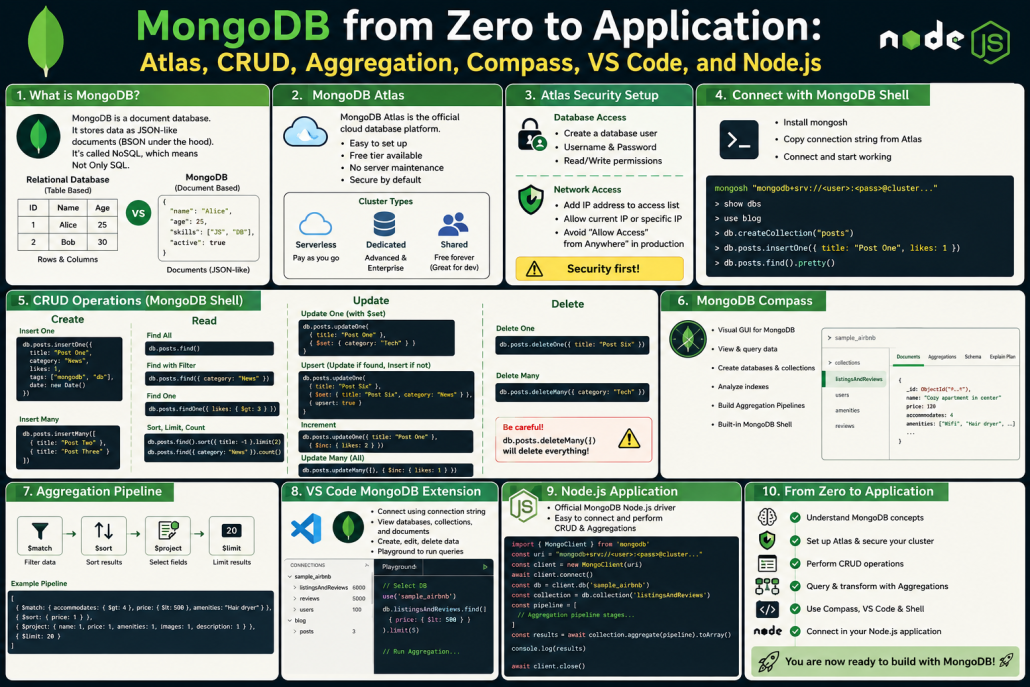
MongoDB from Zero to Application: Atlas, CRUD, Aggregation, Compass, VS Code, and Node.js

MongoDB tutorial roadmap showing Atlas setup, CRUD operations, aggregation pipelines, Compass, VS Code, and Node.js integration.

MongoDB Practical Beginner Guide: From Database Concepts to Node.js Integration

1. What MongoDB Is

MongoDB is often called a NoSQL database, but the better meaning is Not Only SQL, not “No SQL.”

The text explains that MongoDB is best understood as a document database. It stores data in documents that look like JSON, although internally MongoDB stores them as BSON.

Main idea:

MongoDB = Document Database

⸻

2. MongoDB vs Relational Databases

Relational databases store data like spreadsheets:

Tables → Rows → Columns

They need a strict schema before inserting data.

MongoDB works differently:

Database → Collection → Document

A document can store related data together, for example:

{

  “title”: “Post One”,

  “category”: “News”,

  “tags”: [“MongoDB”, “Database”],

  “likes”: 5

}

So instead of splitting data into many tables, MongoDB often keeps related data in one document.

⸻

3. JSON and BSON

Developers usually work with JSON-like data:

{

  “name”: “Sara”,

  “age”: 25

}

But MongoDB stores it internally as BSON.

BSON is like JSON, but with extra data types and better database performance.

⸻

4. Flexible Schema

MongoDB does not require a fixed schema by default.

That means documents in the same collection do not all need the exact same fields.

Example:

{ “name”: “Sara” }

and

{ “name”: “Kian”, “age”: 22, “skills”: [“Node.js”, “MongoDB”] }

can both be in the same collection.

⸻

5. MongoDB Hosting Options

The text explains two ways to use MongoDB:

Local MongoDB

You install MongoDB on your own computer or server.

Good for:

* Full control

* Local practice

But you must manage:

* Updates

* Server maintenance

* Security

MongoDB Atlas

Atlas is MongoDB’s cloud platform.

Good for:

* Easier setup

* Free tier

* No server maintenance

The tutorial chooses MongoDB Atlas.

⸻

6. Creating an Atlas Cluster

In Atlas, you create a cluster.

Cluster options include:

* Serverless → pay as you go

* Dedicated → professional/enterprise use

* Shared → free, good for small projects and testing

The tutorial chooses the shared free cluster.

⸻

7. Atlas Security Setup

MongoDB Atlas is locked by default.

You must configure two things:

Database Access

Create a database user with:

* Username

* Password

* Read/write permission

Network Access

Add an allowed IP address.

Important warning:

Allow access from anywhere = security risk

It may be okay for testing, but not for production.

⸻

8. Connecting with MongoDB Shell

The tutorial connects using mongosh.

Check version:

mongosh –version

Connect using Atlas connection string.

Basic commands:

db

show dbs

use blog

Important point:

A database may not appear in show dbs until you insert data into it.

⸻

9. Creating Databases and Collections

You can create a collection manually:

db.createCollection(“posts”)

Or MongoDB can create it automatically when inserting data:

db.posts.insertOne({…})

In this example:

blog = database

posts = collection

document = one blog post

⸻

10. Creating Documents

Insert one document

db.posts.insertOne({

  title: “Post One”,

  body: “This is a post”,

  category: “News”,

  likes: 1,

  tags: [“news”, “mongodb”],

  date: Date()

})

Insert many documents

db.posts.insertMany([

  { title: “Post Two”, category: “Tech” },

  { title: “Post Three”, category: “News” }

])

Important correction:

It is insertMany(), not addMany().

⸻

11. Reading Documents

Find all documents:

db.posts.find()

Find by category:

db.posts.find({ category: “News” })

Find one document:

db.posts.findOne({ title: “Post One” })

Count documents:

db.posts.find({ category: “News” }).count()

Limit results:

db.posts.find().limit(2)

Sort results:

db.posts.find().sort({ title: -1 })

⸻

12. Query Operators

The text introduces operators for filtering data.

Examples:

$gt   // greater than

$gte  // greater than or equal

$lt   // less than

$lte  // less than or equal

Example:

db.posts.find({ likes: { $gt: 3 } })

Meaning:

Find posts with more than 3 likes.

⸻

13. Updating Documents

Update one document:

db.posts.updateOne(

  { title: “Post One” },

  { $set: { category: “Tech” } }

)

Important:

Use $set to update only one field and keep the rest of the document.

⸻

14. Upsert

Upsert means:

Update if found

Insert if not found

Example:

db.posts.updateOne(

  { title: “Post Six” },

  { $set: { title: “Post Six”, category: “News” } },

  { upsert: true }

)

⸻

15. Incrementing Values

Use $inc to increase a number.

Example:

db.posts.updateOne(

  { title: “Post One” },

  { $inc: { likes: 2 } }

)

For all documents:

db.posts.updateMany(

  {},

  { $inc: { likes: 1 } }

)

⸻

16. Deleting Documents

Delete one:

db.posts.deleteOne({ title: “Post Six” })

Delete many:

db.posts.deleteMany({ category: “Tech” })

Dangerous example:

db.posts.deleteMany({})

This deletes everything in the collection.

⸻

17. Viewing Data in Atlas

In Atlas, you can use Browse Collections to:

* View databases

* View collections

* Add documents manually

* Edit documents

* Filter data

The tutorial shows the blog database and posts collection.

⸻

18. MongoDB Compass

MongoDB Compass is the visual desktop app for MongoDB.

It can be used to:

* View data

* Query data

* Create databases

* Create collections

* Analyze indexes

* Build aggregation pipelines

⸻

19. Sample Data

The tutorial loads MongoDB sample data.

One example is:

sample_airbnb

It contains rental listings, like Airbnb data.

This is used for practicing real queries.

⸻

20. Aggregation Pipeline

Aggregation lets you filter and transform data step by step.

Example goal:

Find rental listings that:

* Accommodate more than 4 people

* Cost less than 500

* Include a hair dryer

* Are sorted by price

* Show only needed fields

* Limit results to 20

Pipeline stages:

$match

$sort

$project

$limit

Important:

The order matters.

Good order:

Match → Sort → Project → Limit

⸻

21. VS Code MongoDB Extension

The tutorial also connects MongoDB to VS Code.

With the extension, you can:

* View databases

* View collections

* Open documents

* Create playgrounds

* Run queries inside VS Code

This makes MongoDB easier for developers working inside a code editor.

⸻

22. MongoDB Playground

A playground is like a practice file for MongoDB commands.

You can:

* Select a database

* Drop a collection

* Insert test data

* Run find queries

* Run aggregation pipelines

Useful for learning and testing before writing backend code.

⸻

23. Connecting MongoDB to Node.js

The tutorial ends by connecting MongoDB to a Node.js app.

Setup:

npm init -y

npm i mongodb

Basic flow:

Import MongoDB package

→ Create MongoClient

→ Connect with URI

→ Select database

→ Select collection

→ Run query or aggregation

Important production note:

The password should be stored in an environment variable, not directly in the code.

⸻

24. Final Understanding

The full context teaches MongoDB in this order:

Concepts

→ Atlas setup

→ Security

→ Shell connection

→ CRUD

→ Atlas dashboard

→ Compass

→ Aggregation

→ VS Code

→ Node.js app

WordPress AI Plugins and Models: Choosing Between ChatGPT, Gemini, and Perplexity

 The effectiveness of these WordPress AI plugins depends heavily on which AI model you connect to them. ChatGPT, Gemini, and Perplexity each offer different advantages and trade-offs in areas like content quality, SEO, research, automation, and cost. Here’s how they compare in practice: 1. AI Engine ChatGPT: Direct API integration using your API key.For example: […]