
Google Adsense vs Admob – Which is Better?
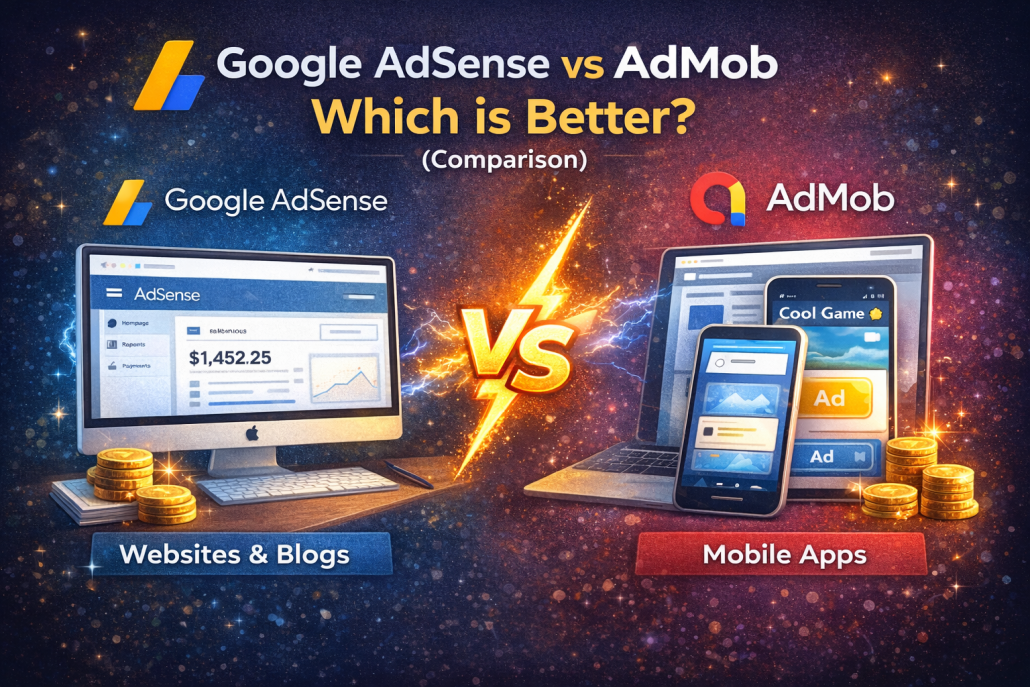
When comparing Google AdMob and
Google AdSense, the first thing to understand is that
they are built for very different purposes, even though
both are advertising platforms from Google. AdMob is
designed specifically for mobile apps. If you’re
developing an Android or iOS app and want to
earn money by showing ads inside that app, AdMob
is the platform created for that exact use case.
AdSense, on the other hand, is more creator-focused.
It’s aimed at bloggers, website owners, and content
creators who want to monetize web traffic through ads
placed on websites or YouTube channels.
AdMob’s biggest strength is its revenue potential when
used correctly. Apps with a large and active user base
can generate significant income, especially if users
spend a lot of time inside the app and see ads
frequently. AdMob also offers detailed targeting
options, which helps advertisers reach users who are
more likely to interact with ads. Another advantage is
how well AdMob integrates with other Google tools
like Firebase, Google Analytics, and Google Ads. This
makes it easier to track user behavior, optimize ad
placements, and improve overall monetization. For
developers who are already using Google’s ecosystem,
setting up AdMob is usually straightforward.
However, AdMob does have clear limitations. It only
works for mobile apps. If you’re running a website,
blog, or any kind of web-based platform, AdMob
simply isn’t an option. This makes the choice very
clear for many people: if your product is an app,
AdMob fits; if it’s a website, you need something else.
That’s where Google AdSense comes in. AdSense is
built for websites and content platforms. It allows
publishers to earn money by displaying ads on blogs,
informational websites, and YouTube channels. The
system works on a revenue-sharing model, meaning
you earn a portion of the income generated when users
view or click on ads. AdSense also offers a variety of
ad formats, giving creators flexibility in how ads are
displayed and how they fit into their content.
The trade-off with AdSense is that revenue potential is
often lower compared to AdMob, especially for smaller
sites or websites with low traffic. This isn’t unique to
AdSense—any ad network depends heavily on
audience size and engagement. Without consistent
traffic, earnings will naturally be limited. Still, for
content creators and bloggers, AdSense remains one of
the simplest and most accessible ways to start monetizing a website.
Choosing between AdMob and AdSense ultimately
depends on what you’re building. If you’re creating a
mobile app and want to monetize user activity inside
the app, AdMob is the clear choice. If you’re running a
blog, a content-driven website, or a YouTube channel,
AdSense is the platform designed for you.
Understanding this distinction upfront saves time and
helps you focus on the tool that actually matches your
goals.
Tip: For external links, consider setting them to open
in a new tab.