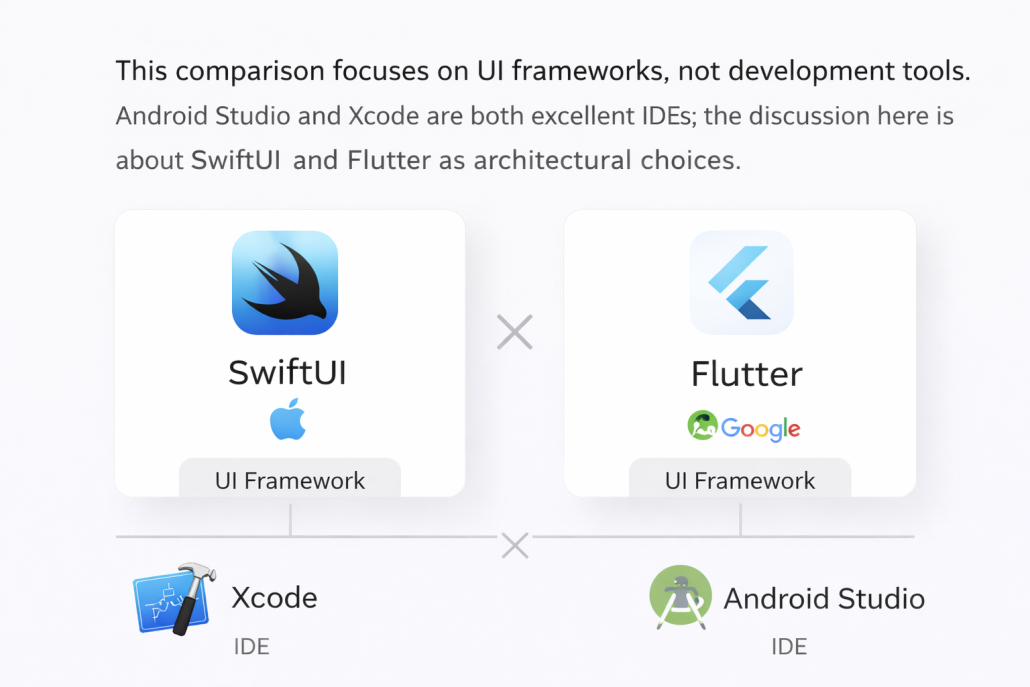

Choosing the right framework for mobile app development is one of
the most important technical decisions a business or startup can make.
Two of the most popular modern options today are SwiftUI and Flutter.
Both are powerful, actively developed, and backed by large
companies—Apple and Google. Yet, they are designed with very
different philosophies in mind.
In this article, we’ll compare SwiftUI and Flutter from a practical, real-
world perspective. Instead of marketing claims, we’ll focus on when
each framework truly makes sense, based on product goals, team
structure, performance needs, and long-term maintenance.
⸻⸻⸻⸻⸻⸻⸻⸻⸻⸻⸻
What Is SwiftUI?
SwiftUI is Apple’s modern UI framework for building applications
across iOS, iPadOS, macOS, watchOS, and tvOS. It was introduced in
2019 and is deeply integrated into Apple’s ecosystem.
SwiftUI uses a declarative syntax, meaning you describe what the UI
should look like, not how to draw it step by step. The system
automatically updates the interface when data changes.
Key strengths of SwiftUI
• Native Apple performance
• Deep integration with iOS APIs
• Clean, readable syntax
• Long-term support from Apple
• Ideal for Apple-only apps
SwiftUI feels like the “official” way Apple wants developers to build
modern apps going forward.
⸻⸻⸻⸻⸻⸻⸻⸻⸻⸻⸻
What Is Flutter?
Flutter is Google’s open-source UI framework for building
applications from a single codebase. With Flutter, you can target iOS,
Android, web, and desktop using the same code.
Flutter uses the Dart programming language and renders UI using its
own high-performance engine. This gives developers full control over
the look and behavior of the interface, regardless of platform.
Key strengths of Flutter
• One codebase for multiple platforms
• Consistent UI across devices
• Fast development cycles
• Strong community and plugin ecosystem
• Great for startups and MVPs
Flutter is designed for speed, flexibility, and cross-platform consistency.
⸻⸻⸻⸻⸻⸻⸻⸻⸻⸻⸻
Performance: Native vs Cross-Platform
Performance is often the first concern when comparing these two.
SwiftUI runs fully natively. It uses Apple’s frameworks directly and
benefits from system-level optimizations. For animation-heavy apps,
complex gestures, or deep hardware integration, SwiftUI has a natural
advantage.
Flutter, while not native in the traditional sense, is still very fast. Its
rendering engine draws directly to the screen, avoiding many
traditional cross-platform bottlenecks. In most business applications,
users will not notice a performance difference.
Rule of thumb:
• If maximum native performance is critical → SwiftUI
• If performance must be “good enough” across platforms → Flutter
⸻⸻⸻⸻⸻⸻⸻⸻⸻⸻⸻
Development Speed and Productivity
This is where Flutter often shines.
With Flutter:
• One team writes one codebase
• Features ship simultaneously on iOS and Android
• UI behaves consistently everywhere
• Hot reload speeds up iteration
SwiftUI development is also fast, but only within the Apple ecosystem.
If you need Android later, you must build a second app from scratch
(or with a different team).
For startups, MVPs, and budget-sensitive projects, Flutter can
significantly reduce time-to-market.
⸻⸻⸻⸻⸻⸻⸻⸻⸻⸻⸻
UI and Design Flexibility
SwiftUI follows Apple’s Human Interface Guidelines closely. This is a strength and a limitation.
• You get a UI that feels “right” on iOS
• But heavy customization can be harder
• Platform-specific behavior is expected
Flutter, on the other hand, is extremely flexible:
• Pixel-perfect custom designs
• Same UI across all platforms
• Full control over animations and layouts
If brand consistency across platforms matters more than native look-
and-feel, Flutter is often the better choice.
⸻⸻⸻⸻⸻⸻⸻⸻⸻⸻⸻
Ecosystem and Long-Term Maintenance
SwiftUI
• Backed by Apple
• Guaranteed long-term support
• APIs evolve with iOS releases
• Some breaking changes between major versions
SwiftUI is a safe long-term bet if you are committed to Apple platforms.
Flutter
• Backed by Google
• Open-source with strong community
• Rapid evolution
• Depends on plugins for many native features
Flutter’s long-term stability is solid, but it relies more on community
packages, which means you must choose dependencies carefully.
⸻⸻⸻⸻⸻⸻⸻⸻⸻⸻⸻
Team and Skill Considerations
Another key factor is your team.
Choose SwiftUI if:
• You already have iOS developers
• Your team knows Swift
• You want deep iOS expertise
Choose Flutter if:
• You want one team for iOS and Android
• You’re building fast with limited resources
• Cross-platform consistency matters
In real projects, team structure often matters more than technical differences.
⸻⸻⸻⸻⸻⸻⸻⸻⸻⸻⸻
Real-World Use Cases
SwiftUI is ideal when:
• You’re building a premium iOS app
• You rely on Apple-specific features
• Performance and native behavior are critical
• Long-term Apple platform focus is clear
Flutter is ideal when:
• You need iOS and Android from day one
• You’re validating an idea or MVP
• Budget and speed matter
• You want shared UI and logic
There is no universally “better” choice—only a better fit.
⸻
Final Recommendation
SwiftUI and Flutter are both excellent frameworks, built for different
goals.
• SwiftUI excels in native Apple experiences, performance, and long-
term platform alignment.
• Flutter excels in speed, flexibility, and cross-platform efficiency.
The right decision depends on your product vision, timeline, budget,
and team—not hype.
If you choose the framework that aligns with your real needs, both can
lead to successful, scalable applications.