
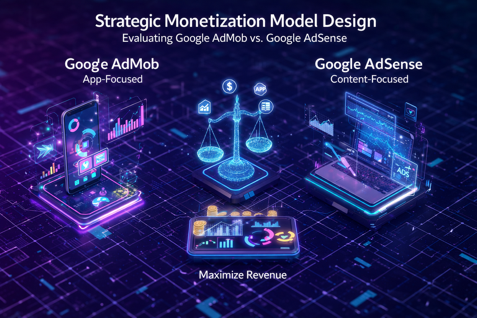
1. Strategic Framework and Introduction
Selecting an advertising platform is not merely a technical decision
made at the end of the development pipeline; it represents the fiscal
foundation and the primary determinant of unit economics in digital
projects. This choice dictates both the technical architecture and the
medium- to long-term growth strategy of the business. Ignoring the
structural differences between these two platforms introduces
significant risk to return on investment (ROI) and can lead to lock-in
within inefficient monetization models.
The strategic objectives of this document are:
• Reengineering revenue streams based on the type of digital asset
(App vs. Web).
• Maximizing Digital ARPU (Average Revenue Per User) through
optimal platform selection.
• Evaluating the scalability of advertising infrastructure to support
high-traffic volumes.
Understanding the distinction between content-centric and
application-centric models is a strategic necessity. This distinction
directly impacts the product lifecycle, as user acquisition (UA) models
and retention costs differ fundamentally between applications and
content platforms. The following sections provide a deep analysis of
these two monetization poles.
⸻
2. In-Depth Analysis of Google AdMob: Focus on the App Economy
Google AdMob is not merely an ad network; it is a specialized
ecosystem designed for app publishers, built on experience-based
engagement. Unlike the web, the focus here is on retaining users
within a controlled environment.
Strategic Capabilities of AdMob:
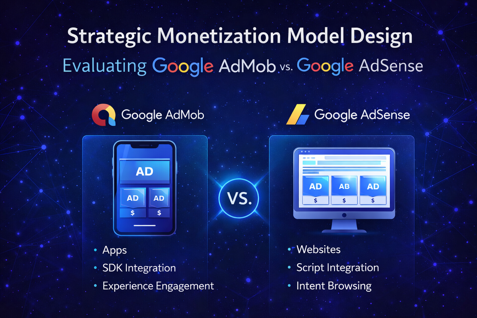
• SDK-based integration: Unlike web-based script integrations, AdMob
operates through SDKs embedded within the application layer,
enabling deeper interaction and greater technical stability.
• Granular targeting: By analyzing behavioral data, AdMob serves ads
to users with the highest engagement potential, directly improving
eCPM (effective cost per thousand impressions).
• Synergy with Firebase and Google Analytics: This integration is not
merely technical; it is essential for calculating LTV (Lifetime Value).
For investors and C-level stakeholders, accurate LTV tracking through
Firebase forms the backbone of marketing budget allocation
decisions.
The “So What?” Layer
Due to its application-centric nature, AdMob benefits from high DAU
(Daily Active Users), offering significantly greater revenue potential
than web platforms. Monetization in this model is driven by user
engagement with tools or games. Failing to use AdMob in native
applications means forfeiting a critical opportunity to optimize ROI
through behavioral data.
⸻
3. In-Depth Analysis of Google AdSense: Focus on the Content
Ecosystem
Google AdSense forms the backbone of web monetization models and
operates on intent-based browsing. Value is created through
information delivery, and advertising must complement the content
flow.
Revenue Share Model
Google acts as a revenue partner, sharing income generated from
clicks and impressions with content owners. This model is ideal for
blogs, news sites, and YouTube channels.
Critical Limitation (E-commerce Exclusion)
According to Google standards, AdSense is not designed for e-
commerce or online stores. Its focus is on content-producing assets,
not direct product sales.
Contextual Ad Formats
AdSense offers diverse formats that integrate seamlessly with content
(native ads), minimizing disruption to user experience.
The “So What?” Layer
Strategic success with AdSense depends on balancing content
production costs against advertising revenue. Low traffic is fatal in
this model. Unlike applications—where fewer users with high
engagement may still generate revenue—AdSense is highly dependent
on scale and high-value keywords.
⸻
4. Comparative Evaluation and Revenue Model Analysis
For senior decision-makers, aligning asset type with platform choice is
the most critical action. Misusing a platform (e.g., deploying AdSense
within complex web apps) results in poor yield and degraded user experience.
Strategic Comparison Table
Evaluation Criteria Google AdMob Google AdSense
Target Asset Type Native mobile apps (iOS/Android) Content websites,
blogs, YouTube
Technical Basis SDK integration Script integration
User Behavior Experience-based engagement Intent-based browsing
Revenue Potential Very high (DAU & impressions dependent)
Moderate (CTR & keyword value dependent)
Key KPI Retention & impressions Content relevance & CTR
Strengths and Weaknesses
Google AdMob
• Strengths: High scalability, strong LTV tracking via Firebase, OS-level
targeting.
• Weaknesses: Limited exclusively to app environments; ineffective on
the open web.
Google AdSense
• Strengths: Access to the largest web advertiser network, rapid
deployment on content platforms.
• Weaknesses: Highly sensitive to traffic volume; unsuitable for e-
commerce models.
⸻
5. Decision Roadmap and Long-Term Scalability
Business sustainability requires aligning digital assets with future
growth objectives.
Decision Logic Guidelines:
• If your product is a mobile app: Choose AdMob immediately. Its SDK-
centric architecture is essential for optimizing mobile monetization
and behavioral analytics.
• If your product is a content platform, blog, or YouTube channel:
AdSense is the standard choice. However, if your site is an e-
commerce store, alternative monetization models must be explored.
Strategic Warning
Using AdSense for app-like experiences (e.g., complex web apps)
typically results in low CTR and poor financial performance due to the
lack of native integration.
Final Recommendations for Scalability:
• Prioritize traffic growth: Neither platform performs well at low scale.
Focus on audience acquisition before ad optimization.
• Continuously monitor ARPU: Track revenue per user to ensure
financial health against server and maintenance costs.
• Leverage analytics: In AdMob-based models, use Firebase data to
personalize user experiences and extend session duration.
Final Statement
Precise alignment between platform and digital asset type is the
primary lever for maximizing Digital ARPU and ensuring financial
sustainability. Choosing the correct platform is not a technical
preference—it is a strategic necessity for scalable growth in today’s
competitive ecosystem.