
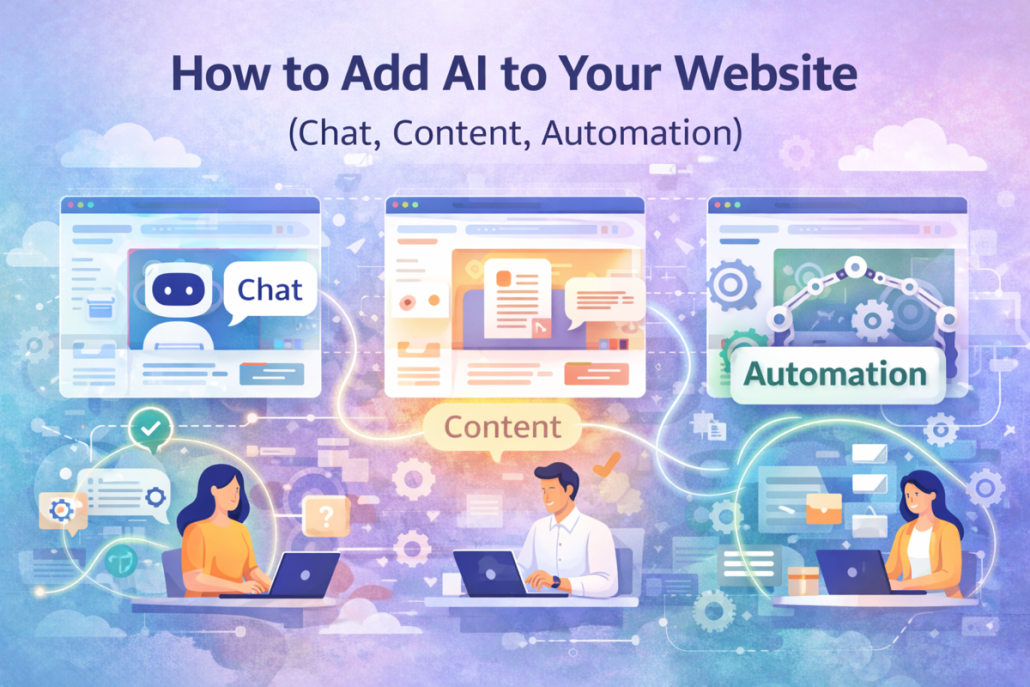
Adding AI to your website is no longer about building
complex systems or replacing everything you already
have. It starts with understanding how visitors interact
with your site and identifying where AI can genuinely
improve their experience or reduce manual work for
your team. The most effective approach is to think of
AI as an enhancement layer—one that supports
communication, content creation, and automation
without disrupting your existing structure. By
introducing AI gradually and with clear goals,
businesses can see real value quickly while keeping
full control over how the technology is used.
One of the most common entry points for AI on a
website is AI-powered chat. An AI chatbot can act as
a 24/7 assistant, answering frequently asked questions,
guiding visitors to the right pages, and helping users
find products or services faster. Instead of relying
solely on pre-written scripts, modern AI chat systems
can be trained on your website content, documentation,
and FAQs. This allows them to respond in a natural,
human-like way while staying aligned with your
business. When designed properly, AI chat reduces
support workload, improves response times, and
increases visitor engagement—without replacing
human support where it matters.
Another powerful area is AI-assisted content. AI can
help generate and improve website content such as
blog posts, service descriptions, product pages, and
even FAQs. The key is not to let AI replace your voice,
but to use it as a drafting and optimization tool. AI can
turn rough ideas into structured text, suggest
improvements for clarity and SEO, and help keep
content consistent across the site. This is especially
useful for businesses that struggle to update their
websites regularly. By using AI to support content
creation, teams can publish more frequently, stay
relevant, and focus their energy on strategy rather than
writing from scratch.
Automation is where AI delivers some of the most
tangible business benefits. AI-driven automation can
connect forms, emails, databases, and internal tools to
reduce repetitive tasks. For example, when a visitor
fills out a contact form, AI can summarize the request,
categorize it, and route it to the right person
automatically. AI can also trigger follow-up emails,
update CRM records, or flag urgent inquiries. These
automations save time, reduce errors, and ensure that
no important requests fall through the cracks. Most
importantly, they allow teams to focus on higher-value
work instead of routine administration.
To successfully add AI to a website, integration and
usability are critical. AI tools should feel like a natural
part of the site, not an add-on that confuses users. This
means designing clear interfaces, setting realistic
expectations for what AI can and cannot do, and
maintaining transparency with visitors. It is also
important to monitor performance and gather feedback.
AI systems improve over time, and regular
adjustments help ensure accuracy, relevance, and
alignment with business goals.
Ultimately, adding AI to your website is not a one-time
project, but an ongoing process of improvement. When
chat, content, and automation work together, AI
becomes a practical tool that enhances user experience,
increases efficiency, and supports business growth. By
focusing on real needs, starting small, and improving
continuously, businesses can successfully integrate AI
into their websites in a way that is sustainable, reliable,
and genuinely useful.