
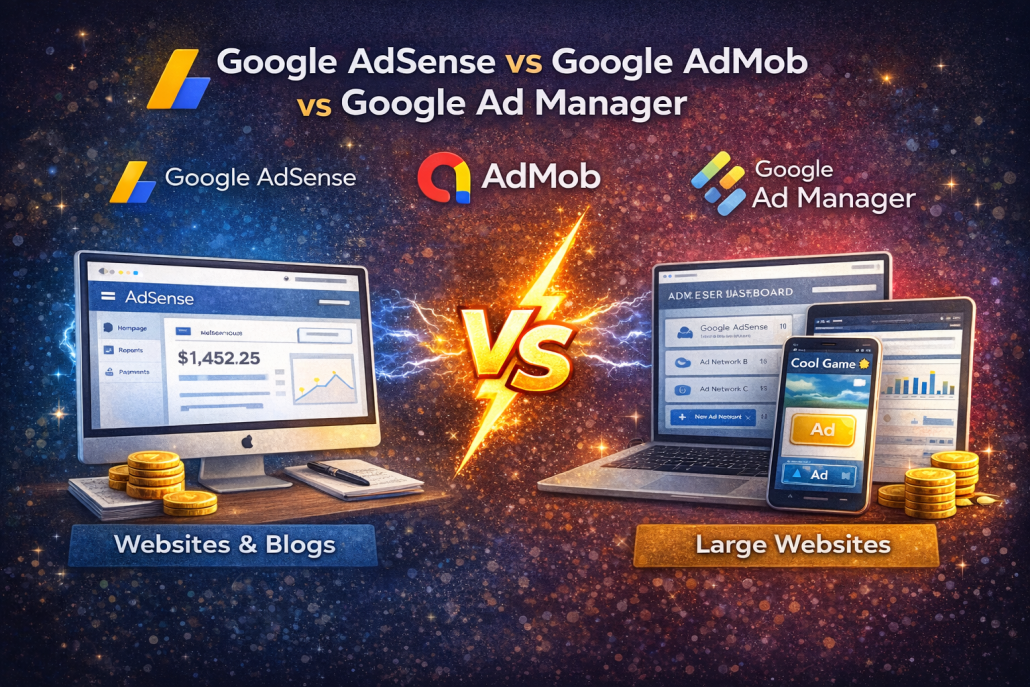
Hello friends! In today’s video, we’re going to understand the difference between Google AdSense, Google AdMob, and Google Ad Manager, because many people get confused about what each of these platforms actually does and who they are meant for.
Let’s start with Google AdMob. AdMob is mainly used for mobile applications. You may have noticed that when you download and use apps from the Play Store—or even apps installed from outside the Play Store—you often see ads inside them. Those in-app ads are usually served through Google AdMob. Developers who build Android or iOS apps use AdMob to monetize their apps and earn revenue from users. So, if you’re someone who develops mobile apps and wants to earn money by showing ads inside those apps, AdMob is the right platform for you.
Now, if you don’t build apps and instead work with websites, then Google AdSense comes into the picture. AdSense is designed for bloggers, website owners, and content creators. If you have a blog, an informational website, or a YouTube channel, AdSense allows you to earn money by displaying ads on your content. It works on a revenue-sharing model, meaning you earn a percentage of the revenue generated when visitors see or click on ads shown on your site.
However, there’s an important limitation with AdSense. When you use AdSense directly on your website, Google has rules that usually prevent you from using other ad networks alongside it. That means your ads are mostly limited to Google’s own network. This is where Google Ad Manager becomes useful.
Google Ad Manager is a more advanced platform that gives you greater control over ad delivery. With Ad Manager, you’re not limited to just AdSense—you can use multiple ad networks at the same time, run sponsored ads, and manage direct deals with advertisers. Large websites, such as news portals like NDTV, often use Google Ad Manager instead of plain AdSense. On such sites, you may still see “Ads by Google,” but at the same time, you’ll also notice sponsored ads or ads coming from other networks. This flexibility is possible because Ad Manager acts as a central system that manages and prioritizes different ad sources.
Many people believe that using Google Ad Manager automatically improves ad quality or earnings, but that’s actually a misunderstanding. In reality, ad performance depends mainly on your content quality, audience, and traffic, not just the platform you use. Whether you use AdSense or Ad Manager, good content and engaged users matter the most.
So, how should you choose? If you create mobile apps, AdMob is the right choice. If you run a blog, website, or YouTube channel, AdSense is usually the best place to start. And if you manage a large website and want more control, flexibility, and access to multiple ad networks, then Google Ad Manager is the better option.
That’s the explanation for today on the difference between Google AdSense, Google AdMob, and Google Ad Manager. I hope this helped you understand which platform suits your needs best. If you have any questions, feel free to ask them in the comments. See you in the next video—thank you and goodbye!