
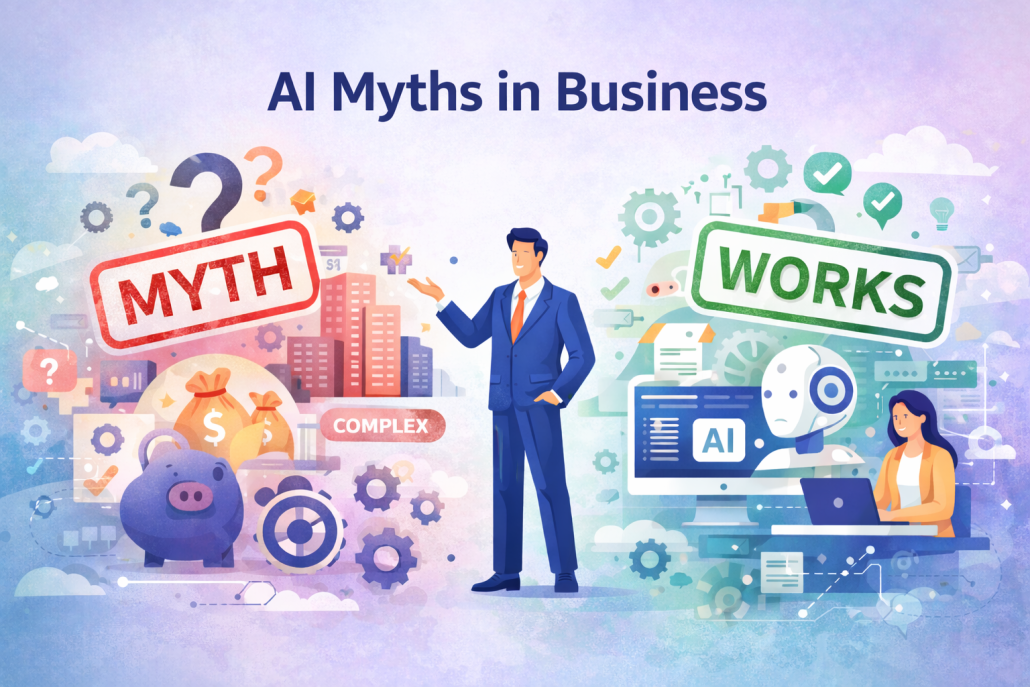
Many businesses approach AI with a mix of curiosity and hesitation,
largely because of persistent myths that distort what AI really is and
how it works in practice. One of the most common myths is that AI is
only for large corporations with massive budgets and dedicated
technical teams. This belief often stops small and mid-sized businesses
before they even start. In reality, many of today’s most effective AI
solutions are lightweight, affordable, and designed to solve very
specific problems. What actually works is starting small—using AI for
a single task such as answering customer questions, summarizing
inquiries, or automating repetitive internal work.
Another widespread myth is that AI is extremely complex and difficult
to manage. While AI can be complex behind the scenes, modern AI
tools are built to be accessible to non-technical users. Businesses do
not need to understand algorithms or machine learning models to
benefit from AI. What works instead is focusing on usability. AI
solutions that integrate smoothly into existing tools—such as websites,
email systems, or apps—deliver value without adding complexity.
When AI fits naturally into daily workflows, teams are far more likely
to trust and adopt it.
Many decision-makers also believe that AI will replace human
workers, creating fear and resistance inside organizations. This myth
causes unnecessary hesitation and internal pushback. In practice, the
AI solutions that succeed are those that support people rather than
replace them. AI works best as an assistant—handling repetitive tasks,
organizing information, or offering suggestions—while humans remain
in control of decisions and relationships. For example, AI can prepare
summaries for customer support teams, but the final response still
comes from a human. This approach increases productivity without
removing the human element.
Another misconception is that AI needs perfect data to be useful.
Businesses often assume that unless their data is clean, structured, and
complete, AI projects will fail. What actually works is using the data
that already exists and improving over time. Many AI solutions deliver
value even with imperfect data, especially when the goal is
automation, pattern recognition, or assistance rather than precision
forecasting. As AI systems are used, they naturally improve through
feedback and refinement, making data quality a process rather than a
barrier.
Some businesses also think AI is a one-time setup—something you
install, configure once, and then forget. This is another myth that leads
to disappointment. In reality, AI works best when treated as a living
system. What works is monitoring performance, reviewing results, and
adjusting the system as business needs change. Markets evolve,
customer behavior shifts, and internal processes grow. AI solutions that
are reviewed and refined over time continue to deliver value, while
static ones quickly lose relevance.
Finally, there is a myth that AI must be highly advanced to be
worthwhile. Many companies chase complex features and ambitious
use cases before mastering the basics. What actually works is
simplicity. The most successful AI projects focus on clear outcomes:
saving time, reducing manual work, improving response speed, or
helping teams make better decisions. Simple AI solutions that solve
real problems consistently outperform complex systems that look
impressive but are rarely used.
In practice, successful AI adoption is not about technology—it’s about
mindset and execution. Businesses that see AI as a practical tool rather
than a magic solution are the ones that benefit most. By starting with
clear goals, choosing simple solutions, integrating AI into existing
workflows, and improving gradually, companies can turn AI from a
source of confusion into a reliable driver of efficiency and growth.