
If I asked you to raise your hand if you’ve ever used a chatbot, you’d probably lift it without thinking. We’ve all interacted with them—on websites, in banking apps, while tracking an order, or asking a quick support question. When they work well, they feel fast and helpful. But we’ve also had moments where the experience was frustrating, confusing, or just plain unhelpful.
At the core of this conversation is something simple and universal: we all need answers. It doesn’t matter whether you’re a customer contacting support, an HR professional helping an employee, a call center agent assisting a client, a sales rep guiding a prospect, or a marketing specialist responding to product questions. Getting the right information quickly makes everything easier. And for businesses, providing clear and accurate answers is critical.
That’s where chat tools come in. But not all of them are created equal.
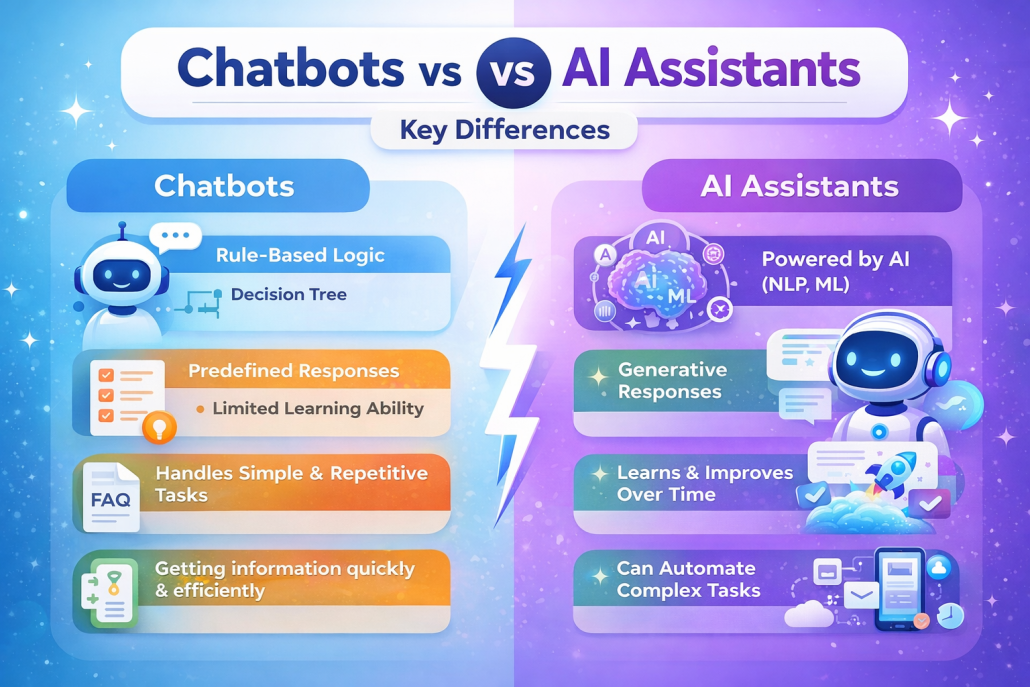
The term “chatbot” is often used broadly. It can describe any system that responds to human questions, whether it uses advanced AI or simple rules. Traditional chatbots are usually built on decision trees and predefined rules. They guide users through fixed options like FAQs, billing, or orders. They work fine for predictable, repetitive questions—but once the conversation moves outside those preset paths, they can struggle. That’s when users start typing “agent” over and over just to reach a human.
AI assistants, however, are built differently. They use technologies like natural language processing, machine learning, and deep learning to understand what people are really asking—even if the wording changes. They can learn over time, remember previous interactions, and personalize responses. Some can even perform tasks in the background, such as sending an email or updating account details.
Imagine a customer—let’s call her Janice—looking for information about a service. If she interacts with a traditional chatbot, she might type her question and be prompted to choose from a limited list. None of the options quite match what she needs. She tries again with different wording, but still no clear answer. Eventually, she’s transferred to a human agent. The problem gets solved, but the process wasn’t smooth or efficient.
Now picture the same situation with an AI assistant. Janice types her question naturally. The assistant understands her request, provides a clear answer, maybe shares a relevant link, and even suggests next steps. The experience feels seamless. Janice gets what she needs quickly. The human agent is free to focus on more complex cases. The business saves time and improves productivity.
The difference comes down to the underlying technology. Traditional chatbots rely on rigid rules. AI assistants rely on learning, context, and adaptability. Humans bring expertise and judgment. Machines bring speed and scalability. When combined properly, they create powerful outcomes.
In today’s world, where customers expect immediate and accurate responses, choosing the right conversational technology matters. Older, rule-based chatbots are quickly becoming outdated. Intelligent AI assistants—capable of learning, personalizing, and automating—are driving real business value by improving efficiency, empowering employees, and meeting growing customer expectations.
AI assistants aren’t just an upgrade. They represent the next stage of digital interaction—and that future is already here.