
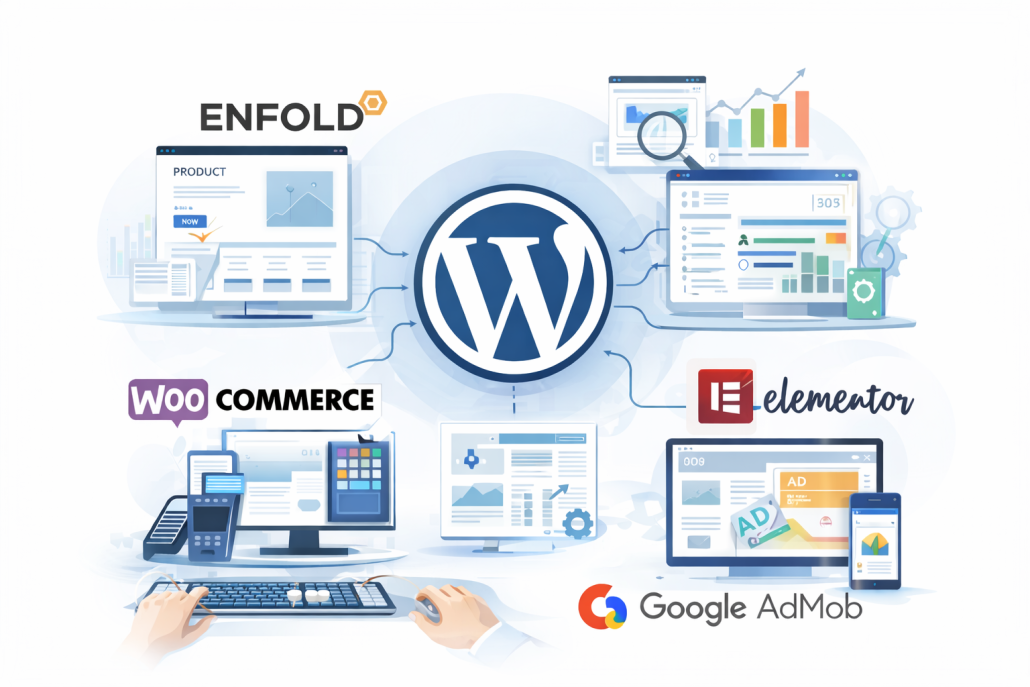
When building a WordPress marketing website, the
goal is usually to keep things simple while still leaving
room for growth, analytics, and monetization. A
popular choice for this kind of setup is Enfold.
Although Enfold is technically a theme, it behaves like
a full framework and is widely used for business and
commercial websites. It offers built-in layout tools,
performance optimizations, and strong compatibility
with analytics and e-commerce features. For many
companies, Enfold makes it easier to present products,
highlight qualifications, and structure content clearly
without relying on dozens of extra plugins.
For payments and online selling, WooCommerce is the
standard solution. It allows businesses to sell products
or services, manage orders, and handle payments
directly inside WordPress. WooCommerce works
smoothly with Enfold and can also be combined with
Elementor to simplify page building. Elementor’s
visual drag-and-drop editor makes designing product
pages, landing pages, and comparison sections much
easier, especially for non-technical teams. Together,
WooCommerce and Elementor reduce development
friction and make ongoing updates faster and more
manageable.
On the monetization side, many websites also rely on
advertising. Google AdSense is commonly used on
content-driven pages to generate passive revenue
through display ads, particularly in blogs and
informational sections. For mobile apps connected to
the same business or brand, Google AdMob serves a
similar purpose by enabling in-app advertising and
monetization. While ads are not always suitable for
purely corporate or product-focused pages, they can be
effective when used carefully in educational or high-
traffic areas.
An important but often overlooked step in this setup is
organizing navigation through the menu system. By
going to Appearance → Menus in WordPress, you
can manually add Posts (such as blog categories or
specific articles) to the main menu structure alongside
Pages like Products or Services. This helps visitors
easily discover content, improves internal linking for
SEO, and creates a clearer user journey between
informational posts and commercial pages. For
marketing websites, adding Posts to the menu ensures
that valuable content supports product pages instead of
being hidden away.
Overall, this combination—Enfold for structure,
WooCommerce for payments, Elementor for ease of
design, AdSense or AdMob for monetization, and a
well-organized menu structure—creates a flexible
WordPress ecosystem. It allows businesses to present
products professionally, guide users through content,
manage commerce efficiently, analyze performance,
and scale their digital presence without
overcomplicating the system.