
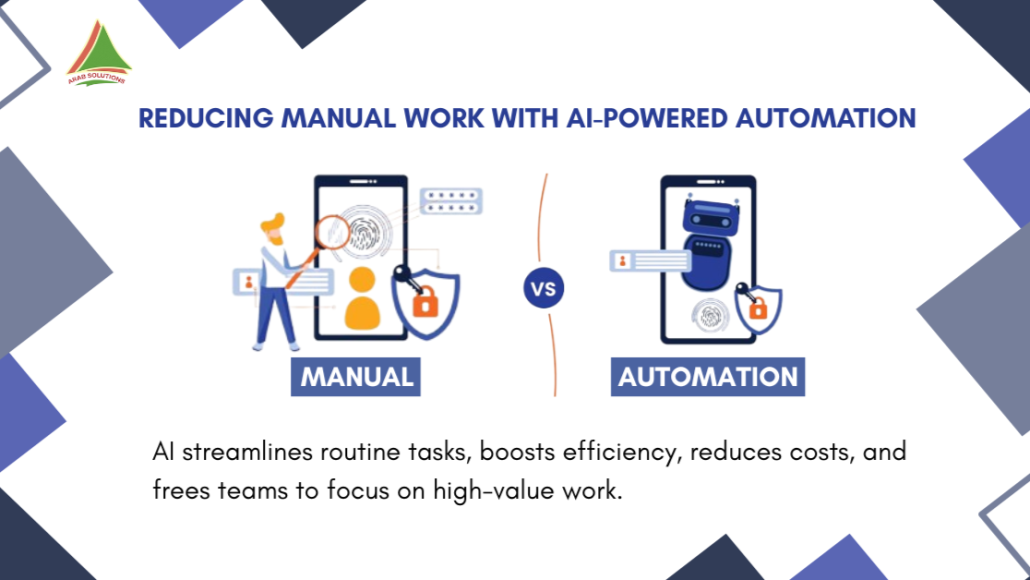
AI automation is becoming one of the most practical
ways businesses can reduce manual work without
disrupting how their teams already operate. In many
organizations, valuable time is still spent on repetitive
tasks such as copying data between systems,
responding to routine emails, updating records, or
coordinating internal processes. These tasks are
necessary, but they rarely create real value. AI
automation focuses on removing this friction so people
can concentrate on work that actually requires human
judgment, creativity, and decision-making.
Unlike traditional automation, which relies on rigid
rules and fixed sequences, AI-driven automation can
adapt to variation. It can understand context, recognize
patterns, and handle inputs that are not always
structured or predictable. This makes it especially
useful for everyday business workflows that involve
forms, messages, documents, and user interactions. For
example, when a customer fills out a form on a
website, AI can automatically classify the request,
extract the relevant information, and route it to the
right system or person—without manual sorting or
copy-pasting. Over time, the system learns which
actions lead to faster resolutions and better outcomes.
One of the key benefits of AI automation is
consistency. Manual processes are prone to delays,
errors, and inconsistencies, especially as teams grow or
workloads fluctuate. AI-driven workflows operate the
same way every time, at any hour, and without fatigue.
This reduces mistakes, improves response times, and
creates a more predictable experience for customers
and internal teams alike. A sales inquiry, for instance,
can be processed immediately, logged in a CRM, and
followed up with the right message—without waiting
for someone to notice it in an inbox.
Another important advantage is scalability. As a
business grows, manual processes often become
bottlenecks. Hiring more people to handle repetitive
tasks increases costs and complexity. AI automation
allows companies to scale operations without scaling
manual effort at the same rate. Whether it is processing
ten requests or ten thousand, the workflow remains
stable. This is particularly valuable for small and mid-
sized businesses that need to operate efficiently with
limited resources.
AI automation also improves visibility and decision-
making. Automated workflows generate structured data
about how processes run, where delays occur, and
which steps require the most intervention. This insight
helps businesses identify inefficiencies and
continuously refine their operations. Instead of
guessing where time is being lost, teams can rely on
real data to optimize workflows and improve
performance.
Most importantly, reducing manual work does not
mean removing people from the process. It means
supporting them. AI automation takes care of
repetitive, low-value tasks so teams can focus on
higher-level work—building relationships, solving
complex problems, and making informed decisions.
When implemented thoughtfully, AI automation
becomes a quiet assistant in the background, making
businesses faster, more reliable, and easier to run
without adding unnecessary complexity.