How AI Helps Identify Bottlenecks and Drop-Offs
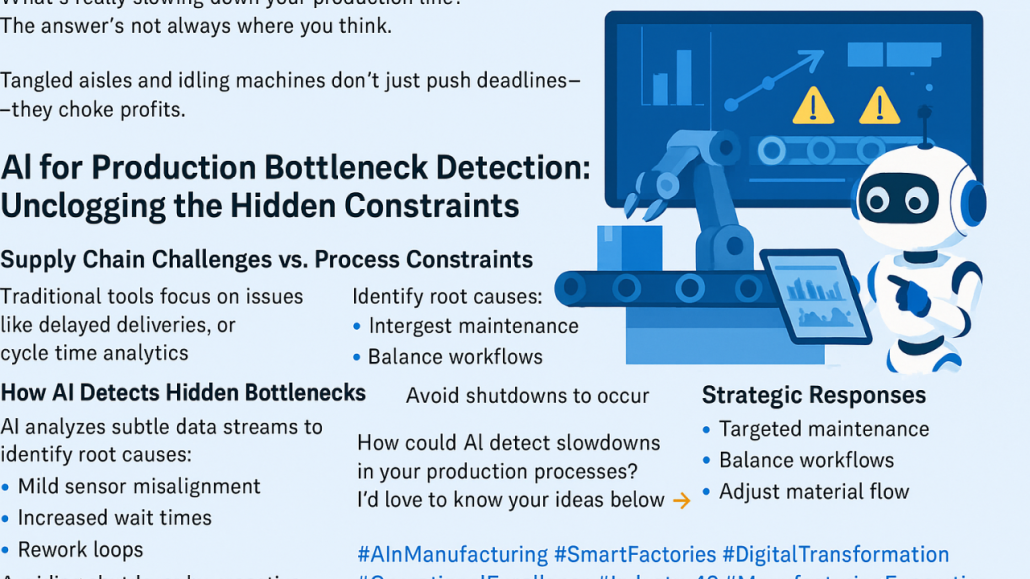
This image presents a clear and practical explanation
of how AI can identify hidden bottlenecks and inefficiencies in production and operational
environments—issues that often remain invisible when
relying on traditional monitoring tools. The visual
composition combines industrial elements, data
dashboards, and a friendly AI robot, symbolizing the
collaboration between human teams, machines, and
artificial intelligence. Rather than portraying AI as a
replacement for people, the image positions it as an
intelligent assistant that observes, analyzes, and
supports better decision-making.
At the core of the image is the idea that what slows
down production is not always obvious. Conveyor
belts, robotic arms, and dashboards represent modern
production systems that appear automated and efficient
on the surface. However, warning icons and
highlighted data points on the screens suggest that
problems can exist beneath this smooth exterior. The
text emphasizes that tangled workflows, idle machines,
or subtle process mismatches do not just delay
deadlines—they directly impact profitability. This
framing shifts the conversation from technical
optimization to business impact, making the message
relevant for both operational teams and decision-
makers.
The left side of the image explains the limitations of
traditional tools. Conventional analytics often focus on
visible symptoms such as delayed deliveries, missed
targets, or overall cycle times. While these indicators
show that something is wrong, they rarely explain why.
AI, by contrast, analyzes continuous data streams
across machines, sensors, workflows, and timing. It
can detect small but meaningful signals—slight sensor
misalignments, gradually increasing wait times
between steps, or repeated rework loops—that slowly
erode efficiency. These issues are easy to overlook
individually, but together they can choke throughput
and margins.
A key strength highlighted in the image is AI’s ability
to identify root causes rather than surface-level
problems. By correlating data across multiple systems,
AI can reveal how one small constraint affects the
entire process. This enables organizations to move
from reactive firefighting to proactive optimization.
Instead of responding only after a breakdown or major
delay, teams can address issues early, before they
escalate into shutdowns or lost revenue.
On the right side, the image focuses on action. AI
insights are translated into strategic responses such as
targeted maintenance, balancing workloads, and
adjusting material flow. This reinforces an important
point: AI analytics are only valuable if they lead to
practical decisions. The visual flow from detection to
response shows AI as a bridge between data and
execution, helping teams act with precision rather than
guesswork.
Overall, the image communicates a strong narrative
about modern operations. Complex systems generate
vast amounts of data, but insight does not emerge
automatically. AI serves as the layer that brings clarity,
uncovering hidden constraints and drop-offs that
humans alone might miss. By making inefficiencies
visible and actionable, AI helps organizations run
smoother operations, reduce waste, and protect profits.
The message is clear and grounded in reality: AI is not
about futuristic promises, but about solving real,
everyday problems that slow businesses down.