
Adding AI to Mobile Apps: iOS, Android, and Web
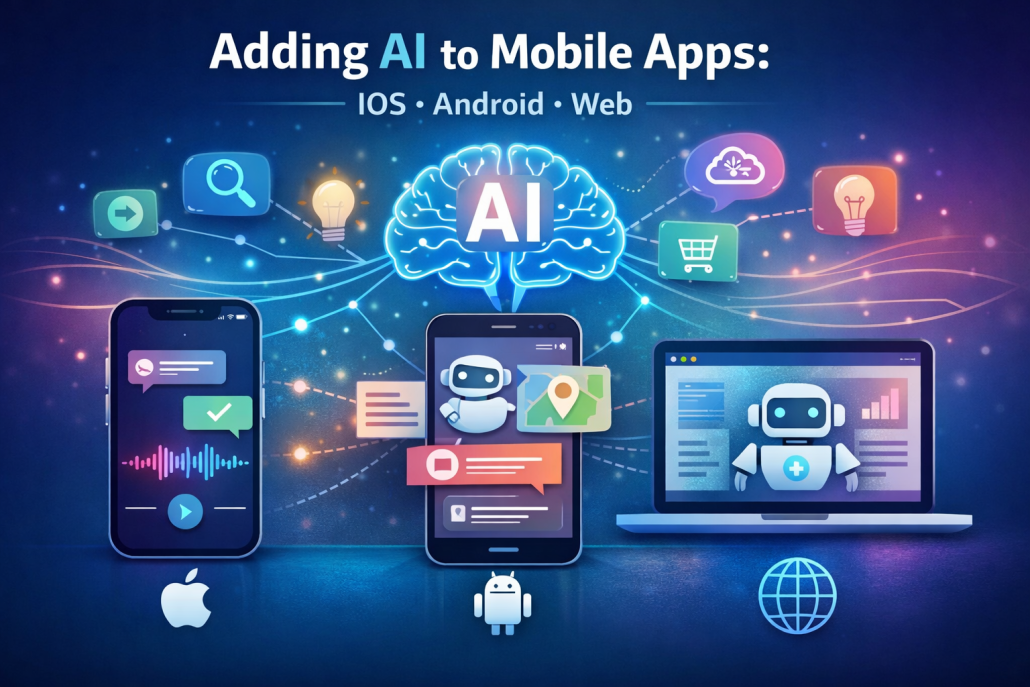
Adding AI to mobile apps has become a natural next
step for teams building products across iOS, Android,
and the web. What started as simple automation has
evolved into smarter, more responsive experiences that
adapt to users in real time. Today, AI is less about
novelty and more about solving everyday problems in
ways that feel intuitive and human.
On mobile platforms like iOS and Android, AI often
works behind the scenes to make apps feel faster and
more personal. Recommendation systems learn from
user behavior to suggest relevant content, products, or
actions without requiring extra input. Voice recognition
and natural language processing allow users to interact
with apps more naturally, whether they are dictating a
message, searching for information, or controlling
features hands-free. Even small touches, such as
predictive text or smart notifications, rely on AI to
reduce friction and make daily interactions smoother.
Performance and efficiency are another major reason
developers add AI to mobile apps. AI models can
optimize battery usage, adapt image quality to network
conditions, and detect unusual behavior such as
crashes or security risks. On-device AI, which runs
directly on the user’s phone, has become especially
important. It allows apps to deliver intelligent features
while protecting privacy and reducing reliance on
constant internet access. This balance between
intelligence and efficiency is critical in mobile
environments, where resources are limited and user
expectations are high.
On the web, AI plays a slightly different role. Web
applications often focus on scale and flexibility,
serving users across many devices and contexts. AI-
powered search, chat interfaces, and personalization
engines help websites respond to diverse user needs
without becoming complex or overwhelming. For
example, an AI assistant on a web app can guide users
through onboarding, answer questions, or recommend
next steps based on their behavior. This creates a sense
of continuity between web and mobile experiences,
especially when users switch between devices.
One of the biggest challenges in adding AI across iOS,
Android, and the web is consistency. Users expect the
same level of intelligence and reliability everywhere,
even though the underlying technologies may differ.
Successful teams design AI features at the product
level first, then adapt them to each platform’s strengths.
This might mean using cloud-based AI services for
heavy processing while keeping lightweight models on
devices for responsiveness. The goal is not identical
implementation, but a consistent experience.
Despite its benefits, AI must be used thoughtfully.
Features that feel intrusive, confusing, or unreliable
can quickly erode trust. Users are more likely to accept
AI when it clearly helps them, explains itself when
needed, and respects their data. Transparency and
control are key, especially as AI becomes more
integrated into everyday tools.
In the end, adding AI to mobile apps and web
platforms is about enhancing human capability, not
replacing it. When done well, AI fades into the
background, quietly making apps more helpful,
adaptive, and enjoyable to use.