
AI Chatbots for Websites: When They Help and When They Don’t
AI chatbots have quietly become a common feature on
modern websites. You see them in the corner of online
shops, service pages, and even personal blogs, offering
help before you’ve asked for it. When they are done
well, they can feel like a helpful assistant who is
always available. When they are done poorly, they
quickly become a source of frustration. Understanding
when AI chatbots help and when they don’t is essential
for anyone thinking about adding one to a website.
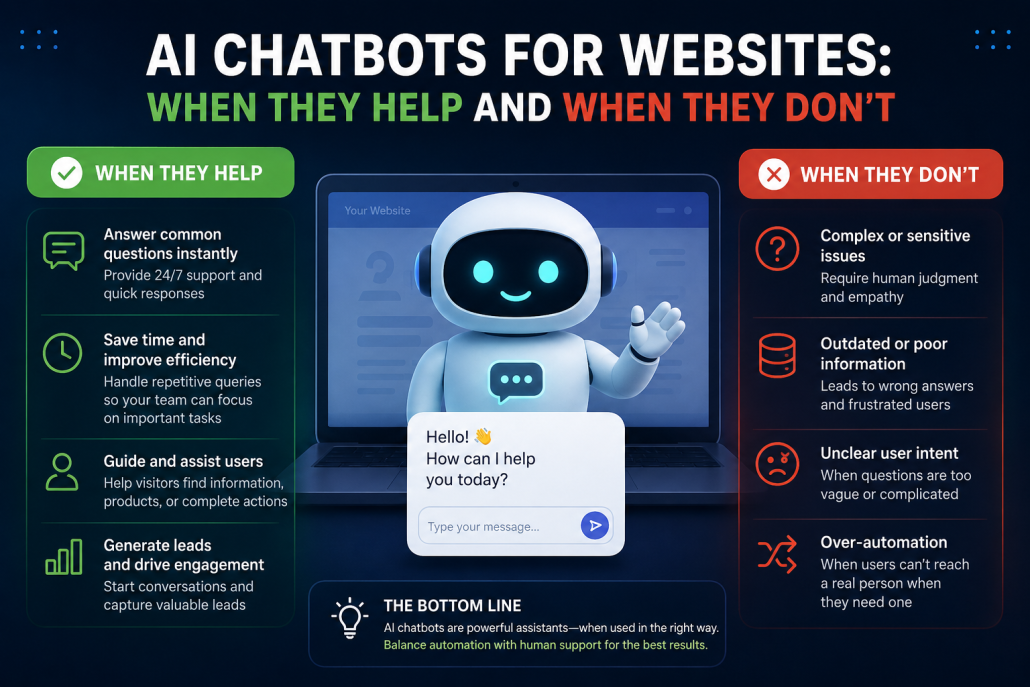
One of the clearest ways AI chatbots help is by
providing instant answers to simple, repetitive
questions. Visitors often arrive with basic needs:
opening hours, pricing ranges, shipping policies, or
how to contact support. A chatbot that is trained on the
site’s content can respond immediately, without
making users search through menus or wait for an
email reply. This is especially valuable outside
business hours, when human support is unavailable. In
these cases, the chatbot reduces workload for support
teams while improving the visitor’s experience at the
same time.
Chatbots are also useful as guides rather than problem-
solvers. On larger websites, people often feel lost. A
well-designed chatbot can ask a short clarifying
question and point users to the right page, product, or
form. For example, on a service website, it might help
a visitor understand which service fits their situation,
or on an e-commerce site, it might narrow down
product categories. Here, the chatbot’s value is not
intelligence in a human sense, but speed and clarity.
However, AI chatbots stop being helpful when they
pretend to be more capable than they are. Many
frustrations come from bots that give vague, incorrect,
or overly confident answers to complex questions.
When a user has a specific problem, an emotional
concern, or a case that requires judgment, a generic AI
response can feel dismissive or even misleading. This
is particularly risky in areas like healthcare, legal
advice, or financial decisions, where wrong guidance
can have real consequences.
Another common failure happens when chatbots block
access to humans. If users are forced to argue with a
bot before reaching real support, trust erodes quickly.
People generally accept automation when it saves time,
but they resent it when it becomes a gatekeeper. A
good chatbot knows when to step aside and offer a
clear path to human help.
In the end, AI chatbots work best when they are
designed with humility. They should focus on
answering what they know well, guiding users gently,
and being transparent about their limits. They fail
when they try to replace human understanding instead
of supporting it. Used thoughtfully, chatbots can make
websites feel more responsive and welcoming. Used
carelessly, they remind visitors how much they miss
talking to a real person.