
How to Add AI to Your Website (Chat, Content, Automation)
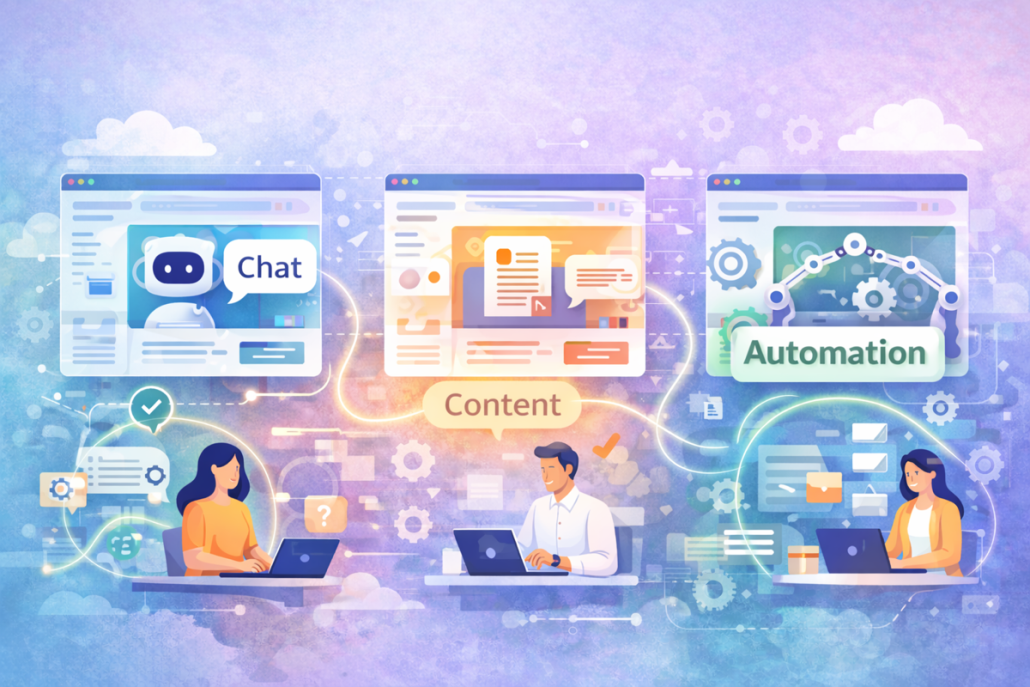
Adding AI to your website is best approached as a practical upgrade,
not a technical overhaul. The goal is to improve how your website
communicates, works, and responds—both for visitors and for your
internal team. Instead of thinking about AI as something complex or
disruptive, it helps to see it as a layer that enhances what already
exists. By focusing on chat, content, and automation, businesses can
introduce AI in a way that feels natural, useful, and immediately
valuable.
One of the most visible and effective ways to add AI to a website is
through AI-powered chat. An AI chat assistant can guide visitors,
answer common questions, and help users find information quickly
without waiting for human support. When trained on your website
content, FAQs, and documents, the chatbot can respond accurately and
consistently, using language that matches your brand. This improves
user experience, reduces support workload, and keeps your website
helpful around the clock. Importantly, a well-designed AI chat system
knows when to hand over to a human, ensuring that complex or
sensitive conversations are handled properly.
AI also plays a powerful role in content creation and optimization.
Many websites struggle with keeping content fresh, clear, and aligned
with search engine requirements. AI can support this process by
helping draft blog posts, service descriptions, product pages, and
FAQs. Rather than replacing human creativity, AI works as a writing
assistant—turning ideas into structured text, improving readability, and
suggesting SEO-friendly improvements. This allows businesses to
publish content more consistently while maintaining their own tone
and message. Over time, AI-assisted content helps websites stay
relevant, informative, and easier to maintain.
Automation is where AI delivers some of the most concrete business
benefits behind the scenes. AI-driven automation connects different
parts of your website and internal systems to reduce manual work. For
example, when someone submits a contact form, AI can analyze the
message, summarize it, categorize the request, and send it to the right
team member automatically. AI can also trigger follow-up emails,
update CRM systems, or flag urgent inquiries. These small
automations add up, saving time, reducing errors, and improving
response speed without requiring constant human intervention.
Successful AI integration depends heavily on simplicity and usability.
AI tools should blend seamlessly into your website, using clear
interfaces and behaving in predictable ways. Visitors should
understand what the AI can help with, and teams should feel
comfortable managing and improving it. Monitoring performance,
reviewing interactions, and refining responses are essential steps to
keep AI accurate and aligned with business goals. AI works best when
it is treated as a living system that evolves with your website and your
audience.
In the end, adding AI to your website is about making it smarter, more
responsive, and easier to manage. By combining chat, content, and
automation thoughtfully, businesses can create a website that not only
looks good, but actively supports users and operations. When
implemented with clear intent and ongoing care, AI becomes a reliable
tool that enhances efficiency, improves user experience, and supports
long-term growth.