
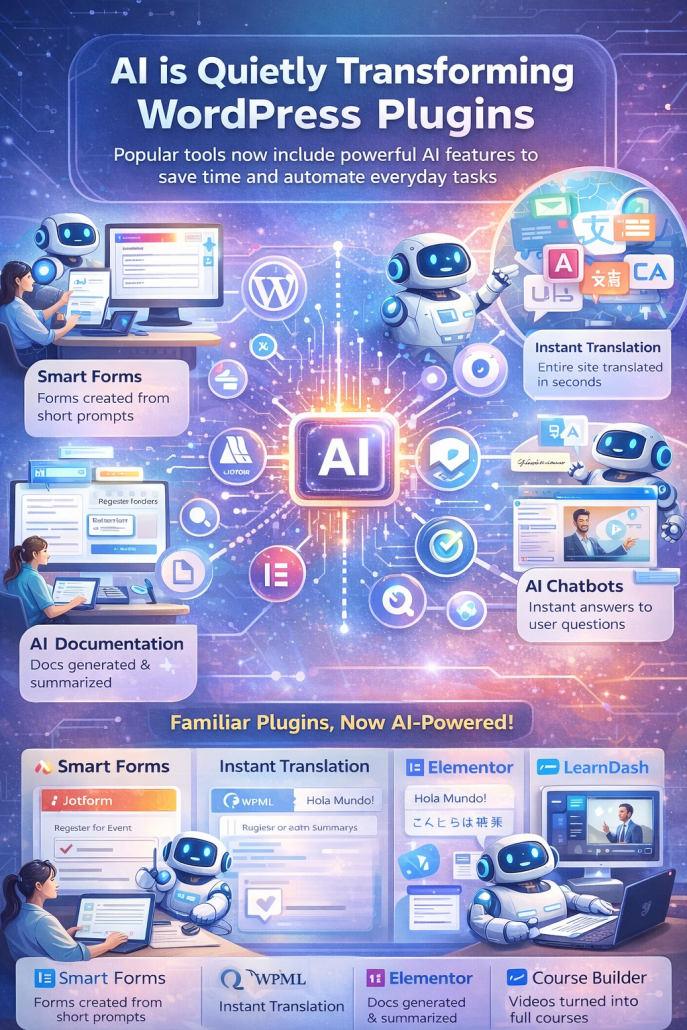
In simple terms, this content explains that many well-known
WordPress plugins people have been using for years now include
serious AI capabilities, even though these features were added quietly
and without much marketing noise. The purpose is not to create hype,
but to highlight practical, real-world ways AI is already being used
inside WordPress.
At a high level, the message is that AI is no longer just an optional
add-on or an experimental feature in WordPress. It is now built directly
into everyday tools such as forms, translations, documentation
systems, online courses, and even web hosting platforms. These AI
features are designed to save time, reduce repetitive manual work, and
remove friction—especially for site owners, agencies, and content
creators who manage multiple tasks at once.
AI is being applied in very concrete and useful ways. It can
automatically generate full forms from short descriptions, instantly
translate entire websites into multiple languages, write and summarize
documentation inside WordPress, power chatbots that search through
knowledge bases, turn video playlists into structured online courses,
and assist with server monitoring by identifying and resolving hosting
issues before they cause real problems.
To make this more tangible, the content walks through several
WordPress plugins as examples. These include a form builder that
creates complete forms using AI prompts, a translation plugin that
converts sites into other languages in real time, a documentation tool
that can write, summarize, and support AI chat over help articles, and a
course platform that automatically generates course structures or
converts videos into lessons.
There is also a strong focus on AI at the infrastructure level. Hosting
providers are now using AI to monitor servers continuously, diagnose
performance or stability issues, and even fix common problems
automatically—saving hours of downtime and reducing the need for
manual support.
Overall, the message is clear: AI in WordPress is not about replacing
people. It is about speeding up work, eliminating repetitive tasks, and
helping site owners and agencies operate faster and smarter using tools
they already know and trust.